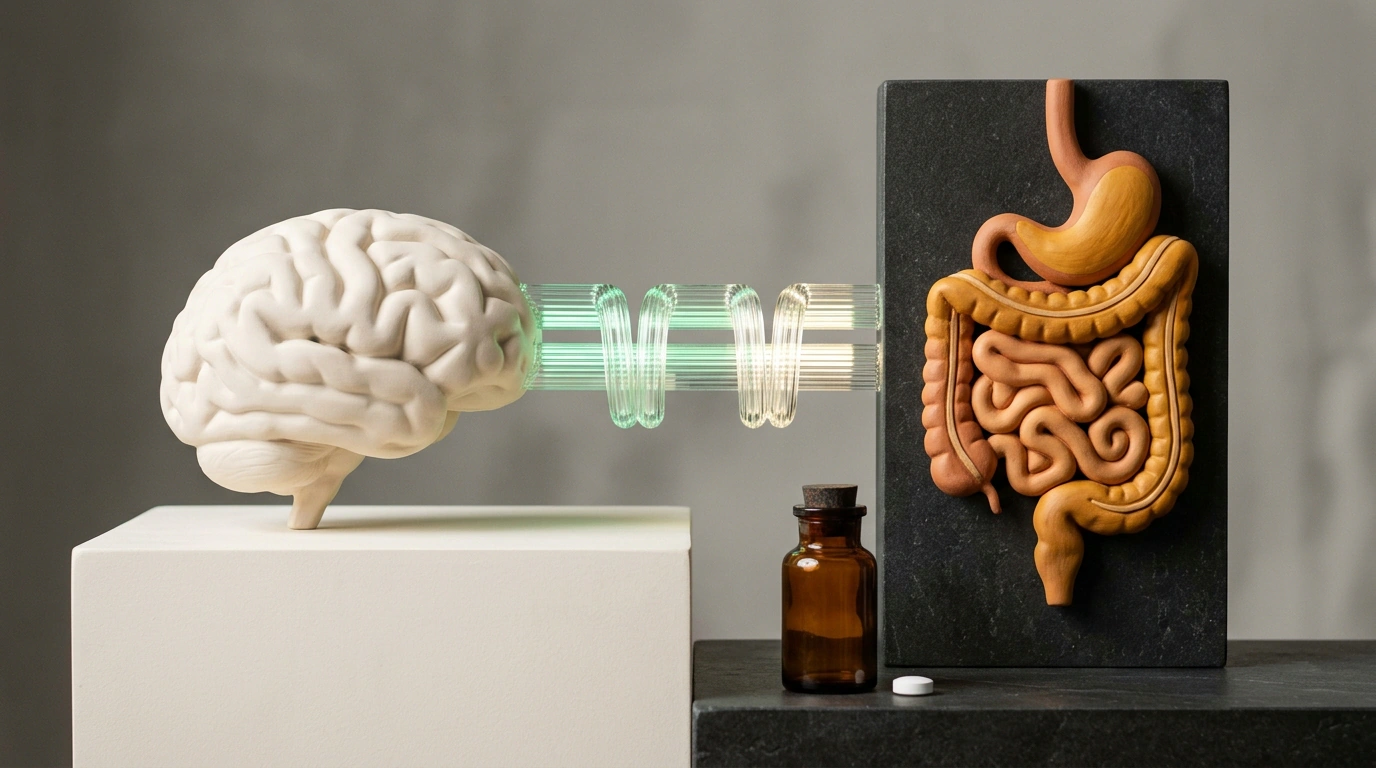
When someone suffers for months from cramping abdominal pain, bloating, and erratic bowel habits, a visit to the gastroenterologist often ends in shock. The doctor listens carefully, reviews clean lab results and scans, and writes a prescription for amitriptyline.
Most patients feel their heart sink at that moment: "Does the doctor think I'm making this up? Are they sending me to a psychiatrist? Why am I getting a heavy old-school antidepressant?" And if constipation is their main symptom, full panic sets in: checking the package insert, they see constipation listed as a common side effect and flatly refuse to touch the pills.
Gastroenterologist Dr. Andrey Kharitonov and leading international neurogastroenterology guidelines explain why this prescription makes complete medical sense—and how a half-century-old drug relieves real physical gut pain.
The Gut-Brain Axis and Visceral Hypersensitivity
In modern evidence-based medicine, irritable bowel syndrome (IBS) is no longer viewed as "inflammation" or a "dirty hands" infection. Under the international Rome IV criteria, IBS is classified as a Disorder of Gut-Brain Interaction.
Lining your digestive tract is a massive enteric nervous system—hundreds of millions of neurons constantly trading signals with your spinal cord and brain. Normally, food moving along or mild stretching of the intestinal wall by gas passes completely unnoticed: gut receptors send a signal, and subcortical brain centers filter it out as harmless background noise.
In IBS, that volume filter breaks. A phenomenon called visceral hypersensitivity develops: gut nerve endings become over-sensitized, and the spinal gate lets every signal flood upward. An ordinary intestinal contraction that a healthy person wouldn't even register hits the brain of an IBS patient as sharp physical pain.
In response to pain, smooth muscle in the colon reflexively spasms. That sparks a vicious cycle: pain triggers spasm, spasm traps stool and causes spastic constipation, and fear of the next flare pushes people to slash their diet—a trap we examined in our look at gut absorption and appetite pitfalls during GI trouble.
Sub-Psychiatric Doses: How an Antidepressant Calms Spasms
This is where tricyclic antidepressants (TCAs) step in. In gastroenterology, they aren't used to treat depression at all—they serve as central neuromodulators of the gut-brain axis.
The crucial difference is the dose:
- In psychiatry, treating mood requires 75 to 150–200 mg of amitriptyline per day.
- In neurogastroenterology, doctors use microdoses: just 10 mg (or half a tablet) taken once at bedtime.
At that tiny dose, the drug doesn't alter your mood or personality. Instead, it blocks serotonin and norepinephrine reuptake at spinal cord synapses, acting like noise-canceling headphones that mute the stream of pain signals traveling from your gut to your brain.
What about the fear of constipation? Theoretically, amitriptyline has anticholinergic properties that slow gut motility. At a 10 mg microdose, however, that effect is minimal. Meanwhile, by shutting down the main trigger—relentless visceral pain—the drug stops the reflexive muscle spasm. Once the bowel relaxes, transit often improves paradoxically and constipation eases, a pattern backed by modern gut-brain axis guidelines for IBS.
The American Gastroenterological Association (AGA) officially lists low-dose TCAs as a first-line therapy for persistent IBS abdominal pain. And if a patient feels too groggy in the morning, a doctor can easily switch to nortriptyline or duloxetine.
Getting an antidepressant prescription from a gastroenterologist isn't a hint that your pain is imaginary. It's targeted tuning of nerve receptor sensitivity so your gut can do its job quietly without firing false pain alarms.