Simon & Schuster has published the debut book by neuroscientist and Stanford School of Medicine professor Andrew Huberman, Protocols: An Operating Manual for the Human Body, reviewed by the authors of the running channel «Бегать просто». Flipping through the table of contents, I noticed a telling detail: even when you open the chapter on fast learning, focus, and motivation, the very fourth item inside sends you off to fix your nighttime sleep after studying.
A whole cult has long grown up around the Huberman Lab podcast: listeners took notes on multi-hour lectures, tried breathing by a stopwatch, and bought dozens of supplement bottles. Yet when you have an ordinary work schedule, household chores, and evening fatigue, trying to adopt every biohack at once turns into a second shift. Let's sort out how to navigate this set of protocols and where a busy person should start without burning out.
Seven Floors of Physiology: Why a 550-Page Manual Was Needed
A tenured professor of neurobiology and ophthalmology at Stanford and winner of the 2017 Cogan Award for vision research, Huberman set out to bring scattered podcast episodes together into a single system. In Protocols, he packed 550 pages of text plus another 100 pages of fine-print index and citations to studies in journals on the level of Nature, Science, and Cell, organizing 7 interconnected areas:
- Sleep and Recovery (Sleep) — the book's foundation, spanning 15 protocols;
- Physical Activity and Exercise (Exercise) — 4 core protocols for strength, endurance, and flexibility;
- Stress Management (Stress Control) — breathing techniques to rapidly downshift the nervous system;
- Nutrition (Nutrition) — nutrient density and microbiome support;
- Light (Light) — 5 protocols for working with daytime and evening lighting;
- Focus, Motivation, and Learning (Focus, Motivation, and Learning) — 6 protocols covering concentration, mental contrasting, learning from errors, post-study sleep, and micro-breaks within 90-minute attention cycles;
- Personal Growth (Personal Growth) — 4 protocols for neuroplasticity, mindfulness, and expressive writing.
In the overlap between chapters—where the learning section insists you get enough sleep—lies the book's central principle: the domino effect. If your circadian rhythms are off and your sleep is ragged, motivation techniques or hard workouts will spin their wheels like software on a laptop with a dead battery. No capsule can replace this foundation; we examined why pills are powerless without routine in our article on the supplement epidemic and the hierarchy of foundational habits.
Let's put this system into practice: take an office worker on a 09:00 to 18:00 schedule and build a baseline week step by step using Huberman's key protocols.
Morning Light and the Melatonin Timer: Setting the Internal Clock
Our office worker's week starts at 07:00 sharp—waking up at the same time every day. Why does the book devote an entire 5-protocol chapter to light, and why does its very first piece of advice tell you to step outside right after waking?
The human internal clock (circadian rhythm) runs slightly slower than a 24-hour day—about 24 hours and 15 minutes. Like a mechanical watch losing a quarter-hour a day, the brain needs a daily morning reset. The sensors are light-sensitive ganglion cells in the lower half of the retina (ipRGCs) containing the pigment melanopsin: they detect sky light and send a signal to the suprachiasmatic nucleus of the hypothalamus.
The mechanics of the Huberman Lab light protocols work as a chain reaction:
- If within the first hour after waking bright morning light in the blue-cyan spectrum (460–480 nm) hits your retina, your brain shuts off remaining melatonin and triggers a morning cortisol peak. In the morning, cortisol acts as a starter motor: it wakes you up, switches on focus, and starts a timer—12–14 hours later, the pineal gland will begin producing melatonin for sleep.
- If instead you spend the morning in a dim room (200–500 lux) or look through a home or car window (glass blocks the spectrum and stretches the reset 5–10 times longer), the cortisol peak shifts toward midday, causing daytime sluggishness and nighttime insomnia.
From 07:10 to 07:30, our office worker gets a morning light anchor without sunglasses:
- Clear sunny day (10,000–100,000 lux): 5–10 minutes outdoors;
- Overcast weather (1,000–5,000 lux): 15–20 minutes;
- Heavy gloom or rain: 20–30 minutes walking to the subway or with the dog.
At 08:00 comes breakfast, while our hero delays the first cup of coffee by 90–120 minutes after waking (until 08:30–09:00) so receptors can clear sleepy adenosine naturally without an afternoon crash. In the evening on the way home, it helps to catch 10 minutes of sunset light (the second light protocol builds a protective retinal buffer before evening screens, while the fourth and fifth cover daytime light on skin and the red/infrared spectrum). At 21:30, overhead lights go off (the third protocol—avoiding bright light an hour before bed), and at 23:00 it's lights out in a cool (18–20 °C), dark bedroom.
The 3 × 3 Movement Framework: Strength and Cardio in a Workweek
Once sleep from 23:00 to 07:00 restores your baseline energy, 4 movement protocols kick in around the formula "3 strength + 3 cardio" sessions of 30–50 minutes each:
- Daily walking: walk as much as possible every day. Morning and evening walks add up to 8,000–10,000 steps for baseline metabolism.
- Three strength sessions per week: preserve muscle mass and bone density. For our office worker, that means Monday (upper body, 45–50 minutes), Wednesday (lower body, 45–50 minutes), and Friday (circuit training for 30–40 minutes).
- Three cardio workouts per week: on Tuesday and Thursday, 30–60 minutes of Zone 2 cardio (brisk uphill walking, easy jogging, or cycling where you can breathe through your nose and speak in sentences). On Saturday morning, 20–25 minutes of interval sprints (Zone 5) to train maximal oxygen uptake ($\text{VO}_2\text{ max}$). Sunday is for rest and walks.
- Micro-blocks for flexibility and mobility: the authors of «Бегать просто» noted that nobody has time for separate hour-long stretching sessions, so Huberman advises adding 5–10 minutes of stretching 2–4 times a week after main workouts.
If weekday workouts are only possible after 18:00, save sprints for Saturday morning and keep weekday evenings at an easy pace (we wrote separately about how evening workouts affect sleep based on data from 4 million nights).
The 90/10 Plate Rule and Adjusting for a Northern Winter
In nutrition, Huberman relies on three simple rules without counting every crumb:
- At least 90% whole, minimally processed foods: vegetables, greens, berries, fruit, meat, poultry, eggs, fish, legumes, and whole grains (like an 08:00 breakfast of eggs, vegetables, and whole-grain bread). Up to 10% remains for dessert without guilt.
- High-fiber vegetables and fruit as primary carbohydrates to feed the microbiome (read more in our breakdown of the role of protein and fiber for satiety and gut health).
- Fatty ocean fish and omega-3s: salmon, mackerel, sardines, or herring provide 1–2 grams of EPA and DHA per day to protect neurons.
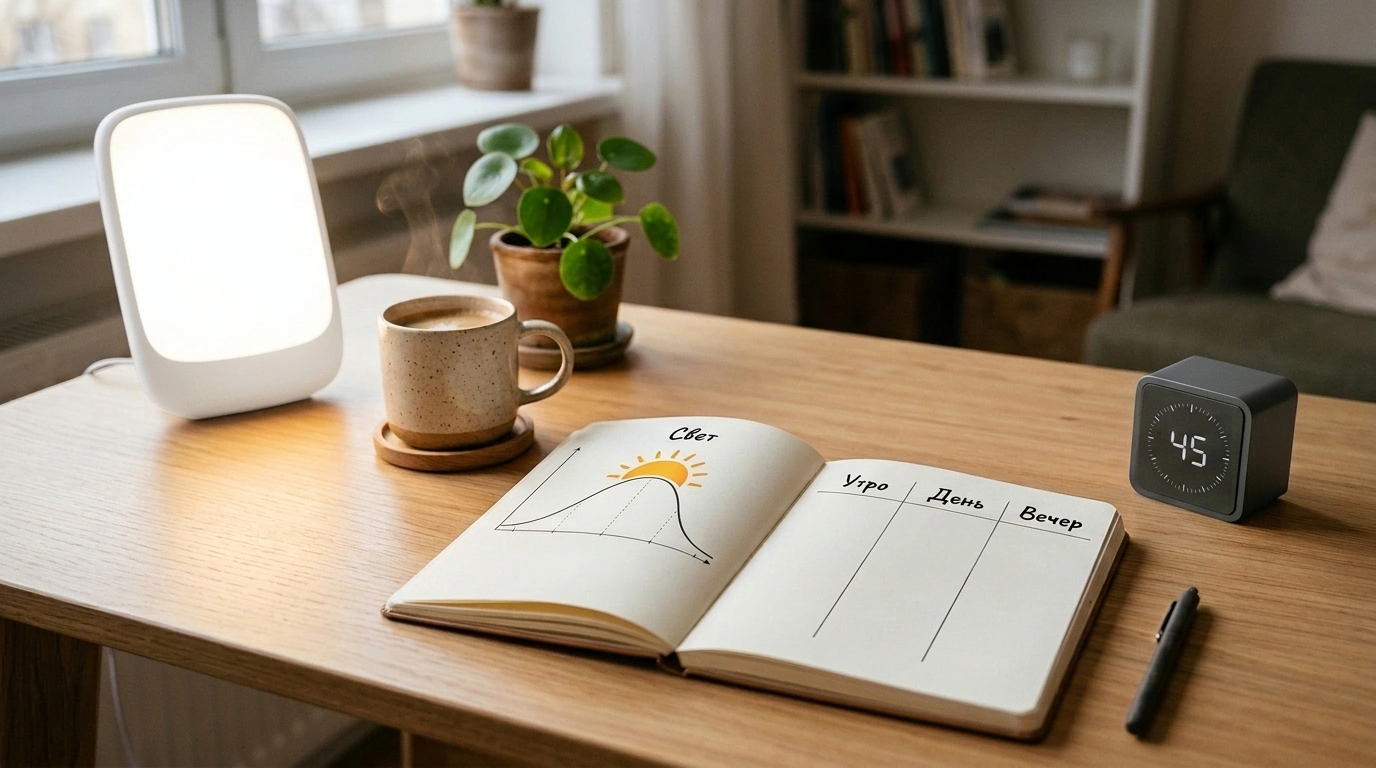
At the same time, the authors of «Бегать просто» made a sharp observation: in sunny Stanford, Huberman clearly wasn't thinking of residents of Norilsk, St. Petersburg, or winter Moscow, where it is pitch dark at 07:00 in the morning. To make the system work in winter, our office worker turns on a 10,000 lux light therapy lamp 30–50 centimeters from the face for 20–30 minutes during breakfast, and steps outside for 15 minutes at lunch. During crunch weeks, hour-long workouts also easily compress down to 30 minutes.
- Protect your retina: never stare directly at the sun in the morning due to the risk of macular burns (solar retinopathy)—look toward the horizon without squinting through pain.
- Dose your training load: strength work and Zone 5 sprints require gradual preparation of joints and the heart.
- Don't take supplements blindly: echoing the review's authors, omega-3s and supplements shouldn't be self-prescribed without a doctor—doses of fish oil above 3–4 grams per day affect blood clotting.
To put the 550-page Protocols to work in real life, keep three anchor steps in mind:
- Start with morning light and sleep: a fixed wake time and 10–30 minutes of bright light (outdoors or in front of a 10,000 lux panel in winter) will trigger daytime alertness and evening melatonin.
- Build the 3 × 3 movement framework: daily walking plus three strength sessions, two conversational aerobic sessions, and one short high-speed session with five-minute flexibility cooldowns.
- Eat by the 90/10 rule without neurosis: base your menu on whole foods, fibrous vegetables, and ocean fish, leaving a tenth for simple pleasures without freelancing with capsules.
With these three anchors, Huberman's book turns from a rigid rulebook into a clear building kit, where basic care for your daily rhythms naturally pulls sharper work focus and deeper nighttime sleep along with it.