Twelve trained trail runners—six women and six men—spent over 3.5 hours straight on a treadmill: three one-hour blocks at a steady pace, each capped with a 12-minute all-out uphill push. You'd expect every metric on their devices to fall apart by the finish, yet a study in PubMed Central highlighted by the Telegram channel Begat prosto (Running Made Simple) uncovered a paradox: on the flat segments, cadence, stride length, estimated power, and energy cost barely budged.
What grabbed me in this test is a contradiction every long-run regular knows well. You glance at your watch late in a run—pace is steady, heart rate is right in zone—yet your legs feel like lead. How do you catch the moment your muscles start losing form when the numbers on your wrist insist everything is fine?
The Steady-Pace Illusion: How Muscles Hide Fatigue Behind Flat Watch Numbers
When you run, your leg acts like a leaf spring: on landing, your Achilles tendon, foot arch, and calf muscles stretch, store impact energy, and snap you forward. As the miles pile up, though, a chain reaction kicks in:
- As glycogen drains from your calf and thigh fibers and micro-fatigue builds, the stiffness of that muscle-tendon spring drops.
- As the spring softens, your ankle and knee sink deeper at impact, absorbing the shock with heavy muscular effort instead of a crisp rebound.
- If you keep holding the same pace through heart and grit, your body has to leave your foot on the ground longer just to push off with the same force.
In physiology, this shift is called mechanical drift. Speed and heart rate look stable while your tissues are already losing bounce—we unpacked why watch numbers drift away from the real physical toll in our article on training by feel and internal load.
Duty Factor: Why Stride-Cycle Percentages Beat Raw Milliseconds
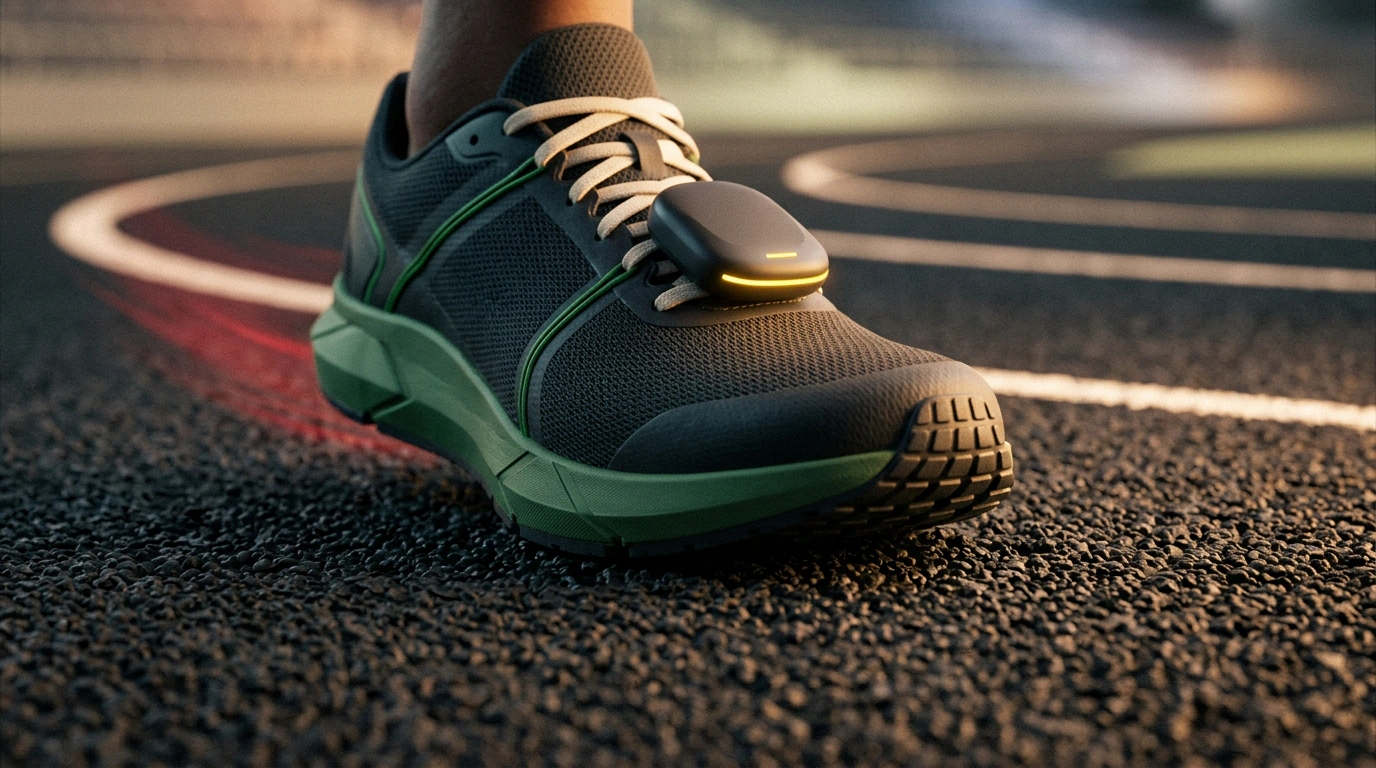
When crisp rebound turns into a "sticky" footstrike, your wrist watch stays quiet—but a Stryd shoe pod catches the shift right away. In the trail-runner study, only one parameter changed with statistical significance: duty factor, the share of the full stride cycle your foot spends on the ground. After hour one it sat at 71.3%, and by the end of hour three it had climbed to 72.7%—a 1.4% jump.
You might ask: "Wait, watches and chest straps have tracked ground contact time in milliseconds for years—what's the difference?" It comes down to the math:
- Absolute ground contact time in milliseconds shifts with speed: fly downhill and the number drops; hit a headwind and it climbs even on fresh legs.
- Duty factor divides ground contact time by the full stride-cycle duration of that same leg and expresses it as a percentage.
Anchoring the metric to the full stride cycle strips out pace noise: when that percentage rises at the exact same speed, your flight phase has shrunk and your foot is lingering on the surface.
Form Reserve on Long Runs: When the Metric Helps and When to Back Off
The ability to keep elastic form under fatigue is called biomechanical durability. To track it without fooling yourself, separate the conditions where a footpod shines from situations where it's useless:
- When the reading is accurate. Compare the number on the same flat stretch at the start and end of a long run at the same pace. If duty factor consistently climbs by 1.5–2% alongside heavy legs across several long runs in a row, your training volume is outrunning your recovery—time for a cutback week.
- When the method fails. Comparing percentages on root-covered trails with steep climbs, or applying these findings to sprints, tells you nothing. A single spike after a short night of sleep means nothing without a repeating trend.
Don't try to force your cadence up late in a long run or "rip" tired feet off the pavement through sheer grit. Longer ground contact acts as a protective damper; forcing fatigued legs to bounce harder dumps shock straight onto your kneecap and Achilles tendon.
Tendons adapt to impact volume several times slower than muscles do, as we covered in our breakdown of the load-and-tissue-capacity model in running. So before you tack extra miles onto this weekend's long run, ask yourself: if your footpod shows your stride bogging down at a steady pace near the finish, do you have the calm to call it a day—or are you still looking for an excuse to squeeze out a pretty GPS track on credit from your knees?