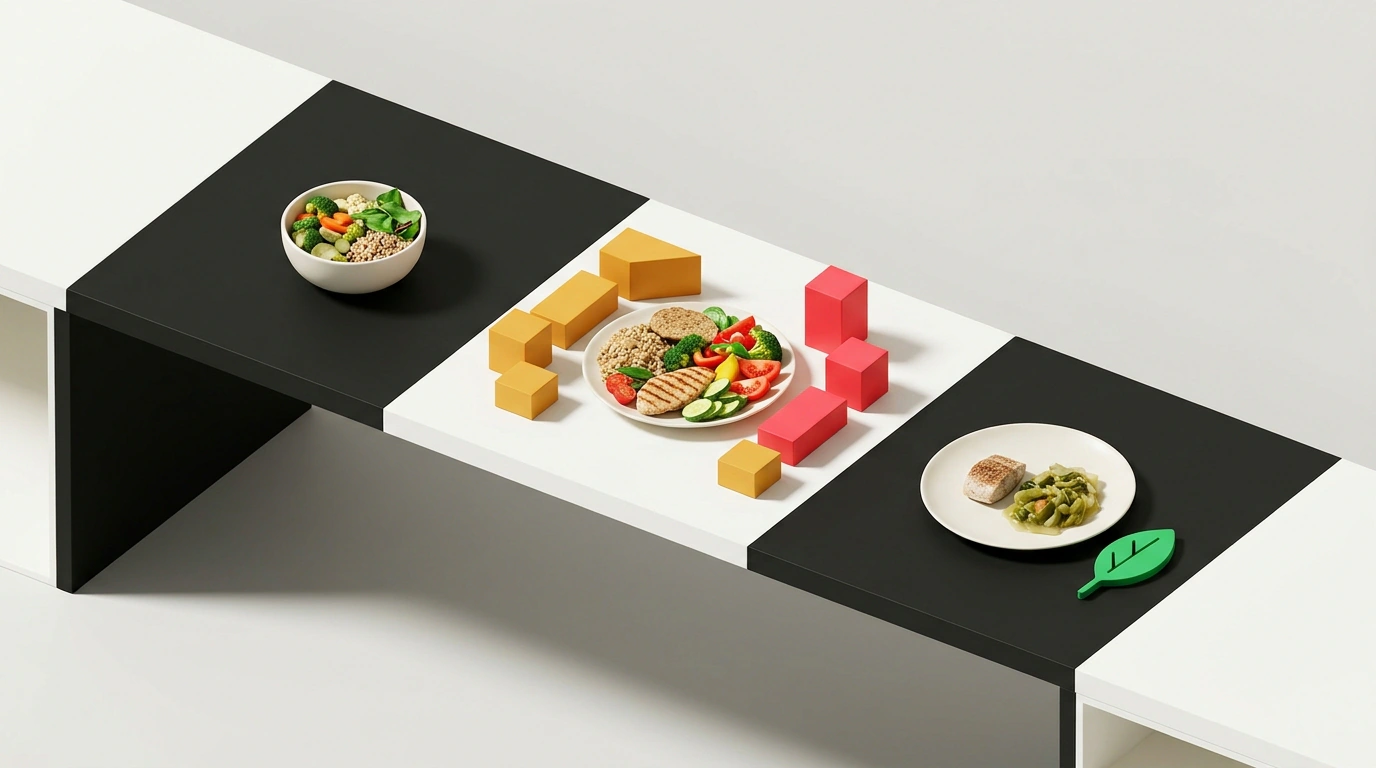
On paper, a standard "clean eating" meal plan from the internet looks spotless: baked fish, chicken breast, eggs, whole grains, and fresh vegetables. It feels like a universal blueprint for health, yet in real life the exact same plate of wholesome food acts like three completely different prescriptions: one person gains weight on steamed patties and salads, another loses strength to the point of muscle cramps, and a third ends up on the verge of a hospital stay.
Why does a balanced menu without a gram of fast food trigger weight gain and bloating in one person, and exhaustion or organ strain in another? I looked into a telling clinical case shared by endocrinologist Maksim Kuznetsov and checked it against KDIGO nephrology guidelines: behind the complaint "healthy eating doesn't work for me" lies the physiology of energy burn, gut motility, and kidney filtration.
Three People at the Same Table: What Happened After a Month on Identical Food
Regulators (the FDA and WHO) picked 2,000 kilocalories purely as a convenient benchmark for food labels—not as a medical standard. When Maksim Kuznetsov compared three patients who followed that exact plan for a month, the outcomes went in opposite directions:
- Maria, 40, economist. Works seated at a monitor. After a month on the "slimming" menu, she gained weight and developed abdominal heaviness, cramps, and bloating.
- Igor, 25, factory machinist. Spends irregular shifts on his feet. Within a month he felt like a drained battery, hit by headaches and painful leg cramps.
- Valentina Ivanovna, 68, retiree. Didn't even last the month: her kidney issues flared up and swelling set in, nearly landing her in inpatient care.
Out of those three stories comes a basic rule of physiology: there is no "right" food separate from the person eating it. Quality ingredients landed in three bodies with completely different metabolic rates, muscle workloads, and organ reserves.
The Mechanics Behind the Split: Energy Burn, Sluggish Gut, and the Kidney Filter
Daily energy needs combine basal metabolic rate (BMR—what your body burns at rest via the Mifflin–St Jeor equation) and a physical activity factor (PAL): between desk-bound inactivity (1.2) and heavy physical labor (1.9–2.2) sits a twofold gap.
Maria's BMR is about 1,300 kcal, and her total daily energy expenditure (TDEE) tops out around 1,560 kcal. The template menu gave her a daily surplus of roughly 440 kcal, adding 1.5–1.8 kg of fat in a month. Her bloating came from suddenly loading 30–40 g of coarse fiber from raw vegetables and bran. Walking stimulates gut movement through gentle abdominal compression; sitting 8–10 hours a day leaves the bowel sluggish, so fiber stalls and ferments.
Igor's BMR is 1,700 kcal, and his factory shifts push daily burn to 2,900–3,100 kcal. The standard menu created an 800–1,200 kcal deficit: glycogen stores ran dry mid-shift, triggering drops in blood sugar and headaches. Cutting salt while sweating heavily washed out sodium, potassium, and magnesium—setting off calf cramps.
The most dangerous breakdown hit Valentina Ivanovna. After age forty, glomerular filtration rate (GFR) declines by 0.8–1 ml/min/1.73 m² per year and by retirement often sits at 50–55 ml/min with zero symptoms, while a standard creatinine test hides the drop due to age-related muscle loss. A menu packed with chicken breast, cottage cheese, and fish delivered 100–120 g of protein a day (1.6–1.8 g/kg at 65 kg), spiking pressure inside kidney nephrons and causing fluid retention. Under KDIGO guidelines, when filtration drops below 60 ml/min, the safe protein ceiling is strictly 0.8 g/kg per day (whereas healthy older adults without kidney disease need 1.0–1.2 g/kg to protect muscle).
Cookie-Cutter Templates vs. Personal Tuning: Three Rules for a Safe Plate
Two approaches compete in nutrition: copying someone else's chart or tuning your plate to your own physiology. Internet templates either starve working muscles or overfeed desk workers while overloading the kidneys and gut. Personal tuning works the other way around: you estimate your real burn, treating calories as a flexible budget, and match nutrients to your health:
- Calculate from real movement. Base calories on your resting burn and daily activity, and replace water and electrolytes when doing physical work.
- Step up fiber gradually. With a desk job, raise vegetable intake slowly—by 3–5 g a week (from 15 to 25–30 g a day)—while drinking at least 30 ml of water per kilogram of body weight.
- Check kidney function before high-protein menus. Past age sixty, get a blood creatinine test with an eGFR calculation (CKD-EPI) and confirm your protein target with a doctor before ramping up intake.
Once you drop borrowed templates and build around your own daily rhythm and age, ordinary home cooking outperforms any trendy diet.