The alarm goes off at seven sharp. You went to bed on time, didn't scroll under the covers, and slept straight through the night—yet over your morning coffee you're still staring at your work chat through a thick haze. Your thoughts move slowly, lines blur together, and your head feels like it's stuffed with wet wool. Usually we blame the weather, a vitamin shortfall, or seasonal fatigue, when the real culprit was quietly radiating heat from the radiator next to your bed all night.
You can lie motionless in a closed, overheated bedroom until morning and still wake up wrecked. Why does stuffiness switch off your morning sharpness even after eight hours in bed, and how do you tune your bedroom climate so you actually wake up clear-headed?
One Thousand One Hundred Eighty-Nine Nights Under Sensors: What the Study Found
For a long time, debates over bedroom temperature sounded like a matter of personal taste: some people love a cracked window, while others pile on the blankets. Recently, however, Christian Rominger's team from the universities of Hildesheim, Graz, and TU Wien put exact numbers on the cost of sleeping in a warm room. Endocrinologist Zukhra Pavlova broke down the findings from Journal of Environmental Psychology.
What caught my eye about this study is that participants weren't wired up in sterile hospital labs—they were tracked at home. Scientists followed 82 adult volunteers (average age 28) across 1,189 "night of sleep – workday" pairs. Sensors beside each bed logged temperature, humidity, and carbon dioxide, smart rings tracked heart rate and sleep stages, and during the day volunteers rated their focus and productivity on a five-point scale.
Average bedroom temperatures hovered around 24 °C—the exact threshold, as Zukhra Pavlova notes, where sleep quality and morning clarity enter the danger zone. Comparing sensor logs with daytime reports revealed a clear pattern. As soon as the air in the room climbed above a person's own usual baseline, recovery started to slip:
- Lower rest quality. Each extra degree above a person's personal optimum knocked 0.5 points out of 100 off their objective sleep score.
- Fragmented sleep architecture. Participants tossed and turned more, restless periods increased, and rapid eye movement (
REM) sleep noticeably shrank. - Daytime drop in focus. The next morning, people felt less rested, and their concentration and self-rated productivity fell by an average of 0.04 points out of 5 per degree of overheating.
Hundredths of a point might sound trivial on paper. Yet when your bedroom is three or four degrees warmer than your norm, those losses stack up into full-blown morning brain fog. And the effect held steady even after adjusting for weekends, morning mood, and whether the home had air conditioning.
Biological Radiators and the Vulnerable Dream Stage: Why Your Brain Needs Cool Air
Why does our body crave cool night air when a warm blanket feels so cozy? The answer sits inside our internal biological clock.
Your body runs on a daily temperature cycle: core organ and brain temperature peaks between 5:00 and 7:00 PM, then steadily drops to its lowest point around 4:00 to 5:00 AM. For the brain to launch deep sleep, your core needs to cool by 0.5–1 °C. To pull that off, your body opens its natural "radiators"—your palms and feet. Tiny blood vessels in your hands and feet widen, bringing warm blood to the skin so heat can escape into the air. That's the exact reason you instinctively stick one foot out from under the covers in a warm bed. It's also why heavy late-night workouts make it harder to fall asleep—a heated core simply doesn't have time to cool down, something we looked at in our breakdown of how evening exercise affects night sleep.
In a stuffy, humid room, the temperature gap between your skin and the air disappears. Heat has nowhere to go, and your brain's master thermostat—the hypothalamus—reads the buildup as an alarm signal, keeping your nervous system from settling into deep rest.
Even worse off is REM sleep, the stage when your brain files memories and processes emotions (we covered the role of this stage in our article on keeping a steady sleep schedule to protect against anxiety). During REM, your internal "climate control" temporarily goes offline: sweating nearly stops, and your body loses its ability to cool itself actively. In an overheated bedroom, a dreaming body warms up fast, forcing the brain to cut REM short with a micro-awakening just to reboot cooling. You won't remember those split-second surfacings in the morning, yet your dream stage gets sliced to ribbons—and your day starts with a heavy head.
Why Everyone Has a Different "Comfort Zero": Thyroid, Muscle, and Hormones
You're probably wondering: why does one person suffocate in the exact same bedroom where their partner shivers under a heavy duvet? That's precisely why the study measured deviations from each participant's own habitual temperature rather than a single universal number.
As Zukhra Pavlova explains, your personal heat threshold depends on several factors:
- Thyroid and metabolism. Thyroid hormones regulate how much heat your cells generate. With hypothyroidism (an underactive thyroid), you feel chilly even in a warm room; with excess hormones, your internal furnace runs hot and the slightest stuffiness becomes unbearable.
- Menstrual cycle and hormonal shifts. In the second half of the cycle, progesterone raises a woman's body temperature by 0.3–0.5 °C. Heat sensitivity also spikes during pregnancy and menopausal hot flashes.
- Body composition and age. Muscle tissue constantly generates background heat, while fat acts as insulation that slows cooling. With age, thermoregulation becomes less flexible, making stuffy nights harder for older adults to handle.
- Habit and bedding. If you sleep at 18 °C year-round, 23 °C will feel noticeably overheated. Humidity, blanket thickness, and a partner's body heat all add up too.
If your bedroom temperature hasn't changed, yet you suddenly start waking up in a sweat-soaked T-shirt or can't get warm under two blankets, check in with a primary care doctor or endocrinologist. Paired with daytime fatigue and weight swings, this often points to a thyroid issue or iron deficiency.
Four Evening Steps to a Cool Bedroom and a Clear Morning Head
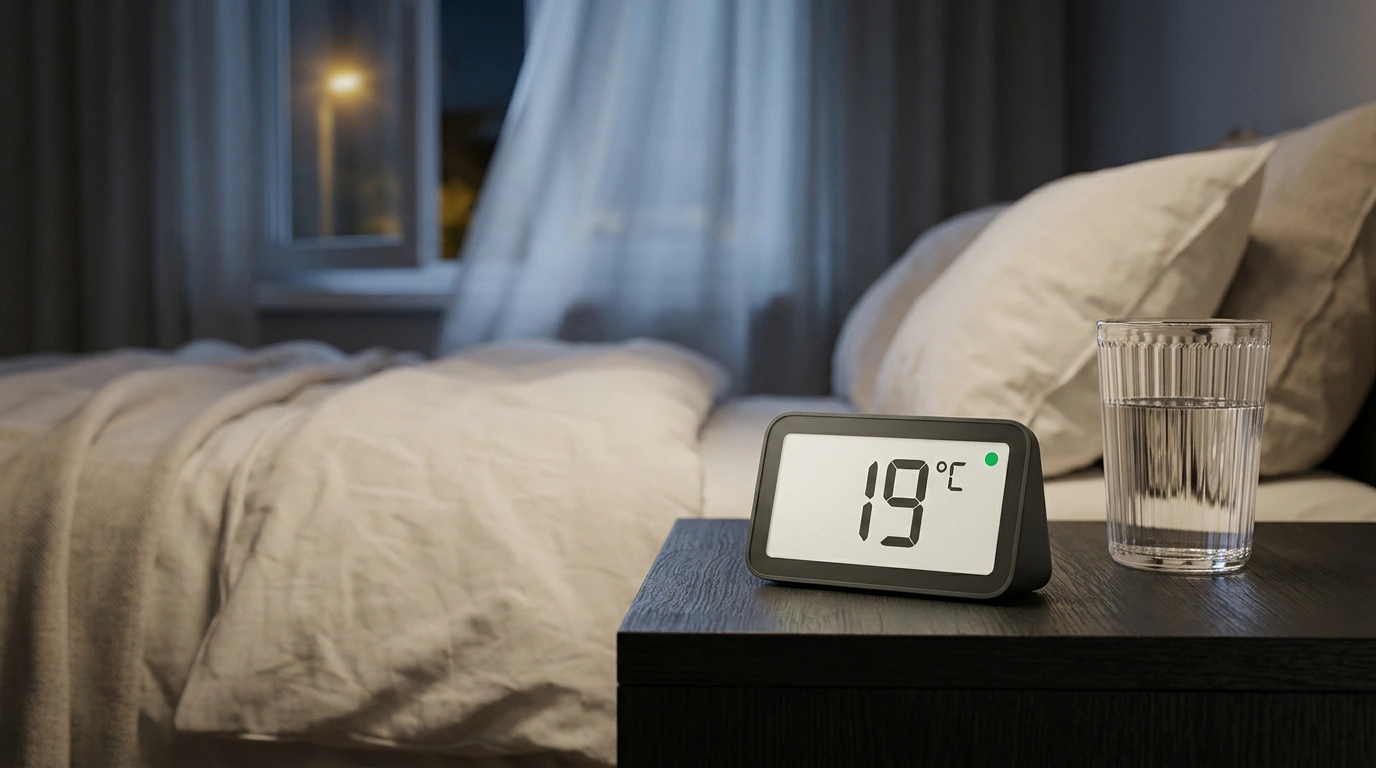
Most people sleep best at 16–20 °C. To hold that sweet spot without freezing drafts, four simple evening habits are enough:
- Cross-ventilate before bed. Open a window for fifteen minutes before turning in to flush out daytime heat and built-up carbon dioxide, refreshing both the room and your sheets.
- Set the AC gently. In summer heat or peak winter radiator season, set your air conditioner to 19–21 °C and aim the airflow away from the bed so you don't wake up with a stiff neck or back.
- Switch to breathable bedding. Even in a cool room, dense synthetics and heavy flannel trap a humid greenhouse under the covers. Stick to fabrics that let air and moisture pass freely: natural linen, cotton, or Tencel.
- Take a warm-to-cool shower to dump heat. A cool or moderately warm shower 60–90 minutes before bed widens skin blood vessels and helps your core shed heat faster once you step out.
Start with one simple move tonight: half an hour before bed, air out the bedroom, turn down the radiator, and toss the extra throw blanket off the bed. Keep that mild coolness going for just one week and notice how much sharper and lighter your head feels in the first hours of the morning.