On paper, weight loss looks like simple accounting: cut your portions, maintain a calorie deficit, and watch the scale creep down. That formula works flawlessly until it meets human physiology. Put two people on the exact same meal plan with identical calories. The first person glides through month after month, sheds body fat, and barely thinks about snacking. Within two weeks, the second person is standing in front of an open fridge at 11 p.m. Even if they push through on sheer willpower, they end up losing muscle and energy along with the weight.
Most of the time, the gap between these two outcomes comes down to one detail on your plate: whether your body is getting enough protein. And we're talking about practical, everyday food here, with no exotic supplements, no weighing every bite, and no strict dinner bans.
The Cost of 20 Grams a Day: From Evening Sugar Cravings to Muscle Loss at 70
Compare a modern supermarket to what humans ate thousands of years ago. In the wild, catching a running source of protein was easier than growing wheat, milling flour, and baking bread. Today, the pendulum has swung the other way: store shelves are packed with fast carbs and fats, while typical city diets run chronically low on protein and fiber.
For your body, protein is the basic building material for almost everything. It forms your muscles, the protein matrix of your bones, immune cells, many hormones, blood transport molecules, and digestive enzymes. Your body can store fat almost indefinitely, but it has no separate reserve tank for protein. When dietary protein falls short, your body starts cutting corners by breaking down its own muscle fibers.
Even a modest daily shortfall of around 20 grams of protein (roughly a 100-gram piece of chicken breast or half a pack of cottage cheese) hits you on two timelines: tonight and thirty years from now.
In the short term, satiety drops first. Protein is the main nutrient that keeps hunger switched off for hours. When you eat too little of it, your stomach starts asking for more food just a couple of hours after lunch. Sugar cravings follow close behind, as your body looks for quick energy to fill the void. To be clear: piling on extra chicken won't magically erase a love for chocolate. Still, closing a real protein gap noticeably quiets that nagging urge to grab something sweet with your tea.
During weight loss, the price of falling short doubles. In a calorie deficit, especially without regular strength exercise, your body happily sheds energy-hungry muscle tissue. The scale might look encouraging, yet the mirror and your energy levels tell a different story: you lose muscle tone, tire faster, and struggle harder to keep the weight off.
In nutrition, dieting hunger is a lot like stretching. When you stretch properly, you feel a mild, manageable discomfort. That's a normal working state. When hunger brings you to tears and shaky hands, the plan is broken, and a binge is only a matter of time. Getting enough protein turns a calorie deficit from an ordeal into a calm, sustainable routine.
The most serious consequences, however, build up quietly over decades. Doctors call gradual, age-related loss of muscle mass and strength sarcopenia. If you undereat protein and rarely challenge your muscles for years, you can lose up to half your muscle tissue by age 70. On paper that sounds abstract, yet in daily life it's starkly concrete: climbing to the third floor without an elevator gets hard, standing up from a deep armchair without pushing off with your hands becomes a chore, and carrying modest grocery bags feels exhausting. With weak muscles and shaky balance, a simple slip on a wet floor can turn life-threatening. Putting enough protein on your plate in your thirties or forties is practical insurance for staying independent in your seventies.
Plate Order: How Protein and Fiber Hit the Built-In Brakes on Appetite
Say you already build a solid lunch using the Harvard Healthy Eating Plate: half vegetables and greens, a quarter whole protein, and the remaining quarter complex carbs like buckwheat, brown rice, or whole-grain bread. It looks balanced and textbook-perfect. Then a familiar scene plays out: your fork heads straight for the warm side dish and fresh bread. Five minutes later, the potatoes or pasta are gone, while half the salad and the piece of fish sit lonely on the edge of the plate because you suddenly feel full.
To make your plate actually work for satiety and weight loss, the order in which food enters your stomach matters. The routine is simple: eat whole protein first, then fibrous vegetables, then starchy carbs, and save dessert for the very end, if you still want it.
Diagram of the Harvard Healthy Eating Plate: half is filled with vegetables and fruits, one quarter with whole protein sources, and one quarter with whole-grain carbohydrates (Source: Harvard T.H. Chan School of Public Health)
Why does such a small swap change your appetite? Two mechanisms kick in at the same time: one mechanical and one hormonal.
The first mechanism is the physical workload of your stomach. Its main job is to grind, churn, and mix food into a smooth paste before releasing it bit by bit into the intestines. Carbs like white bread or mashed potatoes breeze through this stage quickly. A whole piece of meat, poultry, or fish demands heavy mechanical work and stays in the stomach longest. When you start your meal with protein and follow it with bulky, fibrous vegetables, your stomach fills up with dense, low-calorie food that slows down everything eaten afterward. By the time you reach the side dish or dessert, there's noticeably less room left, making overeating physically harder.
The second mechanism is hormonal. When amino acids from protein reach your small intestine first, cells in the gut wall release natural satiety hormones called incretins, most notably GLP-1 (glucagon-like peptide-1). If that name rings a bell, you're right: popular prescription weight-loss drugs like semaglutide mimic this exact natural signal. Here, you trigger it with food instead of injections.
Clinical studies on this "protein preload" show that eating protein and vegetables before carbs sparks an earlier release of GLP-1 and a related hormone called GIP, dampens the hunger hormone ghrelin, slows stomach emptying even further, and noticeably blunts post-meal blood sugar spikes. Instead of a sharp glucose roller coaster that leaves you hunting for cookies an hour later, you get steady energy and a clear head.
Rewiring this habit in a single meal isn't easy, since reaching for bread with the first bite is automatic. Give it one week of consciously starting dinner with a few forkfuls of fish, meat, or cottage cheese plus salad, and your brain adapts fast. Dessert stops happening simply because you genuinely don't want it.
Hidden Fat Disguised as Protein, Realistic Targets, and Who Should Be Careful
The sneakiest trap on a "high-protein diet" is thinking you're eating plenty of protein while actually piling on extra fat and calories. A food looks meaty or dairy-rich on the outside, yet flipping the package over tells a completely different story.
A reliable filter for weight loss fits into one short rule: minimal processing and more protein than fat. Once you run your usual grocery basket through that filter, some surprising truths pop up on the shelves.
Take sausages, hot dogs, and fatty deli meats. Mentally, we file them under "meat," yet nutrition labels often show just 7 to 8 grams of protein per 100 grams alongside 20 to 30 grams of fat. That's mostly fat cleverly disguised as protein. If you really miss sausages, look for lean chicken or turkey versions where protein grams still beat fat grams on the back label, though they still lose to a plain piece of meat as a daily staple.
Hard cheeses tell a similar story. Cheese is delicious and nutritious, but most classic varieties pack as much fat as protein, or even more. Slice 150 to 200 grams of cheese for dinner, feel proud of hitting 40 grams of protein, and you've quietly added 40 to 50 grams of fat along for the ride. Since every gram of fat carries 9 kilocalories (more than twice as much as a gram of protein or carbs), a snack like that wipes out a calorie deficit in seconds. The easy fix is choosing light cheeses or low-fat ricotta, where the ratio tilts in favor of protein.
Nuts, seeds, and sweetened "cottage cheese snacks" create two more illusions. Nuts do contain plant protein, but they're primarily a fat concentrate at 600 to 700 kcal per 100 grams. A small handful upgrades a salad nicely; using nuts to hit your daily protein target while dieting is a fast track to a calorie surplus. With cottage cheese, the dairy aisle plays tricks: chocolate-glazed curd bars, store-bought cheese pancakes, and sweet bakes are loaded with sugar, flour, and added fats. Plain cottage cheese topped with a handful of berries or chopped apple wins hands down on both satiety and nutrition.
The real workhorse protein sources are simpler and cheaper: chicken and turkey, lean fish and seafood, lean beef and pork, eggs (plus extra egg whites for omelets), plain cottage cheese, unsweetened Greek yogurt, beans, lentils, and tofu.
Now for the practical question: how much protein do you actually need each day? Modern sports and clinical nutrition targets have climbed noticeably above old baselines. The standard minimum of 0.8 g per kilogram of body weight (the classic RDA) was set merely to prevent clinical deficiency in sedentary adults. It isn't enough for losing fat while protecting muscle.
The International Society of Sports Nutrition (ISSN) outlines a higher working range for active adults, and doctors managing weight loss often aim toward the upper end of that band. Adults over 60 need special attention too. With age comes anabolic resistance: muscles respond less strongly to small protein servings, so each meal requires a clearer stimulus paired with manageable strength work. An expert group from ESPEN (the European Society for Clinical Nutrition and Metabolism) recommends noticeably more than the baseline minimum for older adults, especially during illness and recovery.
Daily protein intake targets from RDA, ESPEN, and ISSN
The chart makes the gap between bare survival minimums and muscle-preserving targets crystal clear. One practical adjustment often gets overlooked in these calculations: if someone has severe obesity (say, weighing 120 to 130 kg), multiplying these ratios by actual scale weight produces an unrealistic 200+ grams of protein a day that's nearly impossible to eat. In those cases, calculate your target using your goal weight or adjusted body weight.
To skip the phone calculator, estimate your daily range right here.
Daily protein target estimator
Seeing the per-meal number is usually a bigger wake-up call than the daily total. If dinner calls for roughly 30 to 40 grams of protein, a couple of cheese sandwiches won't come close, whereas a proper serving of fish, poultry, or cottage cheese gets you there easily. Keep in mind that high protein is safe for healthy people, but certain medical conditions set strict limits you shouldn't cross on your own.
High protein targets (1.5–2.0 g/kg per day) should not be used without direct medical supervision if you have:
- severe chronic kidney disease or kidney failure (impaired kidneys cannot handle heavy protein loads);
- severe gout;
- active inflammatory bowel disease (IBD).
For healthy kidneys, a reasonable boost in dietary protein is safe, but with any chronic diagnosis, your doctor should set the target.
Evening Protein Without Myths: Why Casein Helps and Eating Carbs After Six Isn't the Enemy
Two stubborn dinner myths have circulated online for decades. The first promises magic: eat a boiled egg before bed and growth hormone will surge overnight to melt fat away. The second warns of instant doom: any carb eaten after 6 p.m. allegedly goes straight to your waist.
The "bedtime egg for growth hormone" claim falls apart on a simple everyday observation. Who on earth needs growth hormone most? Children. Yet kids aren't lining up for boiled eggs before bedtime, and somehow they all still grow up fine. Your body builds protein-based hormones from its overall amino acid pool collected over days and weeks, not from a single late-night snack.
The 6 p.m. carb curfew holds up no better. Your body doesn't have an alarm clock that flips a switch at 6:01 p.m. to divert buckwheat from muscles straight into fat cells. Daily and weekly calorie balance decides the outcome. You can eat carbs in the evening without guilt, and they'll naturally show up alongside berries in cottage cheese, beans, a slice of bread, or potatoes with fish. The real goal of an evening strategy is shifting your plate's center of gravity toward protein.
Why? Take an honest look at a typical weekday. Morning means rushing out the door on poor sleep with half a cup of coffee. Daytime is a blur of work, grabbing whatever's nearby. By evening, you get home tired, starving, and ready to clear out the kitchen. In modern schedules, dinner has become both the largest meal and the prime danger zone for sweet, greasy, ultra-processed binges.
Endocrinologists see this pattern every day. One telling clinical case involved a woman starting at 120 kg who steadily lost weight down to 92.5 kg—a 27.5 kg drop without extreme starvation diets. A major driver of her earlier binges turned out to be plain protein scarcity at dinner. Once solid whole protein anchored her evening meal, relentless late-night cravings faded on their own.
Among evening protein choices, casein stands out. It's the "slow" dairy protein that makes up about 80% of the protein in milk, cottage cheese, Greek yogurt, kefir, and light cheeses. Its secret is purely physical: in stomach acid, casein curdles into a soft, gel-like mass. That slows digestion down, releasing amino acids steadily into your bloodstream over 6 to 8 hours. Satiety lasts until morning, and if you trained earlier in the evening, sports nutrition research shows a pre-sleep serving of roughly 30 to 40 g of protein supports overnight muscle repair.
If dairy doesn't agree with you or simply isn't your thing, don't worry. Eggs, lean fish, chicken, turkey, seafood, tofu, and legumes shut down evening hunger just as reliably.
The Processing Ladder: Why Chicken Keeps You Full for 90 Minutes While a Shake Lasts 20
If protein helps so much with weight loss, why bother cooking? You could buy a tub of whey protein, shake a scoop with water, and get 30 grams of clean protein with almost no fat or sugar. It sounds tempting until you test it on your own stomach.
For healthy kidneys, protein powder itself is safe. The catch is that sports protein was invented for bulking up, not slimming down. Bodybuilders and athletes need to pack in huge amounts of calories and protein even when they have zero appetite left. A liquid shake solves that problem brilliantly: drink a glass, feel zero heaviness, and eat again half an hour later. When your goal is losing weight and staying satisfied for four hours straight, that superpower works against you.
Nutrition science explains this through the food matrix—the physical structure of what you eat. Even when two foods list the exact same grams of protein on the label, your body reacts very differently to solid food versus liquid. Protein foods line up along a simple three-step processing ladder:
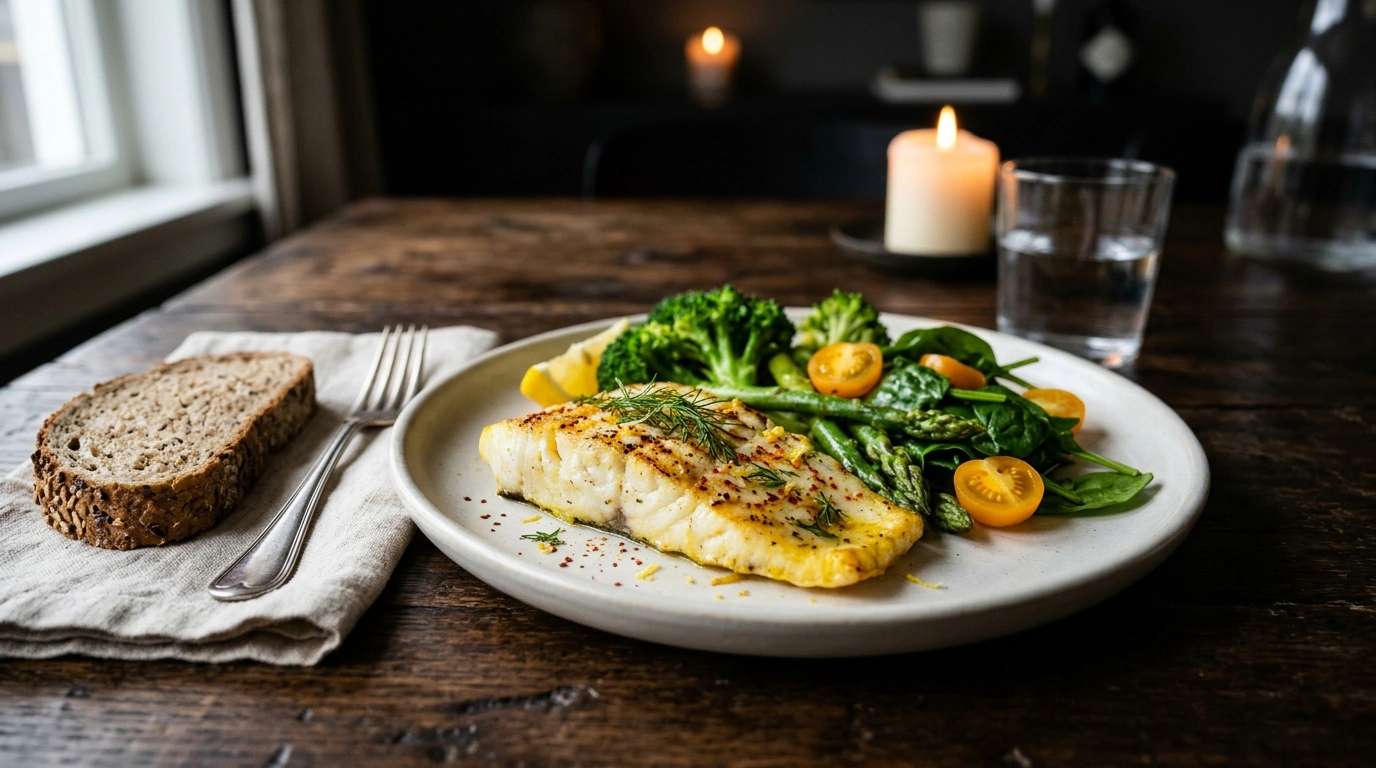
Baked fish fillet with fresh asparagus, broccoli, and whole-grain bread on a ceramic plate in evening light.
- Whole cuts—baked chicken breast, lean fish steak, boiled beef, or chunky cottage cheese. Eating this requires real chewing, which sends early fullness signals to your brain (what physiologists call the cephalic phase). The solid food then stays in your stomach for roughly an hour and a half, keeping it busy churning while gentle stomach stretch keeps hunger quiet.
- Ground or minced protein—ground meat, patties, pâtés, tartare, or heavily tenderized cutlets. Your meat grinder has already done part of the work for your teeth and stomach. Dinner is still nutritious and tasty, yet it digests faster and hunger returns sooner than after a whole cut.
- Liquid protein powder—a whey shake mixed in water. There's nothing to chew and nothing for the stomach to grind. The liquid slips through in about 15 to 20 minutes, sends a quick spike of amino acids into your blood, and leaves your stomach empty. Less than an hour later, you're hunting for a snack again.
Of course, real life doesn't leave energy every night to bake fish in foil. When you're short on time or motivation, a "lazy" whole-food backup from any grocery store beats a shaker: a can of fish packed in water or its own juice (such as saury or tuna—skip the oil-packed tins), canned beans, a tub of plain cottage cheese, or thick Greek yogurt. Open it, put it on a plate, slice a cucumber or tomato, and in three minutes you have real solid food that keeps you full until bedtime.
The "Healthy" Bar Trap: When a Fitness Snack Loses to a Regular Snickers
Checkout lanes next to regular candy bars are now lined with stacks of bars boasting "High Protein," "Sugar-Free," and "Clean Eating" labels. The marketing hits the bull's-eye: anyone trying to watch their diet grabs one with a clear conscience, feeling good about making a smart choice.
In reality, a protein bar is still a dessert, not a meal replacement. It fills you up slightly better than a liquid shake because you have to chew it, and manufacturers often add fiber and nuts. Yet if you flip the wrapper over and compare the numbers against a standard candy bar like Snickers or Mars, you're often in for an unpleasant surprise.
The sports-snack aisle is full of clever marketing tricks. The front wrapper shouts about a massive hit of protein in giant letters, while the tiny back table reveals barely any protein alongside more fat and total calories than a classic chocolate bar. Brands love defending their ingredient list: "We use real hazelnuts and coconut oil instead of white sugar!" That may improve the taste, but for a calorie deficit it means nothing—your body counts total energy. If a "fitness bar" packs more calories than a regular Snickers and tastes like sweet modeling clay, the swap makes no sense. You're better off fitting an occasional real treat into your daily budget and actually enjoying it than forcing down a "healthy" dessert that blows your calories anyway.
The fix is one simple habit: spend ten seconds flipping any flashy package over before it goes in your basket.
Quick grocery shelf check for protein foods
- Check ingredients and processing: the closer a food is to a whole cut of meat, fish, eggs, plain cottage cheese, or beans, the longer it keeps you full.
- Compare protein vs. fat per 100 g: a staple weight-loss protein food should have more protein than fat.
- Flip any 'fitness' bar or sweet dairy snack and check calories for the entire serving (not just per 100 g) against a standard candy bar so you don't pay extra calories for front-label hype.
- Build your plate and eat protein and vegetables first, saving starchy sides and any dessert for last.