A text chatbot can get away with minor delays. If a reply takes two extra seconds, the user just watches the typing dots. Voice telephony is completely unforgiving. A pause longer than 800 milliseconds feels like a dropped call. Poorly tuned interruption handling makes the bot freeze mid-sentence, and an inaccurate support answer causes instant frustration and a hang-up.
Until recently, debugging voice agents was grueling manual work. Engineers and product analysts had to sample gigabytes of audio recordings, match freeze timestamps against backend logs, and rewrite system prompts by trial and error. ElevenLabs decided to automate this at a meta-level with ElevenAgents Architect, a specialized "agent over agents" that handles the full loop of finding issues and generating safe patches.
Invisible Real-Time Failures: Why Voice Bot Debugging Becomes a Nightmare
Building a reliable voice assistant is hard because dozens of dynamic layers interact at once. A single session combines speech-to-text (STT), a language model, ultra-low-latency text-to-speech (TTS), and external database webhooks.
Failures in this chain rarely show up as clean 500 errors. Instead, they appear as subtle behavioral glitches:
- The bot gets confused by multi-digit numbers like order IDs or passport numbers;
- A billing API call hangs when trying to transfer the call to a human agent;
- The assistant fails to wait and talks over the customer when they pause for a second between phrases.
Four Phases of the Meta-Agent: From Alert Investigation to Synthetic Tests
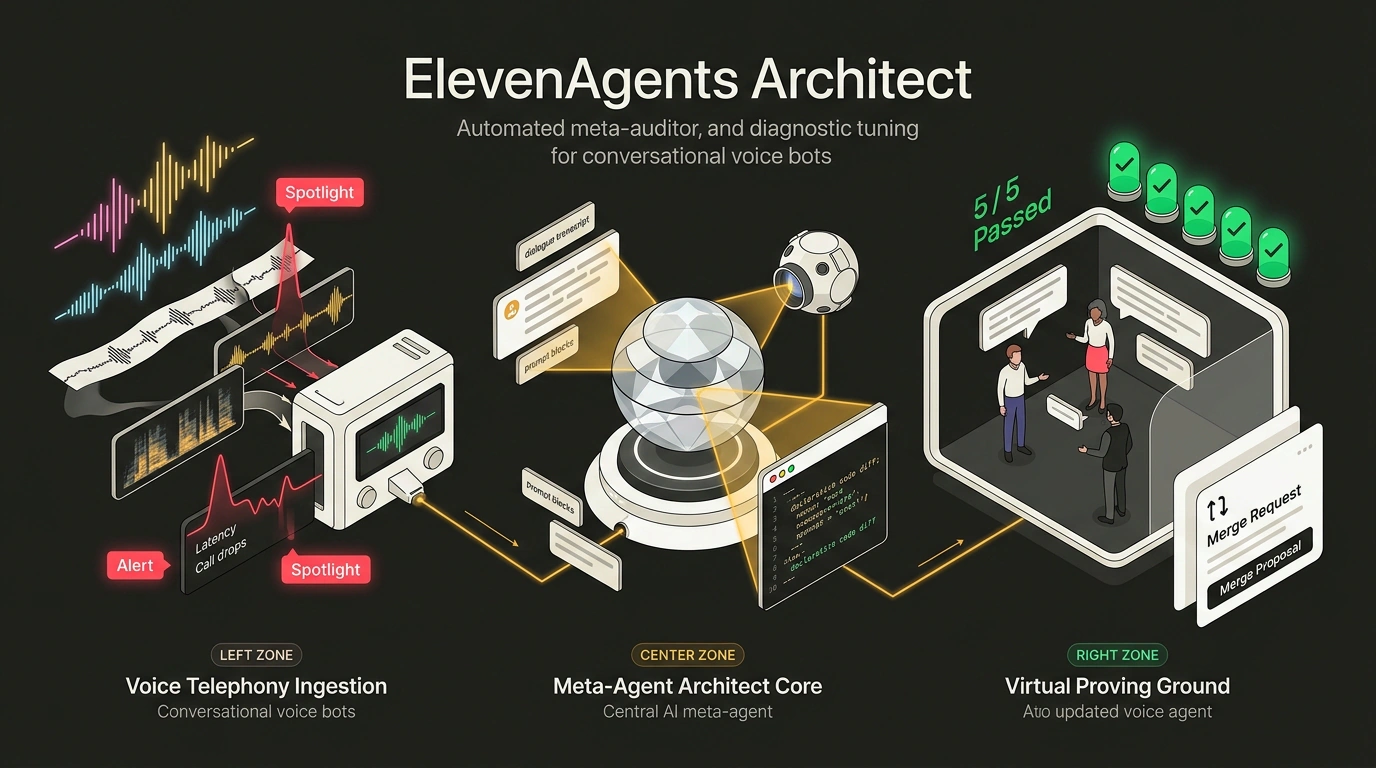
Instead of waiting for customer complaints on social media, Architect runs a closed four-stage self-optimization loop (Investigate, Change, Validate, Propose):
- Investigate. Architect continuously receives signals from the Spotlight monitoring subsystem. Spotlight clusters conversations, flags sudden conversion drops, and spots spikes in early hang-ups. The meta-agent isolates problem sessions and pinpoints the root cause, such as an unclear rule or misunderstood API parameters.
- Change. Once it finds the cause, Architect writes targeted fixes in the config manifests. It can adjust the opening line (
first_message), clarify system prompt constraints, or add edge-case rules to theknowledge_base. - Validate. The biggest risk when editing prompts is regression: fixing a product return flow can easily break new order delivery. Architect generates synthetic conversations with a virtual caller and runs them in an isolated simulator to verify the entire chain.
- Propose. The meta-agent never pushes changes straight to live phone numbers blindly. It creates a
draftand opens amerge proposalwith a clear before-and-after diff that requires a tech lead's approval.
Declarative Agent Setup: Configuring Voice, Latency, and Politeness Rules
You manage voice agents and trigger the auditor through the updated elevenlabs Python SDK. Let's walk through a two-step workflow: first define a basic support assistant, then connect the automated audit loop.
Step one is creating a declarative voice agent profile with a turbo speech synthesis model and conversation rules:
import os
from elevenlabs.client import ElevenLabs

# Initialize the official ElevenLabs client
client = ElevenLabs(api_key=os.environ.get("ELEVENLABS_API_KEY"))

# Define the declarative configuration for the voice agent
agent_manifest = {
    "name": "E-Commerce Support Assistant",
    "conversation_config": {
        "agent": {
            "prompt": {
                "prompt": (
                    "You are a voice support consultant for an online store. Your job is to quickly "
                    "check order status by tracking number and register return requests. "
                    "Always wait for the caller to finish speaking and confirm the transaction amount."
                ),
            },
            "first_message": "Hello! Customer Care speaking. Please tell me your order number.",
            "language": "en"
        },
        "tts": {
            "voice_id": "21m00Tcm4TlvDq8ikWAM",
            "model_id": "eleven_turbo_v2_5"
        }
    }
}

# Register the agent on the platform
created_agent = client.conversational_ai.create_agent(**agent_manifest)
print(f"Voice agent registered. ID: {created_agent.agent_id}")
Running an Investigation via Python SDK: Automatic Merge Requests for Prompts
Now suppose Spotlight monitoring flags an anomaly: customers complain that the bot freezes when processing refunds over 10,000 RUB. Instead of digging through logs by hand, we call Architect to analyze the incident and generate a safe patch:
# Send the anomaly signal to the Architect subsystem
audit_session = client.conversational_ai.architect.investigate_and_propose(
    agent_id=created_agent.agent_id,
    trigger_signal={
        "source": "spotlight_monitor",
        "anomaly_cluster": "high_value_refund_hang",
        "diagnostic_context": "Customers mention amounts over 10,000 RUB, after which the bot takes an unusual pause."
    },
    validation_options={
        "generate_synthetic_conversations": True,
        "test_cases_count": 5,
        "max_tolerated_latency_ms": 750
    }
)

# Check audit results and synthetic simulations
print(f"Merge Proposal created: {audit_session.proposal_id}")
print(f"Synthetic test status: {audit_session.simulation_summary['passed']}/5 tests passed")
print("\nGenerated diff for the system prompt:")
print(audit_session.proposed_diff)
Architect discovered on its own that the original instructions lacked a clear authorization limit. The bot was trying to validate large amounts through an external synchronous service without a timeout. The patch added a rule to escalate large refunds to a senior manager, cutting response latency.
Guardrails: Data Privacy and Production Timeouts
Deploying meta-agents requires strict security practices:
- PII Privacy Policy: During alpha testing, Architect sessions do not support Zero Retention Mode. Never include personal customer data—like credit card numbers, passwords, or passport details—in alert contexts.
- IDE Integration: Architect works not only in the web console, but also inside external dev environments like Claude Code and Cursor. Engineers can review the bot's proposals just like normal pull requests from teammates.
- Pricing and Availability: During the October 2026 alpha launch, Architect compute does not burn minutes from your conversational voice inference quota. Sessions close automatically after 5 minutes of inactivity on standard accounts, or 15 minutes for enterprise customers.
Automating the voice bot lifecycle moves conversational AI from manual guesswork to an industrial pipeline. Bots monitor bots, while engineers keep control over the key decisions.