For a long time, the AI industry followed an unwritten rule: solving hard math and logic problems requires giant models with tens or hundreds of billions of parameters. Deep reasoning traces were thought to need massive compute clusters and huge amounts of VRAM.
A new release from the Italian research lab Paradigma overturns that assumption. The team unveiled Limite 1B - Violetto, a dense autoregressive transformer with just 1 billion parameters. It weighs only 2.1 GB and ships under the open Apache 2.0 license.
Despite its tiny footprint, the model set an all-time record among open compact models on 2026 Olympiad math benchmarks, outperforming much larger industry rivals.
Olympiad Benchmarks: Beating the Giants
On high-difficulty competitive math tests, Limite 1B delivered remarkable scores:
- AIME 2026 (American Invitational Mathematics Examination): the model scored 94.01% accuracy. For comparison, the strong open model VibeThinker-1.5B scored 70.94%, MiniCPM-5-2B reached 90.21%, and the much larger Qwen-3.5-9B stopped at 90.42%;
- HMMT (Harvard-MIT Mathematics Tournament, February 2026): 83.62%;
- Beyond AIME: a tough test of mathematical creativity gave the model 74.25%, while the 30-billion-parameter giant Muse Glimmer 30B scored only 50.0% on the same problems;
- Apex Shortlist: the competitive Olympiad shortlist benchmark recorded 50.80% accuracy.
Packing Mathematical Intelligence into 2.1 GB
This level of performance doesn't come from scaling up hardware. It comes from a fundamentally different approach to data and training:
- Training from scratch on a curated micro-dataset: instead of compressing massive web dumps, Paradigma trained the model from scratch on a carefully filtered dataset of under 300 billion tokens;
- Reinforcement Learning with Verifiable Rewards (RLVR): in exact sciences, an answer is either strictly right or wrong. The model was trained with RLVR, where an algorithmic compiler automatically verified each step of a proof and pruned dead-end branches;
- Massive 131k token context: a context window of up to 131,072 tokens lets this compact model hold long math formulas, intermediate steps, and full theorem proofs in memory.
The Ensemble Paradigm: A Room Full of Bright Students
The biggest practical takeaway from Violetto is the concept of High Frequency Reasoning.
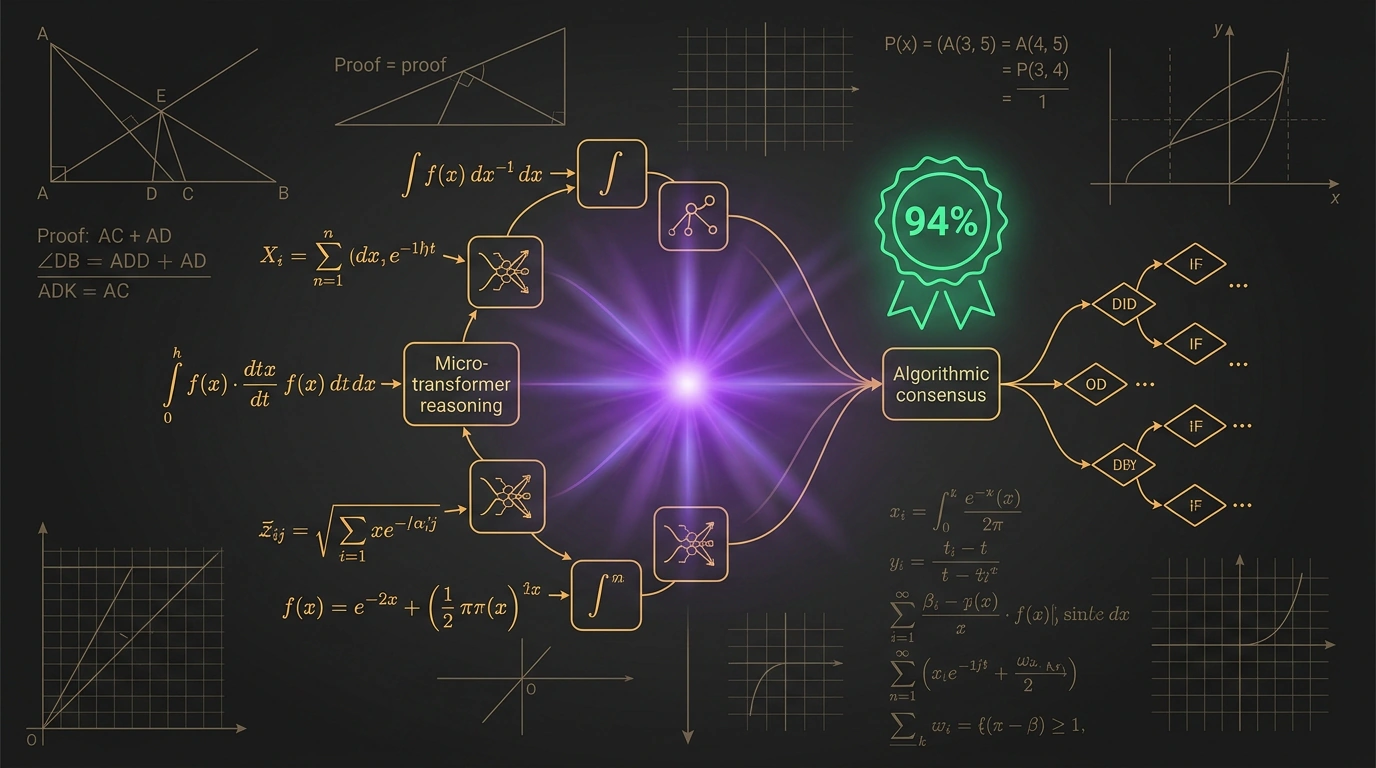
Instead of sending a hard problem to a monolithic 70B model and waiting half a minute for a single long reasoning chain, Paradigma's setup works differently. Because the 1B model needs only ~2 GB of VRAM and runs at high speed, the system launches a parallel ensemble of 6 to 8 independent Violetto instances.
Each copy generates its own proof path. A lightweight algorithmic judge then compares the resulting formulas and numerical answers, picking the consensus result. This ensemble runs faster and more reliably on a standard consumer GPU or Apple Silicon laptop than a single heavyweight cloud model.
Limits and Practical Takeaway
For all its strength, Limite 1B is a strictly specialized tool. It is not a general chat assistant and hasn't gone through classic instruction tuning for casual conversation. If you ask it an everyday question, it will try to turn it into a math proportion or an equation (scope drift).
Still, for engineering math, symbolic computation, algorithm checks, and code verification, Paradigma's release proves a clear point: the future of AI belongs not just to massive data centers, but also to ultra-efficient local models.