From day one, Windows Copilot drew skepticism from power users. In practice, the built-in assistant was little more than a web wrapper around cloud servers. Almost every action—from summarizing an open text file to finding a setting—required an active internet connection, introduced multi-second delays, and raised valid concerns about corporate data privacy.
At an October briefing, Microsoft CEO Satya Nadella announced a major architectural shift toward Hybrid Intelligence.
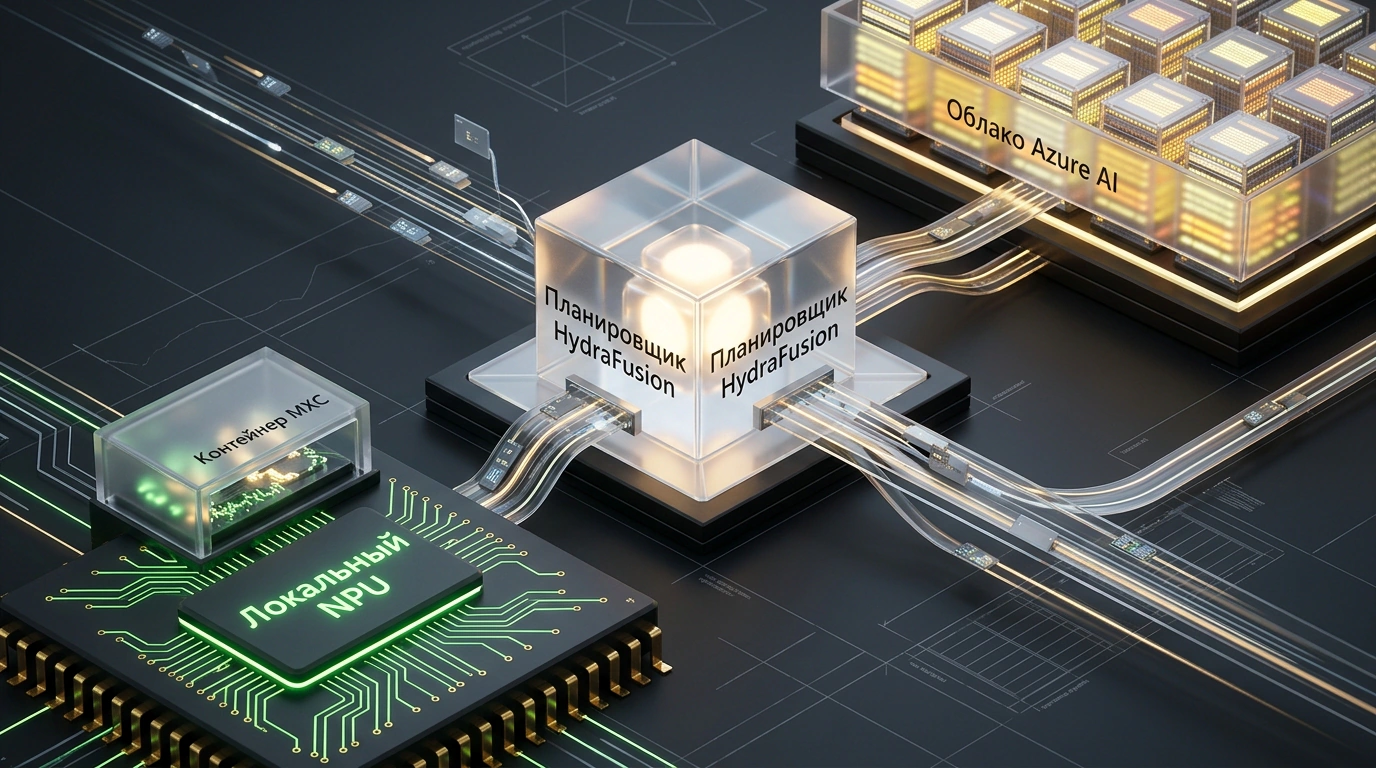
Windows is splitting its AI workloads across two coordinated tiers: an on-device layer powered by neural processing units (NPUs), and a cloud frontier layer running on Azure AI. We previously compared desktop AI assistants in the OS. Now, Microsoft is building load balancing between the local chip and the cloud straight into the system core.
HydraFusion Routing and Split Compute Tiers
At the heart of the new design is HydraFusion, a smart scheduler built jointly by the Windows and GitHub teams. It evaluates every user request in real time across three factors: data privacy sensitivity, compute complexity, and acceptable latency.
Workloads flow through two paths:
- Local NPU tier: Runs on Copilot+ PCs (Qualcomm Snapdragon X Elite, Intel Core Ultra, AMD Ryzen AI). This handles real-time tasks like personal file indexing, screen reading, inline code completion, and local search. Lightweight quantized models—including the 3-bit MAI Code Flash lineup—run via the Windows ML runtime and an optimized
llama.cppengine. Not a single byte leaves the machine. - Azure cloud cluster: Steps in only when a task demands deep multi-step reasoning, large codebase synthesis, or massive multimodal contexts that won't fit in local RAM.
The Autopilot System Agent and MXC Security Containers
The second major addition is Autopilot, a local system agent. Unlike passive chatbots, Autopilot can take direct action inside the OS: managing system services, batch-organizing files, updating environment configs, and collecting diagnostic logs.
Giving AI direct access to the filesystem carries obvious security risks. To prevent accidental system damage or malicious script execution, Microsoft introduced MXC (Microsoft Execution Containers):
- Every agent action runs inside an isolated sandbox with fine-grained permissions.
- The agent has no blanket admin rights and cannot touch system partitions without explicit user approval.
- If unusual behavior or a crash occurs, the sandbox is torn down immediately, rolling back any registry or disk changes.
Hardware Barrier and Verdict
The biggest catch with Hybrid Intelligence is its steep hardware requirement. Full local execution requires a modern PC with at least a 40 TOPS NPU and 32 GB of unified memory. Older machines without a neural chip automatically fall back to cloud-only mode.
Even with that hardware gate, this marks a welcome maturation for operating systems. AI is moving away from bolted-on web widgets and becoming a fast, private, predictable core system service.