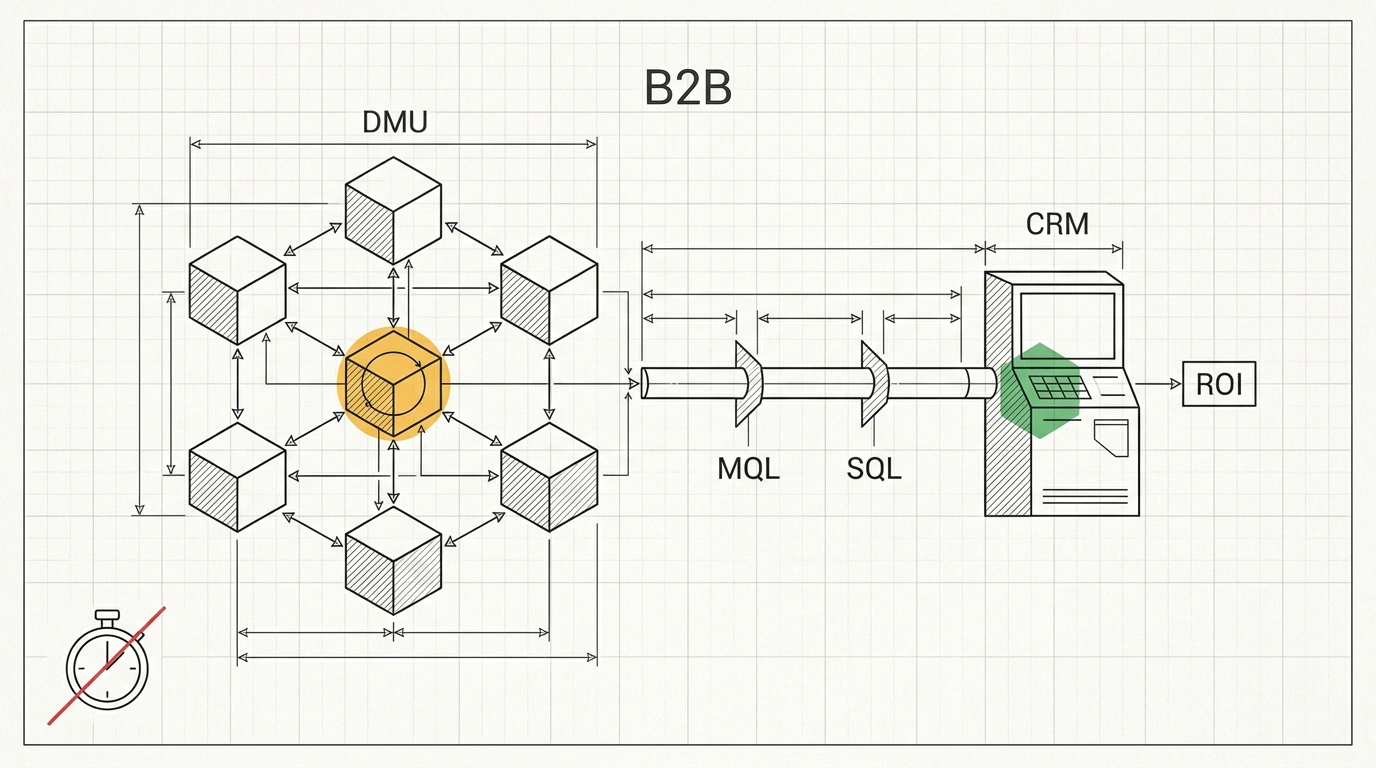
When a marketer with a background in e-commerce or retail services joins a company selling heavy industrial equipment, enterprise software, or wholesale raw materials, they usually hit a wall of culture shock. Out of habit, they launch flashy ads, slap on a "20% off until Sunday only" promo, drop a countdown timer on the landing page, and wait for the orders to roll in. A week later, the clicks are flowing, the budget is draining, and the sales pipeline is dead silent. Or worse—the only leads coming in are students writing term papers and solo freelancers on a shoestring budget.
I've stepped on that rake myself and spent way too long wondering why proven retail playbooks flatline in the corporate world. Let's be honest: selling a pair of sneakers to a commuter on the subway and selling a factory 40 million rubles' worth of CNC machines aren't just different scales—they're completely different universes. In retail, one person makes an emotional call in two minutes. In B2B, you're dealing with a collective brain, rigid procurement rules, and a paralyzing fear of making a career-ending mistake.
Here's what's actually going on behind the scenes. In the corporate segment, your buyer isn't an abstract legal entity with a tax ID and an official stamp—it's real, flesh-and-blood people. And the core paradox is that they aren't spending their own money, yet they're putting their own careers on the line. If a retail shopper buys a bad coffee maker, they sigh and shove it into a closet. If a corporate buyer picks a buggy software vendor and a warehouse grinds to a halt for two days, they get fired in disgrace.
Let's break this machine down piece by piece: how B2B demand actually works, who's really calling the shots behind closed conference room doors, and how to build marketing that brings in multimillion-ruble contracts instead of junk clicks.
Derived Demand: Why Businesses Don't Care About Your Product
First thing you need to tattoo on your brain: a business doesn't want your wonderful product. An enterprise doesn't want your pipes, your server, your CRM, or your consulting hours. A business only ever wants one of three things: to make more money, to save existing resources, or to stay out of trouble with regulators.
In economics, this is called derived demand. Demand for machine tools, packaging film, or freight logistics depends directly on how many finished goods your client's customers are buying in the consumer market right now. If housing demand drops, developers freeze construction sites—and right down the chain, orders for rebar, tower crane rentals, and engineering services dry up too.
So when you write a B2B offer, forget the spec sheets and breathless adjectives. Nobody cares that your machine has platinum gears and an aerospace-grade aluminum body. Speak to the client in the language of their unit economics:
- By what percentage will this cut the production cost per unit on the assembly line?
- How many hours of equipment downtime will your predictive diagnostics prevent?
- How many months until the rollout pays for itself, staff training included?
One warehouse racking manufacturer ran ads for years with the slogan "Reliable racking straight from the factory." Conversion hovered near zero. Then the marketers rewrote the landing page and put an interactive calculator right in the headline: "Calculate how to boost your warehouse capacity by 35% without renting extra floor space." Conversion jumped several times over. Visitors downloaded a detailed PDF breakdown, and the sales rep followed up not with a lame "So, ready to buy some racks?" but with an offer to run a quick audit of their logistics bottlenecks. Feel the shift in perspective.
The Buying Committee: Who's Sitting Across the Table
You never sell to just one person. In a company with 50+ employees, an average of 3 to 7 people take part in a purchasing decision. In Western methodology, this group is called the Decision Making Unit (DMU), or simply the buying committee. If your marketing speaks to only one of them, the deal will almost certainly crash against the resistance of the rest.
Let's look at who sits on this invisible committee:
- The Initiator. The person with an urgent operational headache right now. Say, a head of sales whose reps mix up contacts and lose leads in paper notebooks. They're the first to hit Yandex or industry media looking for a fix.
- The User. The everyday staff who'll be clicking buttons in the new software or standing at the new machine all shift. If the system feels clunky or confusing, they'll stage a quiet sabotage, and your rollout will stall out.
- The Influencer (Technical Expert). A sysadmin, security engineer, or chief technologist. Their job is to poke holes in your pitch: incompatibility with the existing IT stack, security gaps, or failure to meet GOST standards. They can't say "yes," but they hold an absolute veto.
- The Buyer. A professional procurement specialist. Their KPI is to squeeze you dry: knock 15% off the sticker price, push payment terms out to 60 banking days, and force you onto their standard contract with brutal penalty clauses.
- The Gatekeeper. The front-desk receptionist, security department, or corporate legal team filtering out cold emails and calls miles before they ever reach leadership.
- The Decision-Maker (DM). The CEO, CCO, or CFO. The person who signs the final payment order and answers personally to shareholders for return on investment (ROI).
B2B marketing has to hand ammo to every single player in this chain. The initiator needs a clear video walkthrough and an ROI calculator; the technical expert needs detailed API docs and compliance certificates; the buyer needs a transparent quote and total cost of ownership breakdown; and the CEO needs a crisp one-page executive summary showing the bottom-line financial impact.
Trying to close a B2B client with impulse promos, countdown timers, and fake scarcity ('only 2 licenses left at this special price!') just breeds contempt and makes you look shady. Routing a corporate contract through legal, security, and accounting physically takes weeks. Your marketing should arm the client with arguments to defend the project to their CEO, not push emotional panic buttons.
The Qualification Funnel: From Cold Click to Paid Invoice
In retail, the customer journey is short: click an ad, toss the item in the cart, enter a card number—done. In B2B, the sales cycle runs from 1–2 months in small business up to 6–18 months in Enterprise accounts. If you try to go straight for the hard sell on the first screen, you'll just burn through your budget.
Architectural isometric diagram of a B2B lead qualification funnel with four stages: MQL, SQL, Opportunity, and Deal.
What works here is a multi-stage qualification funnel:
- MQL (Marketing Qualified Lead). Someone who showed deliberate interest in the topic: downloaded an expert white paper, signed up for an industry webinar, or used an online calculator on your site. They aren't ready to buy yet, but they've admitted they have a problem.
- SQL (Sales Qualified Lead). A lead vetted by sales. Classic scoring runs on the BANT framework: is there a confirmed Budget, does the contact have Authority to influence the deal, how urgent is the real Need, and what's the hard Timeline?
- Opportunity (Pilot Project). The client agreed to a custom commercial proposal, a technical specification sign-off, or a test pilot on a limited section of production.
- Deal (Closed-Won). Signed contract, issued invoice, and cash in the bank.
Judging B2B ad performance by cost per click (CPC) or even cost per raw lead (CPL) is a dangerous delusion. Cheap 300-ruble leads can flood in from irrelevant individuals, while a single 15,000-ruble lead from a major plant can turn into a contract worth tens of millions. Your true north metrics are cost per Sales Qualified Lead (SQL) and Customer Acquisition Cost (CAC).
Don't let your sales reps spend hours building massive quotes before doing basic lead qualification. Their first three questions should filter out tire-kickers: 'What specific problem are you looking to solve?', 'Who in your company signs off on the final budget?', and 'By what date does this need to be up and running in production?' If the caller has neither a timeline nor a budget, route them into an automated content-nurturing sequence.
In a healthy B2B business, the ratio of Customer Lifetime Value to Customer Acquisition Cost (LTV/CAC) should stay in the 3:1 to 5:1 corridor. Drop below 3:1 and your model is burning cash on traffic; climb above 5:1 and you're underinvesting in marketing, handing market share to bolder competitors. To dig deeper into long-cycle analytics, check out this step-by-step guide to B2B account scoring, which breaks down how to track buying committee intent.
Channels That Actually Work: Where to Catch Corporate Clients
Let's look at which digital marketing channels actually pull their weight in B2B and which ones turn into money pits.
First, search ads in Yandex. This is your baseline for capturing hot demand. But surgical keyword work and strict negative keywords are non-negotiable here. If you sell industrial ventilation, you have to block terms like "for apartment," "DIY," "cheap," "term paper," and "used." You want narrow commercial keywords tied to GOST standards, equipment series, and industry specifics.
Second, content marketing and implementation case studies. Corporate buyers only trust precedents in their own sector. Show them a granular breakdown: "How we upgraded a compressor station for an agribusiness holding: initial problem, technical constraints, installation schedule without halting the shop floor, and 4.2 million rubles saved on electricity in year one." A story like that outsells any flashy tagline.
Third, expert webinars and training programs. These are ideal lead magnets for capturing contacts of technical specialists and initiators. When you teach engineers how to calculate loads properly or unpack new regulatory changes, you cement your status as the go-to authority.
Fourth, targeted account-based outreach (Account-Based Marketing). You build a list of 100 target enterprises in your region, use professional networks and public registries to find the chief power engineers or IT directors, and run tailored outreach with offers built around each plant's specific bottlenecks.
Finally, end-to-end analytics. With a 3-to-6-month sales cycle, standard web counters can't connect an ad click to money hitting the bank. Click data, campaign source, UTM tags, and a unique ClientID have to pass automatically from your website form straight into your CRM. Ad management platforms like eLama let you pull Yandex Direct, VK Ads, and Telegram Ads into a single dashboard and sync ad spend with closed CRM deals. That way, you optimize bids for actual contract margin—not empty clicks.
B2B marketing isn't a sprint for quick likes; it's a methodical marathon. The winners are the ones who listen to real business pains, respect the buyer's time, and speak the only universal language in the corporate world: numbers, payback, and managed risk.