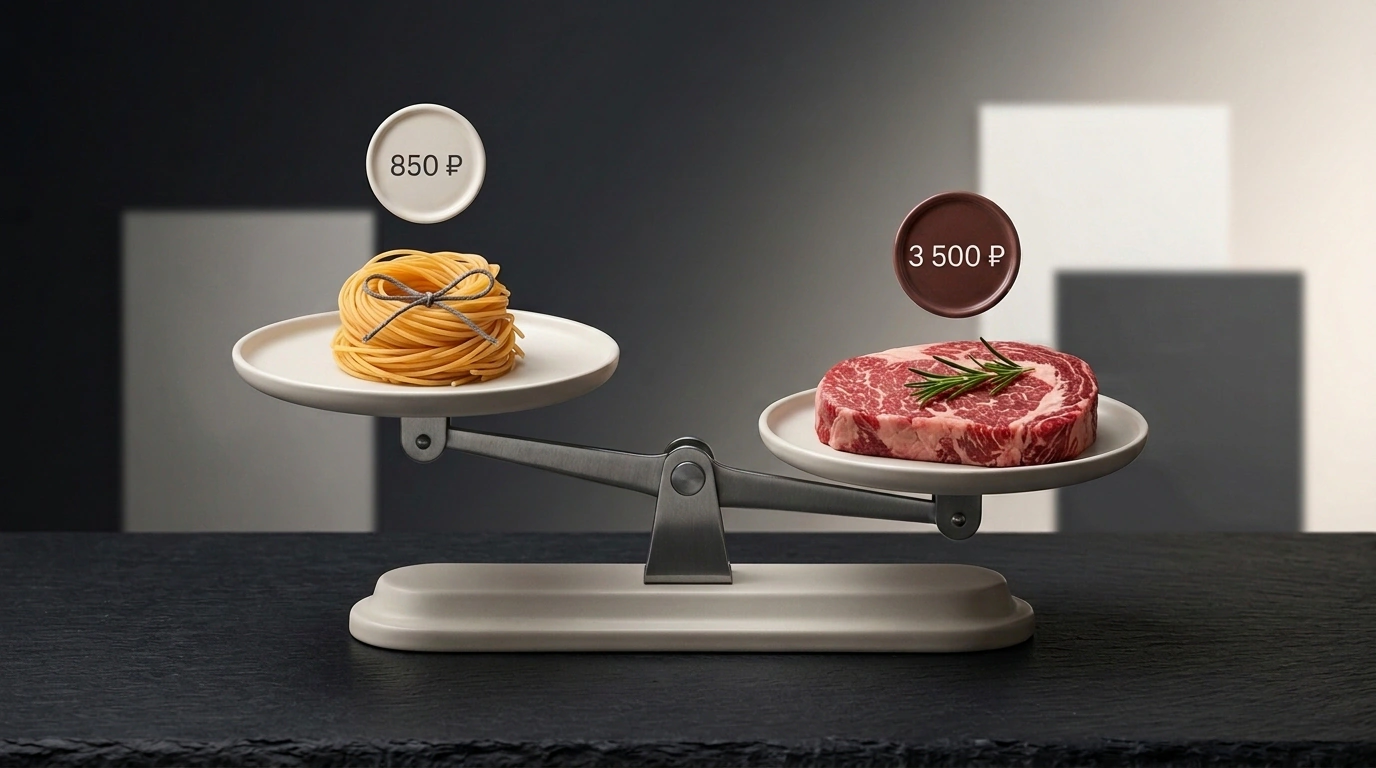
You've probably felt this weird itch at a restaurant before. You open the menu: a marbled beef Ribeye steak is 3,500 rubles, and a classic Carbonara is 850 rubles. You order the steak without blinking, knowing it's an expensive treat. Yet when your eyes hit the pasta line, a quiet wave of irritation rises up: "Eight hundred fifty rubles for a plate of boiled noodles and a scrap of bacon?! Are you out of your minds?!"
A fresh study by the financial marketplace Sravni confirms this isn't just your personal quirk—it's a mass psychological phenomenon. Pasta and pizza topped the public anti-rating of the most overpriced restaurant dishes by a landslide. Diners happily forgive astronomical tabs for fish, seafood, and dry-aged beef, yet lose their temper over flour-based dishes.
Let's take this mechanism apart: why our brains fight the price of pasta so fiercely, how restaurant economics actually work behind the kitchen doors, and what fundamental lesson every business owner and marketer needs to steal from this.
"Grocery Shelf" Psychology: The Trap of Transparent Costs
Behavioral economics has a foundational concept called Perceived Value. People almost never judge a price in a vacuum. Subconsciously, they hunt for a familiar reference point—an anchor to measure your price tag against.
In the restaurant business, that anchor is the local supermarket shelf:
- A pack of durum-wheat spaghetti at the corner store costs 100–150 rubles. One pack makes four hearty servings.
- A splash of cream, a bit of bacon, an egg yolk, and a pinch of grated parmesan add maybe fifty to seventy rubles per plate.
- A diner looks at an 850-ruble plate and does instant mental math: "The ingredients here cost 120 rubles tops! That's a 700% markup! I'm being robbed in broad daylight!"
Now look at the Ribeye steak. A raw cut of grain-fed marbled beef at the grocery store runs 1,500 to 2,000 rubles per portion. Cooking it at home on a standard non-stick pan without turning it into a rubber shoe sole is something one person in twenty can pull off. You need a cast-iron grill, high heat, an instinct for doneness, and quality butter. When a restaurant charges 3,500 rubles for a steak, your inner critic relaxes: the raw cut is expensive, the prep is tricky, and paying 1.5x to 2x feels like a fair tribute to the chef's skill and the ambiance.
Behind the Menu: Who Subsidizes Whom
Peek into the financial statements of any successful restaurant (pros call this Menu Engineering), and you'll spot an ironic twist: a restaurant doesn't make its money on the items that look expensive to the guest.
- Food Cost on pasta, pizza, and French fries is just 12–18% of the menu price. These are the restaurant's real profit engines.
- Food Cost on prime beef, fresh seafood, and specialty fish hovers around 35–45%.
If a restaurant sold nothing but steaks at that cost ratio, it would go bankrupt after its very first rent and utility bill. In reality, cheap carb-heavy pasta directly subsidizes the expensive steak. The venue puts luxury meat on the menu for status and to pull in a discerning crowd, while making its actual margin on flour, water, and potatoes.
The easier it is for a client to break your service down into dirt-cheap raw components (billable hours, a standard template, cost of materials), the harder they will haggle over every single ruble. To protect high margins, package your product so the buyer sees the end value of solving their problem—not the assembly cost.
The Core Lesson for Any Business: How to Protect Your Margin
This restaurant drama repeats itself in every industry—from web development to consulting and construction.
If you pitch a client "writing five social media posts for 50,000 rubles," their brain immediately runs the grocery-shelf math: "Okay, a copywriter spends two hours per post, so that's 5,000 rubles an hour? Are you crazy? Someone on a freelance board will write a post for 300 rubles!" You just walked straight into the pasta trap: the client sees cheap ingredients and resents your markup.
But change the packaging and sell "a content-nurturing system that pre-qualifies leads and cuts paid ad acquisition cost by 30%," and the conversation shifts to steak territory. The client stops counting copywriter hours. They're weighing the financial upside for their business—and they're happy to pay real money for that outcome.
Stop selling your clients flour and water. Sell them hard-won craft, managed risk, and guaranteed results.