Organizing a major corporate event, a 500-person dealer conference, or an invite-only client forum is classic high-stress territory for any marketer or growth director. During the pitch and concept defense, every agency looks spotless: sleek PowerPoint decks, festival awards, glossy photos of smiling executives clinking champagne glasses, and solemn promises from producers: "Don't worry, we'll deliver a turnkey event at the highest level!"
Then setup day arrives—and the fairy tale shatters. Turns out the LED screen has dead panels, wireless mics hiss and squeal every time a speaker takes a step, catering mixed up the vegetarian trays, and the decor truck is stuck at the hotel gate because the agency forgot to file an overnight loading permit. Right in the middle of the panic, the producer walks up with an innocent look and hands you an addendum to sign: "You see, unexpected expenses came up—we need another 35% of the budget wired right now, or catering won't start setting the tables."
I've watched this drama unfold from the client side more than once. Most corporate blowups and frayed nerves don't happen because the agency set out to fail—they happen because the client picked a vendor based on glossy slides and judged the quote by a single number in the "Total" row.
Let's take off the rose-colored glasses and treat this like a strict engineering problem: what five uncomfortable questions to ask producers in the very first meeting to weed out middlemen instantly, and what four filters to run the budget through to shield your company from hidden surcharges.
5 Tough Questions to Test Real Experience
When an agency starts reciting its rehearsed pitch, cut through the polish and run a quick stress test. A seasoned practitioner will answer these effortlessly—and even enjoy the rigor—while a middleman with no real operational chops will start nervously glancing at their teammates and asking for "time to check with our technical leads."
- "Off the top of your head, without checking your phone, give me the banquet price range and lighting rental cost at three popular venues in town." A real event producer lives in the market: they know the quirks of major halls by heart, know which banquet menus hide a mandatory 10–15% service charge, and know which ceilings can't support heavy rigging trusses. A broker who just hires random freelancers out of Telegram chats doesn't keep baseline numbers in their head and will stumble right away.
- "What exactly does your team do if the host or keynote headliner calls two hours before showtime saying they're stuck at the airport?" This checks for a real Disaster Recovery Plan. A mature team always has a hot backup: a roster of vetted hosts on standby, a protocol for reshuffling program blocks, and pre-built interactive segments to stretch timing without awkward dead air. If they say, "That never happens to us, our talent is never late"—you're looking at amateurs.
- "What is the minute-by-minute role breakdown for your crew on setup and rehearsal day?" Ask point-blank: who is personally responsible for audio patching? Who greets speakers and clips on lavalier mics? Who cues presentation decks from the control booth? Who checks the serving temperature of hot dishes? If an agency sends one junior coordinator and two interns to run a five-million-ruble event, a fire on-site is guaranteed.
- "Tell me about your team's worst technical screwup over the past year and how you fixed it." Professional maturity shows in how openly someone discusses emergencies and lessons learned. Flawless events don't exist: neighborhood power grids trip, mixing consoles freeze, flights get delayed. A true pro will tell you calmly: "Last November the venue lost a phase 10 minutes before the plenary session. We switched the control booth to a backup diesel generator in four minutes while the speaker kept the room engaged live." If an agency claims a 100% perfection record, they're either rookies or lying.
- "What is the exact structure of your agency fee, and are you willing to show direct vendor invoices?" This is the Open Book pricing test. A pro says it straight: "Our fee is 12% of the project budget. We pass through all catering, lighting rental, and talent invoices in the original with zero hidden markups." Middlemen will fight tooth and nail to protect a closed-book quote where every line item is padded by 50%.
4 Budget Filters: How Not to Overpay 40% in Hidden Costs
Now lay the draft budget in front of you. Rule number one of financial hygiene: never judge a proposal by its bottom-line total alone. A quote that comes in 20–30% below market during a tender is almost always a trap—designed to win the contract at any cost and hit you with "force majeure" add-ons on event day.
Paper collage and infographic breakdown of an event budget with four control filters and highlighted risk zones.
Let's run the document through four key filters.
Filter 1: Granularity of the Technical Rider
A budget should never have vague catch-all lines like "Hall sound equipment — 450,000 rubles" or "Lighting fixtures — 300,000 rubles." That's a blind spot where shady organizers hide fat margins.
Demand a detailed spec sheet:
- Exact brands and models of speaker systems (e.g., L-Acoustics or d&b audiotechnik), total wattage, and placement diagram.
- Number of digital wireless mic systems (Shure, Sennheiser) with explicitly listed backup frequencies.
- Dedicated uninterruptible power supply / backup generator for the control booth.
Real case in point: a company booked a conference off a lowball quote, saving 80,000 rubles on the technical rider. The contractor brought cheap wireless mics without frequency reservation. Right in the middle of the CEO's keynote, the mic started picking up walkie-talkie chatter from the neighboring hotel's security team. The speech was derailed, and the reputational hit in front of partners dwarfed any savings.
Filter 2: Contingency Fund
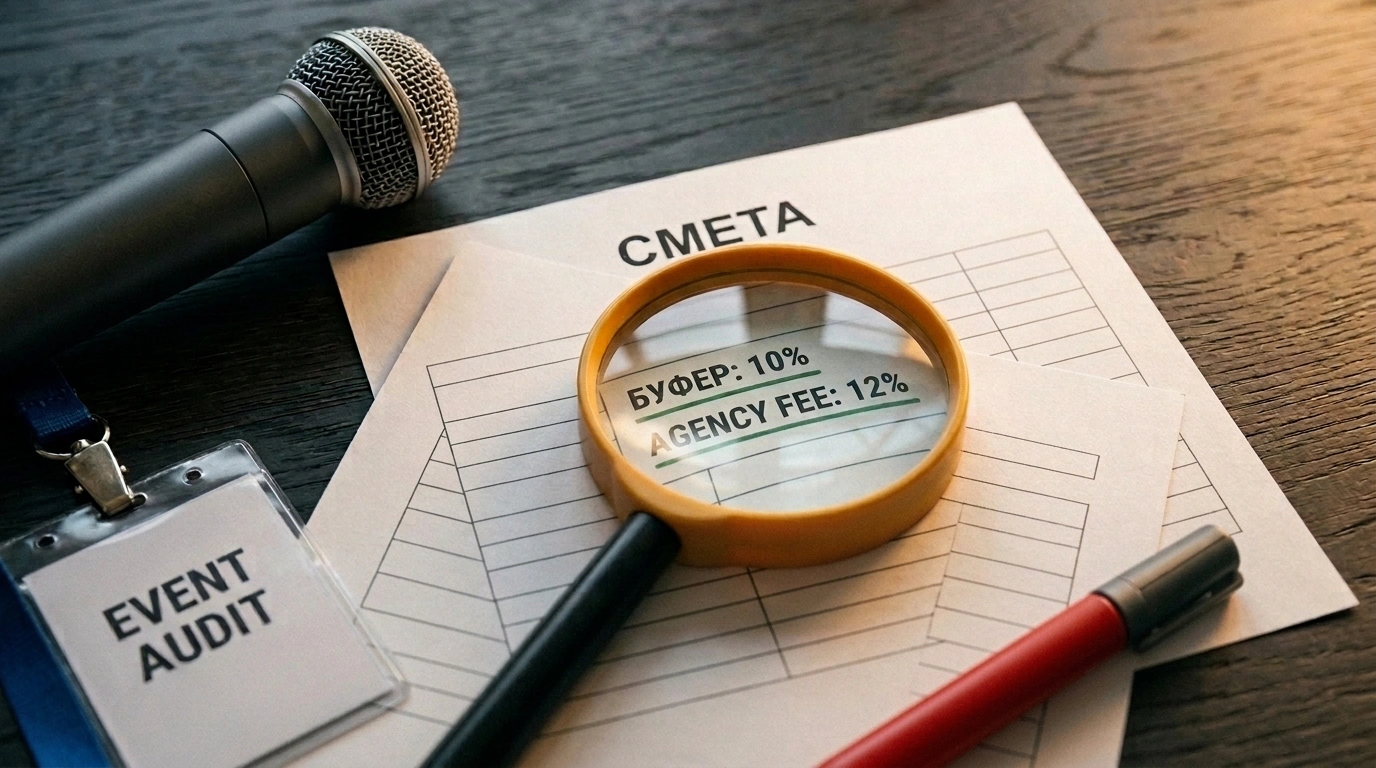
In professional event production, there's a strict standard: the budget must include a dedicated contingency line equal to 5% to 10% of the total spend.
But that line needs legal guardrails:
- The buffer is refundable: if no emergencies happen, the money stays with the client.
- Any drawdown from this fund requires prior written approval from the client's representative (even a quick confirmation in the working Telegram chat counts).
If that line isn't in the budget at all, the agency has either buried hidden padding inside every line item—or they'll come knocking for emergency cash right in the middle of the banquet.
Filter 3: Logistics, Load-In Shifts, and Hidden Fees
The oldest trick in a lowballing agency's book is stripping out all the "invisible" labor so the tender total looks artificially pretty.
Check whether the document includes:
- Load-in shifts the day before the event (renting the hall 24 hours early to build the stage).
- Overnight strike/teardown: after midnight, rates for loaders, stagehands, and drivers jump 1.5x to 2x.
- Venue cleaning before setup and after teardown.
- Paid freight permits for heavy trucks entering the city center.
If these items are missing, brace yourself for the budget to balloon by 25–40% on event day. We put together a detailed breakdown of what to watch for when auditing a contractor's quote and spotting hidden markups in our agency audit playbook.
If an agency tells you, 'We don't charge the client a fee—our agency commission is 0%, we make our money off venue discounts,' run. No business works for free. It means the organizer is burying a 30% to 50% hidden margin inside every subcontractor line—and when a dispute pops up, they'll defend the venue paying their kickback, not you.
Filter 4: Transparent Agency Fee
According to the National Association of Event Organizers (NAOM), the standard market rate for an agency fee in corporate events is 10% to 15% of net subcontractor spend.
That's an honest fee for:
- Developing the creative concept and show direction.
- Hundreds of hours of negotiations and coordinating dozens of vendors.
- Financial and legal accountability for the final outcome.
Ask the agency to attach direct commercial quotes from three core vendors (venue, AV/lighting, catering). Compare those numbers against the vendors' public rate cards. If the agency's budget lists hall rental at 800,000 rubles while the venue's official rate is 650,000 rubles, the agency is pocketing a hidden markup on top of its official fee.
An event isn't just a party—it's a marketing engine that builds partner trust, fires up your team, and signals brand stature. Don't buy the illusion of cheapness. Demand transparent math, ask the awkward questions upfront, and only work with teams ready to own every line item and every minute of the run-of-show.