You've probably heard colleagues say: "Why don't we launch an affiliate program? We'll only pay for results—they bring a customer, they get a cut, zero money wasted on empty clicks!" It sounds great on paper, yet nine out of ten DIY affiliate programs either die in silence because affiliates refuse to send traffic, or quietly push the business into a cash-flow hole.
The root cause is a clash between two completely different perspectives:
- The business looks only at the cost per approved lead (CPL) and tries to squeeze it as low as possible.
- The affiliate (media buyer) judges an offer by EPC (Earnings Per Click)—how much net revenue each click on their link generates.
If you set a 1,500-ruble payout, but picky moderation approves only one in four leads, affiliates will happily walk over to a competitor paying 800 rubles with a 55% approval rate. We covered how to build lasting partner relationships in our look at the transformation of affiliate marketing. Anatoly Bushov, founder of ProCPA and Affelora, mapped this entire unit economics into a clear mathematical model.
A CPA Funnel in Real Numbers
Take a baseline example: a company sells an online product for 30,000 rubles at a 50% gross margin (15,000 rubles gross profit). The payout model is CPL: 800 rubles paid to the affiliate per verified valid lead.
Here is how the traffic flows:
- Affiliates drive 20,000 clicks.
- Landing page conversion rate (CR) is 2% -> the company gets 400 leads.
- Approval rate is 55% -> 220 leads are approved (180 rejected as unreachable, duplicates, or spam).
- Sales team close rate is 20% -> 44 sales closed.
- End-to-end funnel conversion: $2% \times 55% \times 20% = \mathbf{0.22%}$ (44 sales from 20,000 clicks).
The Affiliate's View: Why EPC Rules Everything
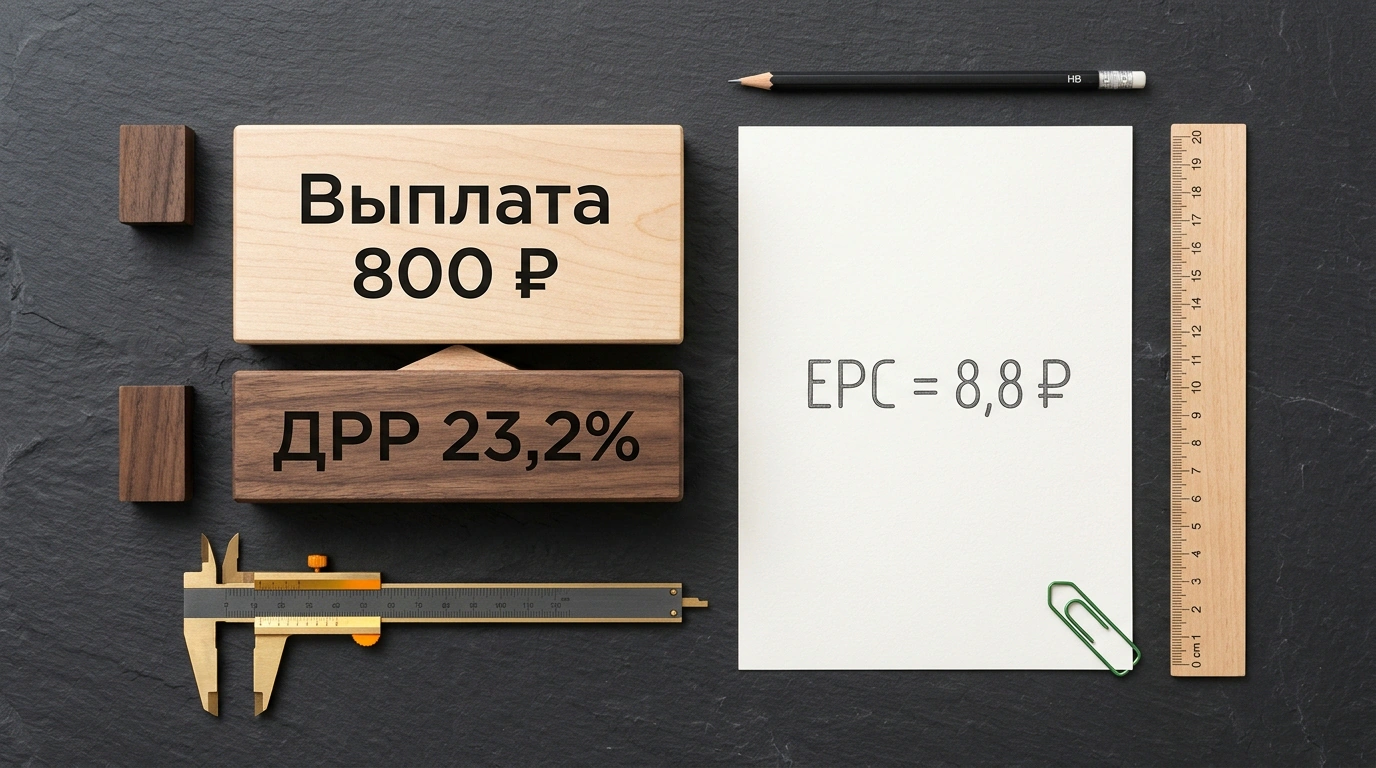
Here's how the media buyer calculates earnings per click: For 220 approved leads, affiliates earn a combined 176,000 rubles. Divide that by 20,000 clicks and you get the same 8.8 rubles per click.
If an affiliate buys traffic at 7 rubles per click, their return is $ROI = (8.8 - 7) / 7 \approx \mathbf{25.7%}$. But if your call center drags its feet and the approval rate drops to 40%, EPC crashes to 6.4 rubles. The partner takes an −8.6% loss and pulls the plug immediately.
The Business's View: Calculating DRR and Hidden Costs
Many marketers only count the affiliate payouts (176,000 rubles). In reality, the channel carries hidden operating expenses:
- Call-center processing: reps have to dial all 400 incoming leads, not just the approved ones. At 150 rubles per call, that's $400 \times 150 = 60,000\text{ rubles}$.
- Infrastructure: an affiliate manager's salary plus tracking software adds another 70,000 rubles a month.
Total channel cost: $176,000 + 60,000 + 70,000 = \mathbf{306,000\text{ rubles}}$.
The financial bottom line:
- Revenue from 44 sales: $44 \times 30,000 = 1,320,000\text{ rubles}$.
- Gross profit: $44 \times 15,000 = 660,000\text{ rubles}$.
- Net profit from the affiliate channel: $660,000 - 306,000 = \mathbf{354,000\text{ rubles}}$.
- Ad spend-to-revenue ratio (DRR): $306,000 / 1,320,000 = \mathbf{23.2%}$ (well below the 50% margin, so the channel is profitable).
- ROMI on gross profit: $(660,000 - 306,000) / 306,000 = \mathbf{115.7%}$.
Never calculate ROMI on gross revenue (which would look like 331%)—on thin margins, that masks real losses. For more on setting realistic financial expectations early on, check our breakdown of ad payback timelines.
Safety Guardrails: Payout Ceiling and Sales Threshold
To sleep soundly, keep two limits in mind:
- Payout ceiling: gross profit per approved lead is $20% \times 15,000 = 3,000\text{ rubles}$. Overhead per approved lead is $130,000 / 220 \approx 591\text{ rubles}$. Break-even max payout: $3,000 - 591 = \mathbf{2,400\text{ rubles}}$. Paying 800 rubles leaves the business a 3x safety buffer.
- Critical sales conversion: breaking even requires $306,000 / 15,000 = 20.4$ sales. If the sales team's close rate drops below 9.3% (fewer than 21 sales out of 220 leads), the affiliate program goes into the red.
Always calculate unit economics on closed cohorts: because of the lead verification hold period, a calendar-month report will always look artificially unprofitable. And ban branded search bidding from day one—unscrupulous affiliates love hijacking your organic brand traffic, slashing your true ROMI from 115% down to 66%.