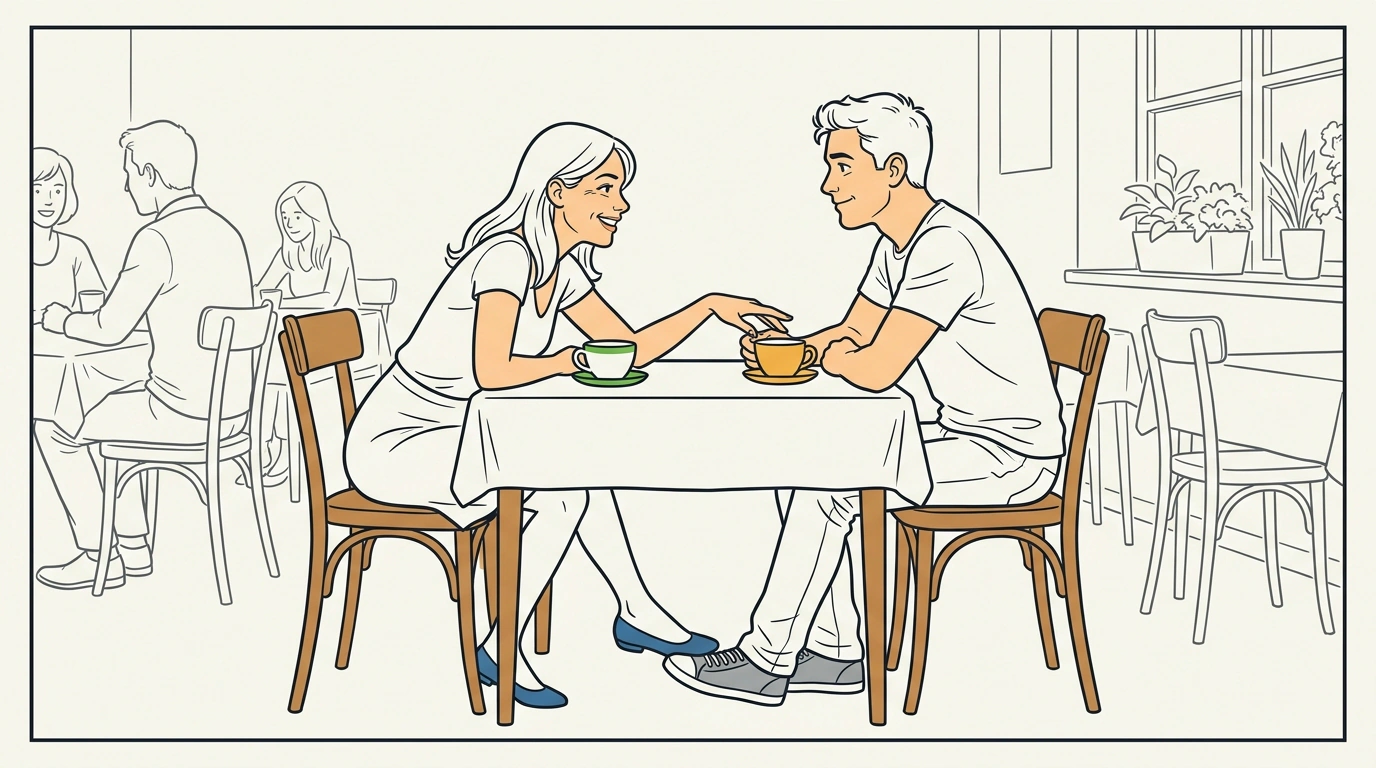
You're sitting across from a woman in a dimly lit bar, good music is playing, and you're chatting about bands or travel. Things seem to be going smoothly, yet a nagging question drills into your head: 'Does she actually like me? Or is she just being polite until she finishes her drink?'
Expecting her to look you dead in the eye mid-sentence and say, 'Hey, you're cute, I want to kiss you,' is naive. Between upbringing, fear of seeming too forward, and plain awkwardness, women rarely announce romantic interest in words. Their bodies, however, speak louder than any declaration.
Writers at The Modest Man and researchers in nonverbal communication agree on one thing: physiology moves faster than conscious thought. When someone feels attraction, their autonomic nervous system fires off dozens of micro-reactions that are nearly impossible to fake or suppress. You just need to know what to look for and how to calibrate.
The Cluster Principle: Why One Gesture Means Nothing
Before we break down specific cues, lock in the golden rule of body language: never draw conclusions from a single isolated gesture.
If she crosses her arms over her chest, it doesn't mean she's shutting you out behind a fortress wall. Maybe the AC is just blasting. If she tucks a strand of hair behind her ear, she might simply be keeping it out of her food.
Genuine interest always shows up as a cluster—two or three nonverbal signals firing together or back-to-back within a couple of minutes. In our breakdown of hidden signs of female attraction, we showed how context separates polite friendliness from real romantic pull.
Foot and Torso Direction: The Zone Nobody Fakes
In kinesics, there's an unspoken law: the farther a body part is from the brain, the worse we are at consciously controlling it. We manage facial expressions easily—we're trained from childhood to smile politely. Nobody teaches us to monitor where our feet are pointing.
Check where her toes and torso are aimed:
- If she's angled half-away, shoulders turned toward the exit or the room, and her feet point past you, her attention is scattered—mentally, she's already half out the door.
- If her torso leans slightly forward across the table, her shoulders are relaxed, and her feet point straight at you, her subconscious radar is locked onto you. Even in a noisy bar, she's deeply tuned in to your conversation.
Eye Contact, the Duchenne Smile, and Mirroring
The next critical marker is how she holds eye contact. In casual small talk, a person's gaze lingers for a second or a second and a half before drifting off to the side.
When a guy is attractive to her, she holds that gaze just half a second longer than normal. It's not a heavy, staring-contest glare—it's soft eye contact paired with a subtle half-smile. Often, she'll drop her eyes downward (not sideways!) right after, then look away. Psychologists treat that downward glance as a classic flirtation cue.
Second is the genuine Duchenne smile. In a polite, forced smile, only the corners of the mouth move. When she's genuinely enjoying your company and laughing, the muscles around her eyes engage, crinkling the outer corners.
Finally, watch for mirroring. If you lean back into the booth and two seconds later she settles back too—or if you pick up your glass and she reaches for hers—rapport is locked in. Her nervous system is syncing up with yours.
Proxemics and Micro-Touch
Proxemics studies how people use personal space. According to anthropologist Edward Hall's classification, personal space starts around 1.2 meters (4 feet), while intimate space begins closer than 45 centimeters (18 inches).
If she unconsciously closes the gap—scooting closer on a shared bench, leaning in when she asks you something, or placing her glass right next to yours—the barrier is down.
Want to quietly test whether she's comfortable getting closer? Slide your cup or glass slightly toward her side of the table, shrinking the neutral zone. If she leaves hers where it is—or nudges it closer too—she feels safe around you. If she instinctively pulls her glass back or leans away, don't rush escalation; give her a bit more time to warm up.
The clearest green light of all is situational touch. When she laughs and lightly taps your shoulder or forearm, or 'accidentally' brushes her knee against yours under the table, that's an unmistakable signal. She's giving you quiet permission to close the distance and take the lead.