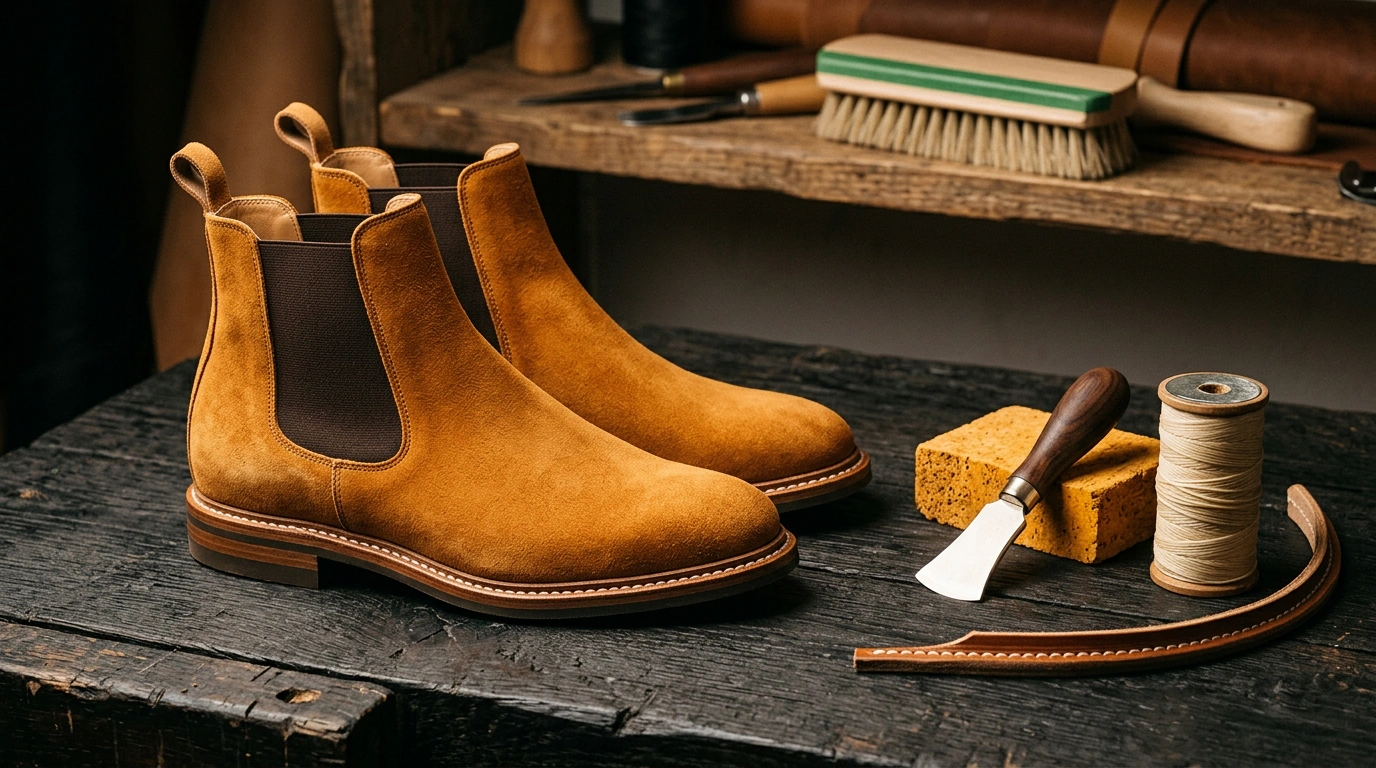
There's an unspoken rule in menswear: a woman might forgive a plain sweater or a simple jacket, but beat-up, shapeless, or sloppy boots will bury a first impression on the spot. Cold-weather footwear isn't just utility gear for dodging puddles. It's the visual anchor of your entire outfit.
Every autumn, most guys either stubbornly slog through November slush in mesh summer sneakers or grab cheap glued boots from fast-fashion chains that crack and leak within three weeks.
In a massive recent test, the experts at Gentleman's Gazette compared 19 pairs of men's boots from around the world, while stylist Harry Has broke down the silhouettes of Chelseas and combat boots. Let's look under the hood at how proper men's boots are built—and how to pick a pair that lasts for years.
Construction Battle: Goodyear Welt vs. Blake Stitch vs. Glue
The real secret to a boot's lifespan isn't on the surface—it's hidden inside the sole. Quality shoemaking relies on two historic methods:
- Goodyear Welt. The gold standard of classic British footwear. A leather strip (the welt) is stitched to the upper and insole with one seam, and to the outsole with a second, independent seam. The cavity in between is filled with natural cork. The payoff is huge: water stays out, the cork molds to your foot's exact shape after 20–30 hours of wear, and when the sole wears down, a cobbler can cleanly slice it off and stitch on a new one (resoleability). The trade-off is a stiffer break-in period and a wider, protruding welt edge.
- Blake Stitch. The Italian school. The outsole is stitched directly through the insole from inside the boot. That makes the boots remarkably flexible, lightweight, and sleek right out of the box, with a slim, streamlined profile. The catch: in deep puddles, moisture can wick up through the stitch holes, and you can only resole the pair once or twice over its lifetime.
- Cemented (Glued). The sole is simply glued to the upper. In laceless Chelsea boots, pulling them on and off puts 25–30% more stress on that bond than in laced dress shoes. Glue fatigues quickly through freeze-thaw cycles, and by mid-winter the sole starts flapping open.
In our detailed men's footwear guide, we broke down why buying one Goodyear-welted pair ends up costing three times less over time than replacing cheap glued boots every year.
Leather Beats Geography: Why the Country Stamp Comes Second
The Gentleman's Gazette test uncovered an eye-opening fact: a Made in Italy or Made in England stamp no longer guarantees top-tier quality, just as factories in Portugal or Vietnam don't automatically mean corners were cut. Everything comes down to the grade of leather.
Steer clear of 'polished' or 'corrected grain' (bookbinder) leather. That's low-grade hide coated in a thick layer of polyurethane plastic. It shines under store lights, but it doesn't breathe, rejects conditioning creams, and develops ugly chalky creases and cracks within a month.
Look for full-grain calfskin or dense French calf suede. Full-grain leather keeps its natural pores, ages gracefully, absorbs protective waxes, and builds a rich patina over the years.
Balancing Pants and Soles: Getting the Proportions Right
Even great boots can be ruined instantly by pairing them with the wrong trousers. Stylist Harry Has emphasizes one core rule of visual balance: the chunkiness of the sole has to match the width of your pant leg.
If you wear heavy combat boots on a thick lug sole with skinny jeans, you end up with a cartoonish 'Mickey Mouse' silhouette on stick legs. Rugged boots need visual weight to balance them out: straight-leg cuts, relaxed denim at 13–14 oz or heavier, or textured corduroy that drapes cleanly over the boot shaft.
Conversely, sleek, minimalist Chelsea boots on a smooth sole are made for straight wool trousers or clean dark denim. Just make sure the Chelsea shaft hugs your ankle closely—a wide, gaping opening will catch the back of your pant leg and bunch it up awkwardly.
People wrongly assume suede Chelseas are fragile. In reality, quality suede handles road salt and slush better than smooth leather: there's no top finish to crack, and white salt rings don't scar it permanently. Before your first wear, coat the pair in three light passes of a waterproof nano-spray spaced 20 minutes apart, and once mud dries, brush it right off with a dry crepe brush.
Invest in one pair of properly built boots, dial in your trouser fit, and your cold-weather look will read sharp, masculine, and effortlessly put together.