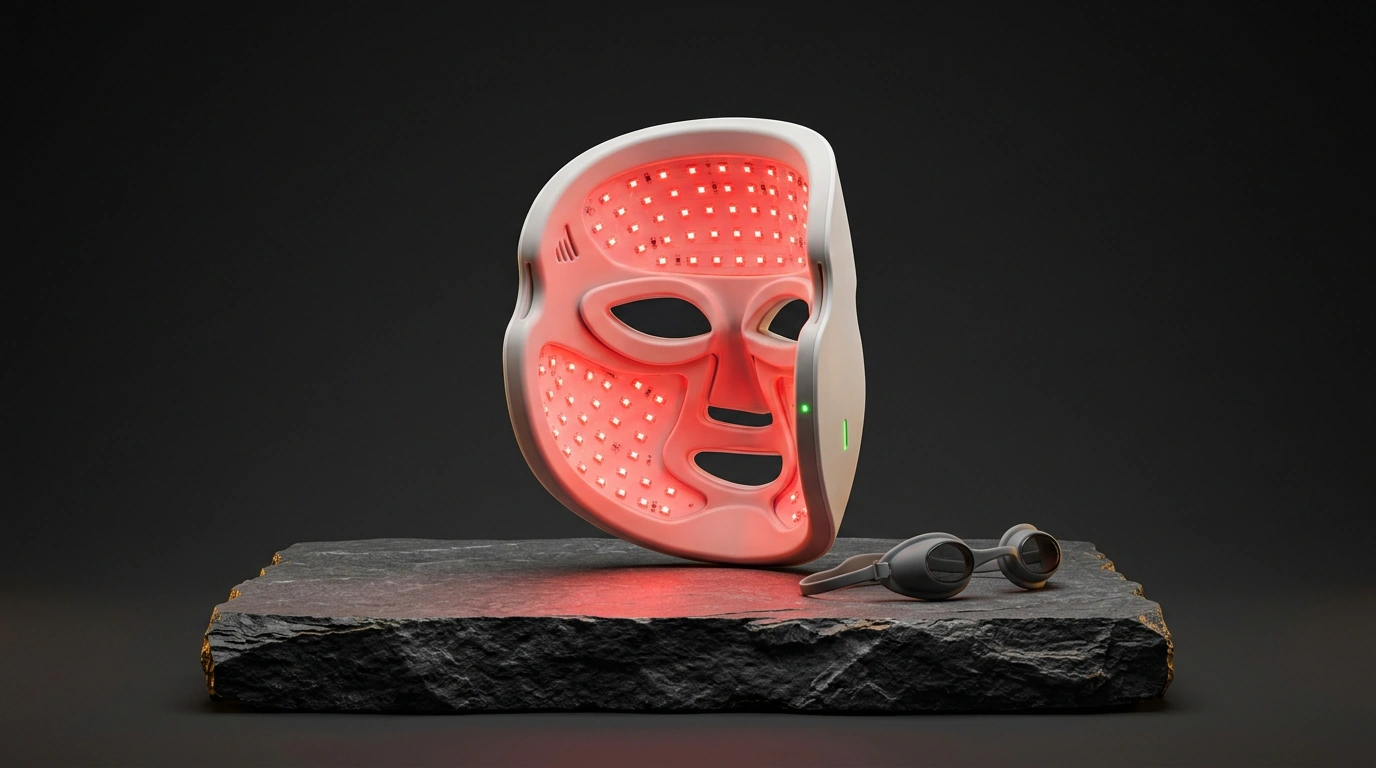
You've definitely scrolled past those sci-fi selfies on social media: people lounging around in glowing plastic masks bathed in neon red or blue light, looking straight out of a cyberpunk movie. At-home LED masks and panels promise miracles—erase fine lines in two weeks, wipe out acne, crank collagen production into overdrive, and hit pause on aging with one button press.
Meanwhile, the price gap is enough to make your head spin. Online marketplaces sell flexible silicone masks for thirty bucks, while dermatology clinics run professional light panels costing tens of thousands of dollars.
So what's the real story here? Another overhyped biohacking cash grab, or a legitimately proven dermatology tool?
Board-certified American dermatologist Dr. Andrea Suarez (Dr Dray, MD) broke down the clinical evidence behind photobiomodulation (PBM, also known as Low-Level Light Therapy or LLLT). Turns out there is serious quantum biology behind LED light—yet for photons to actually rejuvenate skin instead of just warming the air, a device has to hit strict optical specs.
Let's break the physics down photon by photon: how light charges your mitochondria, how red wavelengths differ from blue, why power density decides everything, and how to avoid wasting money—or frying your retinas—with a glorified holiday light strip.
Quantum Biology: How Photons Recharge Cellular Batteries
First, clear up one big misconception: photobiomodulation is fundamentally different from cosmetic lasers, fractional resurfacing, or IPL flashes. Lasers work through controlled micro-thermal injury—they heat and literally vaporize tiny columns of skin, forcing your body to rebuild tissue via an inflammatory burn.
LED therapy works through a strictly non-thermal, quantum mechanism. Good LEDs don't cook your epidermis. Instead, therapeutic effects happen when specific intracellular molecules—called chromophores—absorb light photons.
The primary photoacceptor in human skin cells is cytochrome c oxidase (Complex IV in the mitochondrial respiratory chain). Here is how the molecular chain works in plain English:
- Under oxidative stress, aging, or chronic inflammation, mitochondrial output slows down: nitric oxide (NO) binds to cytochrome c oxidase and clogs cellular respiration like a cork in a pipe.
- When red or near-infrared photons hit the cell, photodissociation occurs: light energy knocks nitric oxide free from the enzyme's active site.
- The enzyme opens right back up, restoring smooth electron flow along the respiratory chain.
- The inner mitochondrial membrane rebuilds its electrical gradient, triggering a surge in adenosine triphosphate (ATP)—the universal energy currency of every living cell.
- Alongside ATP, cells release a brief, controlled pulse of signaling reactive oxygen species (ROS), switching on nuclear transcription factors (NF-kB, AP-1) that drive tissue repair, protein synthesis, and faster fibroblast turnover.
In short: light at the right wavelength recharges your cells' drained mitochondrial batteries, giving them serious fuel to repair themselves.
Red Light (630–660 nm): The New-Collagen Factory
Visible red light between 630 and 660 nanometers is the gold standard in anti-aging dermatology and wound healing.
Scientific visualization of red-spectrum light waves penetrating into skin cell layers.
Why those exact nanometers? Because they sit right inside the optical transparency window of human tissue. Shorter wavelengths get absorbed early by melanin in the epidermis or hemoglobin in surface capillaries. Waves at 630–660 nm travel freely down 2–3 millimeters—landing straight in the reticular dermis where your skin's primary builders, dermal fibroblasts, live.
Here is what happens in the dermis under red photons:
- Surging Type I and Type III procollagen synthesis. Powered by fresh ATP, fibroblasts ramp up new collagen and elastin fibers, reinforcing your skin's firm structural scaffolding.
- Suppression of aging enzymes (matrix metalloproteinase MMP-1). UV exposure and age activate collagenase enzymes that chew up collagen and carve wrinkles. Red light measurably suppresses MMP-1 activity, protecting existing collagen from breakdown.
- Boosted microcirculation. Local nitric oxide release dilates tiny capillaries, improving oxygen and nutrient delivery to facial tissue. Skin picks up a healthier, fresher tone as dullness and fatigue fade.
Randomized placebo-controlled trials recorded that a consistent red-light photobiomodulation routine (3–4 sessions per week for 8–12 weeks) produced a statistically significant 18–26% increase in dermal collagen density and a 25–35% reduction in fine-line depth—with zero downtime.
Near-Infrared Light (830–850 nm): Deep Tissue Recovery
Right next to visible red sits near-infrared (NIR) light at 830–850 nanometers. This band is invisible to the human eye—when NIR diodes are running, the panel looks switched off or glows with just a faint cherry-red hint.
Yet near-infrared boasts phenomenal penetration in biological tissue—reaching 5–10 millimeters deep. It clears the epidermis and dermis to reach subcutaneous fat, superficial facial muscles, ligaments, and deeper vascular beds.
Core benefits of NIR:
- Strong systemic inflammation control by modulating pro-inflammatory cytokines (IL-6, TNF-alpha).
- Faster fading of stubborn post-acne marks, bruises, and micro-scarring.
- Lymphatic drainage support—calming morning facial puffiness and supporting vessel tone.
That's why top dermatology panels and clinical masks combine two wavelengths simultaneously: red (633 nm) for surface skin quality and near-infrared (830 nm) for deep inflammation recovery.
Blue Light (415–420 nm): Targeted Acne-Bacteria Destruction
Visible blue light at 415–420 nanometers runs on a completely different, laser-focused biological mechanism. It is evidence-based dermatology's main weapon against inflammatory acne.
Cutibacterium acnes bacteria thriving inside clogged, oil-rich pores naturally produce and store light-sensitive pigments called endogenous porphyrins (primarily coproporphyrin III and protoporphyrin IX).
Porphyrins have one glaring weak spot: their peak optical absorption sits squarely at 415 nanometers:
- When a blue photon strikes a porphyrin molecule inside the bacterium, the molecule jumps into an excited energy state.
- A photodynamic reaction follows: the excited porphyrin reacts with dissolved oxygen to generate hyper-reactive singlet oxygen (^1O_2) and hydroxyl radicals.
- Singlet oxygen acts like a microscopic grenade—instantly oxidizing and rupturing the C. acnes cell membrane, killing the bacteria on contact.
The beauty of this mechanism is that bacteria are wiped out without antibiotics, meaning they can't build drug resistance.
Blue light packs short wavelengths and high photon energy. First, high-intensity blue light can trigger post-inflammatory hyperpigmentation in darker skin tones (Fitzpatrick phototypes III–IV). Second, intense blue light is phototoxic to the retina. Never use blue LED devices without proper blackout protective goggles. Keep blue-light sessions to 10–15 minutes max, and balance them with restorative red light.
The Physics of Power: The Arndt-Schulz Law and Cheap-Mask Scams
Here is the section that will save you hundreds of dollars. Why do $30 marketplace masks do nothing while clinical-grade devices cost real money?
In photobiology, one rule governs everything: results depend not on the color of an LED, but on the total dose of absorbed energy.
Three engineering specs determine whether an LED device actually works:
- Irradiance (Power Density): measured in milliwatts per square centimeter (mW/cm²). To trigger photochemical reactions inside mitochondria, power at the skin's surface needs to hit at least 30–50 mW/cm². Cheap novelty masks use weak indicator diodes—essentially holiday string lights—putting out 2–5 mW/cm². They glow bright, yet never cross the therapeutic threshold because photons simply can't penetrate past the epidermis.
- Fluence (Energy Dose): measured in joules per square centimeter (J/cm²), calculated as irradiance multiplied by session seconds. The clinically proven sweet spot for skin rejuvenation and repair is 4 to 6 J/cm² per session. At 30–40 mW/cm², you hit that dose in 10–15 minutes. With a weak 3 mW/cm² mask, you'd have to sit motionless for four straight hours just to reach a baseline dose.
- The Biphasic Arndt-Schulz Law. Light biology follows a bell curve: too little energy triggers zero response; the optimal dose (4–6 J/cm²) stimulates repair; and excessive dosing (>15–20 J/cm²) causes photoinhibition—overloading mitochondria with oxidative stress and stalling healing. Sitting under an LED panel for 90 minutes actively works against your skin.
Checklist for choosing a legitimate at-home LED device
- Exact wavelengths are specified: red 630–660 nm, near-infrared 830–850 nm, blue 415 nm
- Spec sheet confirms irradiance of at least 30 mW/cm² at treatment distance
- Box includes opaque blackout silicone goggles that block direct glare
- Device carries recognized medical clearance (FDA Cleared / CE Medical / national health-authority registration)
- LEDs stay cool during operation without heating the skin surface
Home Clinical Protocol
If you decide to add photobiomodulation to your grooming routine, follow Dr. Andrea Suarez's clean dermatological protocol:
- Prep your skin: Run your session strictly on clean, dry skin right after washing. No mineral sunscreens (titanium dioxide and zinc oxide bounce light right back), heavy oils, or tinted serums. Thick creams on the skin surface reflect up to 40% of photons.
- Watch retinoids and photosensitizers: If you use prescription retinoids (tretinoin, adapalene), apply them after your LED session—never before. Combining active photosensitizing acids with intense light can irritate or burn skin.
- Protect your eyes: Wear your blackout goggles. Even with eyelids shut, bright panels strain the optic nerve, and blue wavelengths pose a direct risk to the retina.
- Exposure time: 10–15 minutes per zone (face, neck, shoulders). Respect the dose window and don't overdo it.
- Consistency: 3–5 sessions a week for 8–12 weeks to see measurable skin firming and calmer breakouts, then 1–2 maintenance sessions weekly.
- Post-session skincare: Right after finishing, apply a hydrating serum with hyaluronic acid, antioxidants (vitamin C, niacinamide), or peptides. Boosted microcirculation helps active ingredients absorb deeper and faster.
LED therapy isn't magic or sci-fi snake oil. It's hard, proven photobiology—and with real hardware and steady consistency, it turns light into a sharp tool for clearer, healthier, better-looking skin.