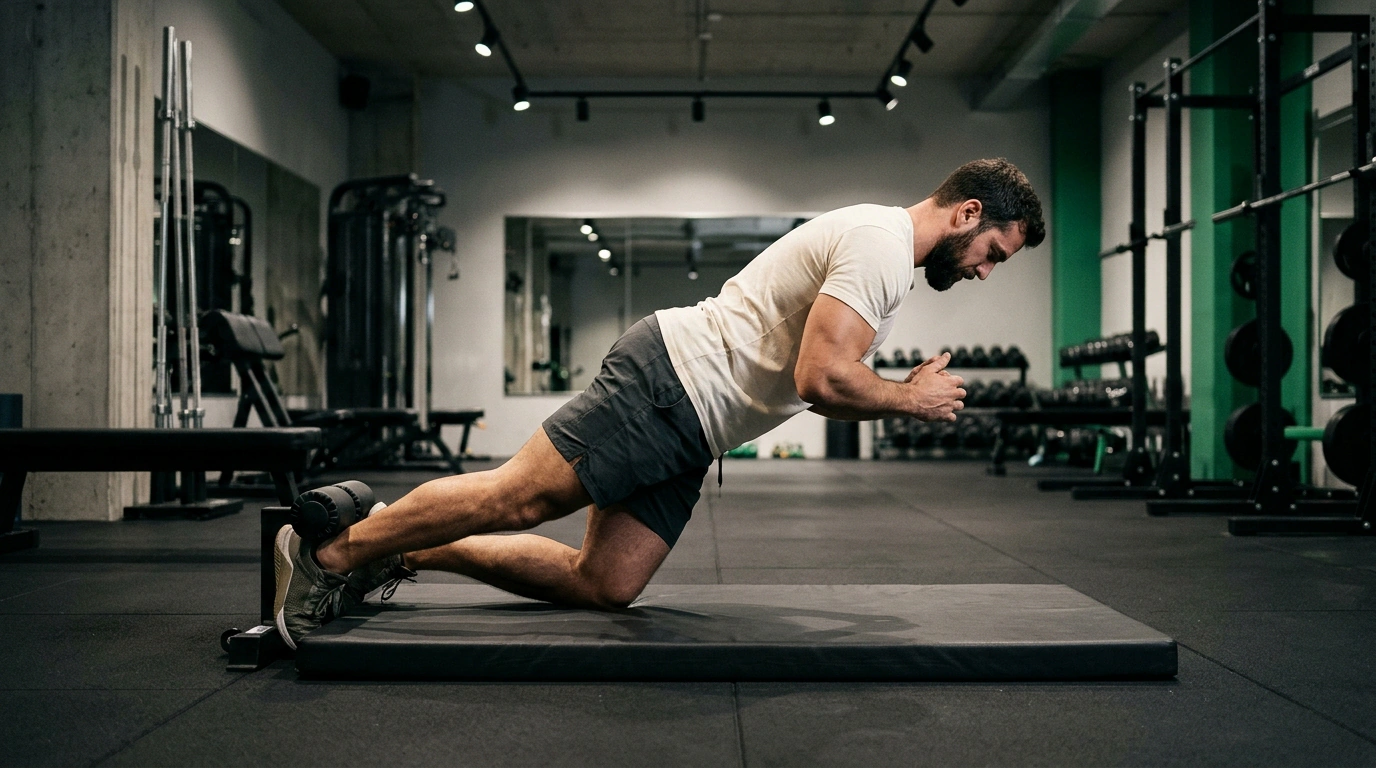
Look at the average guy's leg day at the gym: barbell squats, leg press, and leg extensions. The quads take a massive beating, while the back of the legs (biceps femoris, semitendinosus, and semimembranosus) are lucky to get three half-hearted sets on the lying leg-curl machine.
That builds a nasty strength imbalance: overpowering quads yank the knee joint forward while weak hamstrings can't stabilize it. The result? Chronic knee pain, pulled hamstrings on any sudden sprint, and legs that look flat from the side.
Calisthenics coach Daniel Vadnal (FitnessFAQs) points to one undisputed king for posterior-chain strength: the Nordic Hamstring Curl.
Eccentric Overload: Data from the British Journal of Sports Medicine
Why does sports medicine rate the Nordic curl as the gold-standard hamstring builder?
A major meta-analysis in the British Journal of Sports Medicine (including work by Jesper Petersen) proved that adding a Nordic hamstring protocol cuts hamstring tears and strains in athletes by 51%.
The secret lies in massive eccentric overload. As you slowly lower a rigid torso toward the floor with your ankles locked down, your hamstrings have to fight gravity while lengthening under huge mechanical tension. That drives longitudinal muscle growth (sarcomerogenesis), lengthening muscle fascicles and making your hamstrings downright bulletproof.
- Lock your ankles tight. Hook your heels under an ab-bench roller, stall bars, or have a training partner pin your ankles down with their full weight. Always put a thick pad or mat under your knees.
- Keep your hips neutral and straight. The #1 mistake is hinging at the hips and sticking your butt back. Your body from knees to head should form one rigid straight line—squeeze your glutes and brace your abs hard.
- Slow 3–5 second descent. Lower yourself as slowly as possible, fighting gravity purely with your hamstrings until your palms catch the floor at the bottom.
Step-by-Step Progression for Beginners
Roughly 95% of men can't lower down and pull themselves back up cleanly with zero hand help on day one—and that's completely normal. Work through a smart progression:
- Level 1: Eccentric-only with a push-up assist. Take 3–4 seconds to lower under control, catch yourself gently at the bottom like a push-up, and give a light press off the floor to return to the start. Only train the lowering phase at first.
- Level 2: Resistance-band assist. Anchor a heavy band behind you at waist height and loop it around your chest. The band takes load off at the bottom so you can pull through a full rep.
- Level 3: Full unassisted reps. Lower and rise purely on hamstring power.
Hit Nordic curls twice a week for 2–3 sets of 4–6 clean reps. Don't chase high volume—eccentric stress runs deep, and your tendons and muscles need up to 72 hours to recover fully. Strong, sculpted, injury-proof legs are worth every rep.