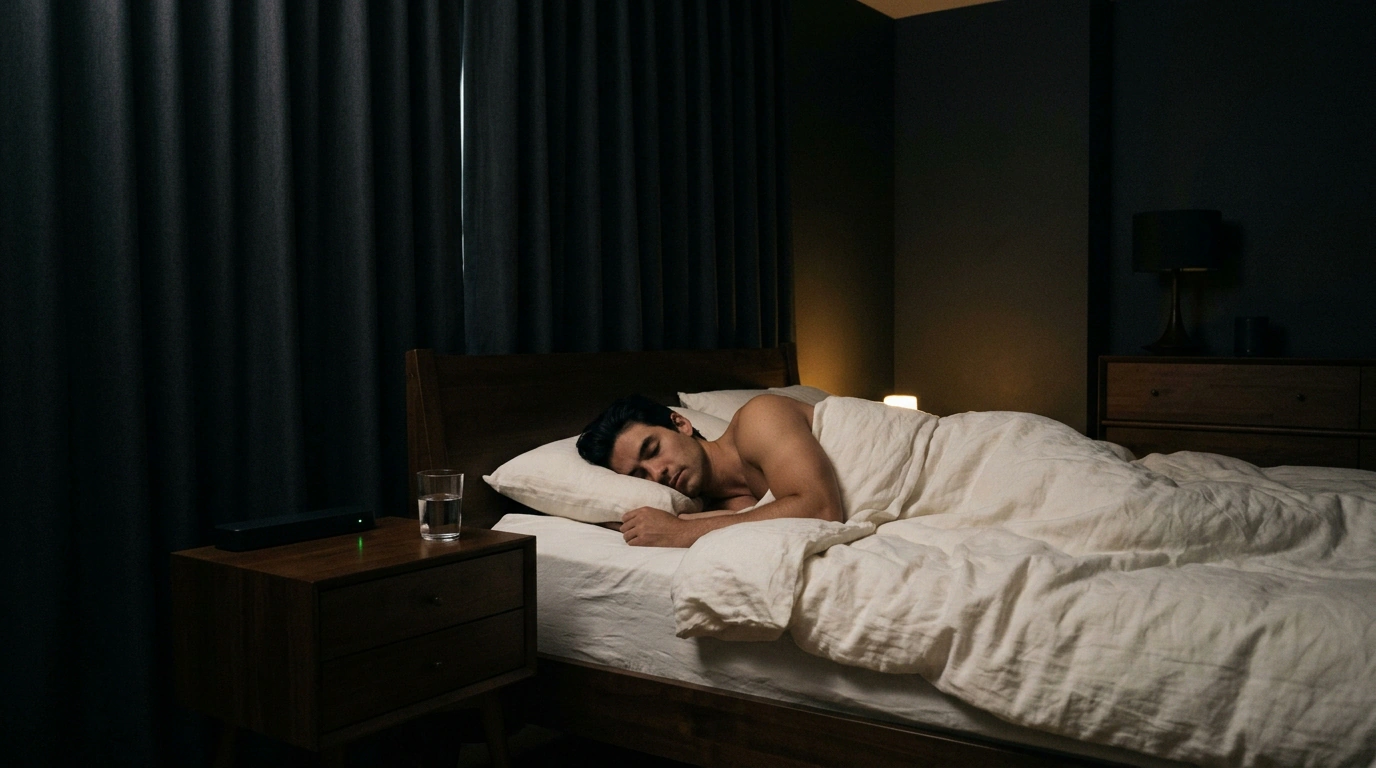
You can hire the sharpest coach, weigh every gram of protein, carbs, and fats in meal-prep containers, stock up on creatine and whey isolate, and train until your calluses tear. Yet if you're sleeping five and a half hours a night—scrolling feeds until two in the morning before a merciless 7 a.m. alarm—you're flushing most of that gym work straight down the drain.
Most guys genuinely assume: "Muscles grow from lifting, and sleep is just how I avoid crashing during the day. I'll catch up on the weekend!"
Let's be real: that is one of the worst biological myths in fitness. Dr. Mike Israetel of Renaissance Periodization puts it bluntly: chronic sleep debt wrecks male body composition and stalls hypertrophy harder than skipped workouts or sloppy diet days.
Nedeltcheva's Experiment: Where Weight Actually Comes From on Short Sleep
To see the scale of the damage, look at a landmark clinical study led by Dr. Arlet Nedeltcheva, published in Annals of Internal Medicine.
Researchers put two groups of dieting adults on the exact same moderate calorie deficit with identical total calories and equal protein intake. The only variable was sleep duration:
- Group one slept a full 8.5 hours a night.
- Group two slept 5.5 hours a night (a typical big-city workweek schedule).
After two weeks, the bathroom scale looked deceptively identical: both groups lost right around 3 kilograms of total body weight. Then the researchers ran precision DEXA body-composition scans—and the lab went dead silent.
In the 8.5-hour group, over 50% of the weight lost was pure body fat, while lean muscle mass stayed almost completely intact. In the sleep-deprived 5.5-hour group, 60% of the weight lost came straight from skeletal muscle, and a miserable 20% came from fat! Short sleep literally forced the body to burn its own muscle tissue for fuel while locking down fat stores.
See what that means? On chronic short sleep, every "cutting" phase turns into self-cannibalization of your muscle frame—leaving you softer, flatter, and squarely in skinny-fat territory.
The Hormonal Wreck: Testosterone, Cortisol, and Insulin Resistance
Why does sleep control anabolism so ruthlessly? Because short sleep triggers a cascade of neuroendocrine breakdowns:
- Free testosterone crashes. University of Chicago research showed that cutting sleep to 5 hours a night for just one week drops daytime testosterone in healthy young men by 10–15%—the endocrine equivalent of aging 10 to 15 years overnight.
- Catabolic cortisol spikes. Chronic sleep debt drives baseline cortisol up. Cortisol directly inhibits the mTOR signaling pathway (your main trigger for muscle protein synthesis) and switches on proteasome enzymes that break muscle protein down into amino acids.
- Growth hormone (GH) gets choked off. Roughly 70–80% of daily growth hormone pulses out from the pituitary during deep slow-wave sleep (stage N3). Cut sleep short or keep it shallow, and you chop off the exact recovery peak your tendons, joints, and muscle fibers rely on overnight.
- Insulin sensitivity drops sharply. Studies show just 3–4 nights of short sleep cut muscle-cell insulin sensitivity by 20–25%. Instead of packing glucose into muscles as glycogen, your body shunts more of it toward fat storage—leaving muscles looking flat, soft, and weak.
- Leptin and ghrelin flip. Satiety hormone leptin drops 18% while hunger hormone ghrelin jumps 24%. Your brain panics and demands fast sugar and greasy food, setting up diet blowouts.
Under chronic sleep debt, your central nervous system's ability to fire high-frequency motor signals drops 15–20%. The barbell feels welded to the floor, form breaks down, and your risk of tweaking a tendon or blowing out your lower back on deadlifts shoots way up. Meanwhile, adenosine builds up in the brain, creating heavy brain fog. Caffeine only parks on adenosine receptors for a couple of hours—it never erases actual neural fatigue.
Sleep Hygiene for Lifters: 5 Non-Negotiable Rules
Mike Israetel lays out a simple baseline protocol for any guy chasing a strong, lean, athletic build:
- The 8-hour darkness rule. Stay in bed at least 8–8.5 hours so you actually bank 7.5–8 hours of real sleep.
- Total blackout. Use 100% blackout curtains or a comfortable silk sleep mask. Even faint streetlight leaking through closed eyelids suppresses melatonin output.
- Cool room (18–19°C). Your core temperature has to drop by 0.5–1°C to enter deep restorative sleep. Hot, stuffy bedrooms lock you into light, fragmented rest.
- Digital sunset 60 minutes before bed. Shut down laptops, put the phone away, and kill the TV. Blue screen glare tricks your circadian clock and pushes sleep onset back by up to two hours.
- Caffeine curfew. Have your last coffee or pre-workout 8–10 hours before bed. Caffeine's half-life in blood plasma runs 5 to 7 hours.
If life hits hard and you get stuck with a rough night, use a tactical Power Nap: 20–25 minutes before 3:00 p.m. That clears excess adenosine without dropping you into deep sleep inertia, salvaging your evening session.
Training only sends the signal for muscles to grow—actual growth and fat loss happen while you're asleep. Treat deep sleep like your strongest legal anabolic, and your gym progress will jump to another level.