Should you go on dates and build a relationship if your own head is still a bit of a mess? Popular social media advice sounds tidy: work through every trauma alone, stand firmly on your own feet, and only then open dating apps.
Real human psychology rarely works that neatly. Psychiatrist Alok Kanojia, better known as Dr. K from HealthyGamerGG, unpacked this dilemma using real-life scenarios in a mental health meme review. Some inner cracks truly only heal in contact with another person—the real question is whether you're building healthy support or propping up a house of two falling cards.
Anxious Attachment vs. Codependency and the 'One-Month Test'
Guys often treat relationship anxiety and codependency as the same thing, even though they run on different mechanics. With anxious attachment, you get hit by the fear that she'll pull away or lose interest at any second. You might obsessively check your texts when she hasn't replied for three hours and replay worst-case scenarios. Still, your own identity stays intact: you keep your friends, work, hobbies, and a clear sense of who you are on your own.
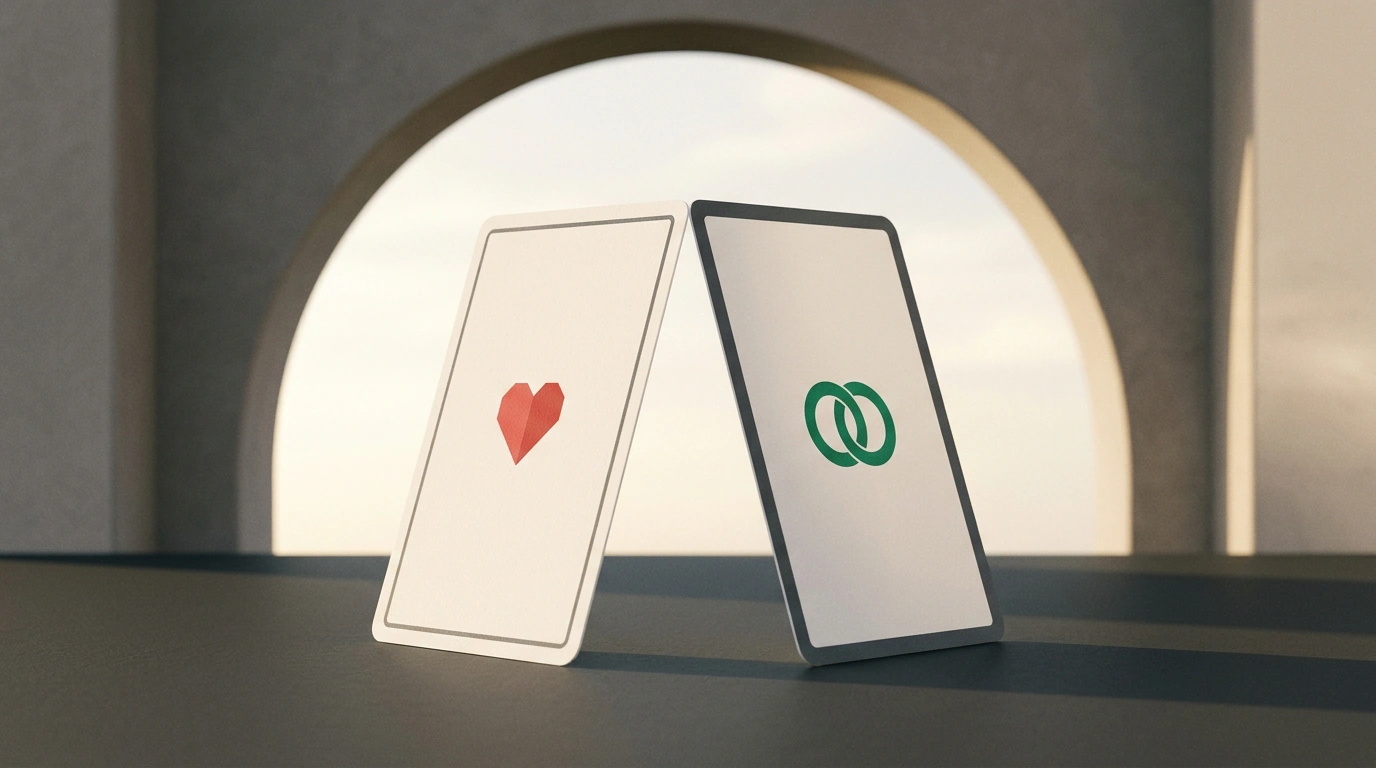
Codependency cuts deeper and shuts down autonomy. In that kind of bond, both partners outsource their emotions, mood, and sense of self to each other. You end up with two incomplete people: half of you dissolves into the relationship, and half of her does too. Dr. K paints a vivid picture: take two playing cards and lean them against each other like a tent. They stay upright only while touching; pull one away, and the other collapses flat onto the table.
A simple benchmark separates that dynamic from a normal partnership. Healthy couples almost always share interdependence—a practical division of roles where two independent adults handle different parts of daily life. Maybe you pay the bills while she waters the plants, or she handles dinners while you manage trips and finances. Splitting chores on its own means nothing unhealthy.
To see where you actually stand, Dr. K suggests the "one-month test." Picture one of you getting sick and sidelined for thirty straight days. Could the other person handle basic daily life without panicking or falling apart? In a healthy couple, the answer is a solid yes because both partners grow more capable over time. Say she did all the cooking at first, yet over a year you helped out, learned a few simple dishes, and took over the kitchen one night a week. In codependency, the arrow points backward: every month you cope worse alone and lean on your partner more like a crutch.
| Criterion | Healthy Interdependence | Codependency |
|---|---|---|
| Reaction to distance or a pause | Grounded in yourself: you can miss her while keeping your footing | Spiral into panic and lose track of who you are without her |
| Sharing daily tasks | Practical role balance where both pass the 'one-month test' | Even basic everyday routines collapse without the other person |
| Trajectory over time | Each partner grows more capable and learns from the other | Autonomy shrinks while reliance on the partner deepens |
Hyper-Independence: Why You'd Rather Stuff a Cup in Your Backpack Than Ask for Help
At the opposite end from merging sits a trap that confident-looking guys fall into all the time: hyper-independence. On the outside, a guy like this looks rock-solid, handles everything solo, and never bothers anyone. Inside sits a strict ban on accepting any support.
Two memes in Dr. K's breakdown nail this pattern. The first reads like a bitter joke: "So to get help I have to tell people I need it and actually let them help me? Sounds like a scam." The second hits everyday life even harder: "Therapist: you're afraid of being a burden. Me: puts an empty coffee cup in my backpack instead of asking where the trash can is."
Asking for help is built into humans from birth. A baby doesn't feel shy screaming across the house when hungry and fully expects adults to respond. If a grown man insists on carrying everything alone and can't ask for a tiny favor, he was trained into that habit in childhood. Most often, the root is emotional neglect: his requests were ignored, met with irritation, or handed back with a guilt trip like "now you owe me."
Inconsistent help cuts even deeper—getting rescued today, then abandoned or blamed tomorrow. Dr. K compares it to a friend who promises to drive you home from work yet flakes half the time. After a couple of weeks, your brain draws a completely rational conclusion: relying on someone who lets you down hurts worse than just walking from the start. That's how a kid learns to "be invisible" and absorbs the rule that having needs creates trouble for everyone else. In adult relationships, that guy stays quiet until he burns out and pushes his partner away when she genuinely tries to support him.
Can a Partner 'Fix' You—and the 'Broken Profile' Trap
Let's circle back to the main question through one more meme from the episode: "My dating profile doesn't work, but it might be fun to fix." Behind that joke lies a real paradox of relationship psychology. Humans are social creatures, so some old wounds only close through warm, steady contact with a real partner. Sitting alone with a journal in a vacuum simply cannot give you that experience.
Dr. K explicitly calls being with a securely attached partner one of the strongest evidence-backed ways to heal anxious or avoidant attachment. That means someone who speaks directly, doesn't vanish to play silent-treatment games, and handles your emotions without running away. Research backs this up. In the 23-year Minnesota Longitudinal Study, Glenn Roisman and colleagues (Roisman et al., 2002, Child Development) documented earned security. Adults who grew up in tough homes, made sense of their past, and built steady bonds went on to form marriages just as strong—and parent just as well—as people who were securely attached from childhood.
Another study of young couples (Roisman et al., 2010, Developmental Psychology) went beyond surveys and measured physical stress during live disagreements, including skin conductance. Secure attachment helped couples argue constructively and measurably lowered physical stress. In Simpson and Roisman's work, this is known as the partner buffering effect: having a consistent, emotionally available person beside you literally helps rewire anxious beliefs about the world.
Still, this healing mechanism has two hard limits where trying to "get fixed by dating" backfires.
The first limit is the severity of your current state and personal responsibility. If someone is currently battling active addiction, frequent meltdowns, or zero impulse control, entering a relationship for "therapy" is a bad idea. Dr. K stresses that a partner deserves a healthy bond rather than a full-time caretaker role, or both people end up hurt. Roisman's 2002 longitudinal data also adds an important nuance: even adults with earned security often keep a higher baseline sensitivity to inner distress and low moods. A good relationship acts as a buffer, yet it doesn't erase your past at the push of a button.
The second limit shows up right inside dating apps and explains why a bio pitching "I'm a mess, but I'm fun" still pulls matches. When a guy feels broken, insecure, or behind his peers—say, after a year of depression and unemployment—the thought of meeting a grounded, put-together woman triggers real fear. One script loops in his head: sooner or later she'll "wake up," see all your cracks, realize she's way out of your league, and walk away.
So the brain finds a clever workaround: why take that risk when you can pick someone in "your own league" who feels just as shaky? Two people match because neither has to feel weak next to someone equally bruised. Early on, that brings a deceptive sense of safety, even though the foundation is mutual insurance against rejection and loneliness. Instead of healing, both partners quickly end up right back as those two playing cards, standing only until the first gust of wind.
