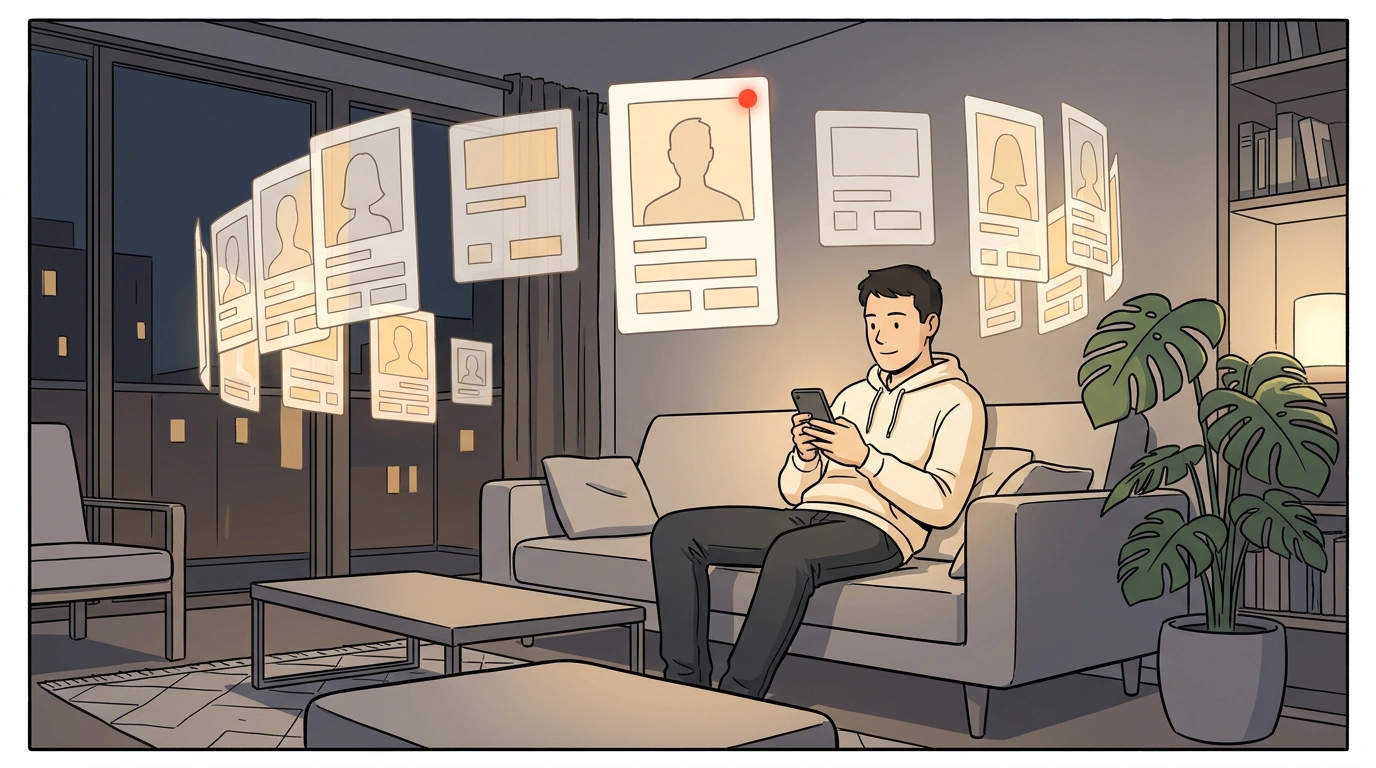
It's a weekday evening. You drop onto the couch, open a dating app, and start swiping on autopilot: left, left, right. It feels like you're just browsing profiles. Behind the scenes, a tricky shift happens: your brain switches from real-life socializing to online shopping mode, where every woman has a price tag made of five photos and two lines of bio.
Writers at the men's outlet The Modest Man summed this up sharply in their piece "19 Harsh Truths About Love in the App Era": apps promised to make dating easier, yet they poured fuel on the fire. On paper, it sounds like a dream. Hundreds of women within a couple of miles, just pick and ask out for coffee. In real life, it often turns into the opposite: tons of matches, five chats running at once, zero real dates, and the feeling that anyone can toss you in the trash in one second. Here's how this system works from the inside and how to play it on your terms.
Window-shopping mode and why endless choice blocks choosing
When an endless feed of faces sits in front of you, the paradox of choice kicks in. Having too many options doesn't help you find "the one." It stops you from committing to anyone. You're chatting with a cute girl, things are going well, yet a quiet thought keeps nagging in the back of your head: "What if the next swipe is even better?" As a result, nobody seems good enough, and you don't invest fully in any single conversation.
Psychologists Tila Pronk and Jaap Denissen from Tilburg University in the Netherlands tested this effect. In their study, people browsed a series of online dating profiles, and with each new card, a rejection mind-set kicked in. The chance of liking a profile dropped by an average of 27% from the first option to the last. A tired brain stops looking for reasons to say "yes" and starts hunting for tiny flaws to swipe left. Bad lighting in the third photo? Pass. Weird caption? Next.
There's a second trap, too. A great photo triggers an instant spark, and it's easy to mistake that for real compatibility. Your heart jumps at a beach photo, you match, and it feels like chemistry is already there. Yet a profile shows nothing about her real-life humor, her values, or how she talks when she's tired or upset. That photo spark dies fast if you have nothing to talk about in person.
Fake closeness in chat and built-in ghosting
Now look at the most common script guys fall into. You get a match, and a lively chat starts. Jokes fly, stickers drop, and you talk about favorite shows and annoying coworkers. One week passes, then two. You feel like you've known each other forever. You wait for her texts and check your phone every ten minutes, yet you've never met once. This is the talking stage: lots of light flirting and emotions, zero real steps or commitment.
The problem is that texting is a low-effort channel. Text has no tone of voice, facial expressions, eye contact, or clues about how someone acts in everyday life. On a profile, you're not seeing lies, just clean marketing: best angles, cool hobbies, and a sharp bio joke. The Modest Man gives a realistic estimate: a profile shows at most 20% of the real person, while the other 80% only appears in person. When you stay in chat for weeks, your brain fills in that missing 80% using your own fantasies. You're not falling for her. You're falling for a character you invented.
Then she simply vanishes. Your messages sit on "read," or the chat disappears from your list altogether. Dropping communication without warning is called ghosting, and getting mad at it is like yelling at rain. Ghosting is built right into how apps work. You share no mutual friends, no campus, and no office. The cost of disappearing is zero: close the chat, and it's as if you never existed. Demanding a "honest final talk" from a stranger makes no sense. If a woman fades out after two days of texting, it's not a verdict on you. It's just the normal cost of a platform where connections cost nothing.
Algorithms, 'dead' profiles, and the price of the comfy couch
Why does it so often feel like the game is rigged? Because dating apps are built to maximize your screen time, not your happy love life. If you find a great partner fast and delete your account, the app loses a customer. That's why algorithms push the most popular photos and most active users to the top. Surface filters like looks, height, age, and visible status get blown out of proportion, while real-life male traits like calm confidence, voice, wit, and reliability barely show through a screen.
Add digital noise on top. A huge share of profiles in the feed are "dead": people deleted the app long ago without deleting their account, or they log in once a month out of boredom. You spend time writing a clever opener and compete for the attention of someone who isn't even online. Another chunk of users browse just for fun between tasks: collecting likes, boosting their ego, or killing time on the train with no intention of meeting anyone.
In response, many guys play a numbers game and juggle five to seven chats at once. On paper, it sounds "efficient." Something has to land, right? In practice, your focus splits, you forget who loves dogs and who flies to St. Petersburg, and dating turns into a second shift after work. Psychologists call this dating fatigue. According to Forbes Health surveys, around 75–80% of active users hit this swipe burnout: repetitive "how's your day?" openers, ghosting, and constant judging drain all the excitement out of it.
And here is the hidden price of staying on your couch: while you hide behind filters and rehearsed chat lines, your real-life social skills get rusty. Before long, the simple idea of walking up to an attractive woman in a coffee shop and saying a few words without a screen between you starts to feel terrifying. The benefit is saving two minutes and avoiding direct rejection. The price is losing confidence in the real world, where true chemistry actually happens.
Rules of a healthy game: taking control back
To avoid burning out in this grinder, you have to change your approach. The Modest Man offers a simple guideline: treat the app like a work tool, not an all-you-can-eat buffet. Log in, make a clear move, and log out without spending two hours scrolling at night.
Five Hygiene Rules for Dating Apps
- Keep 1–3 active chats instead of five. Fewer chats mean more focus and real energy for each woman. Set a time limit for swiping so your brain doesn't slip into a 'rejection mind-set.'
- Move to a real date within 1–2 weeks. Even sooner is better once the chat flows well. Don't feed an endless talking stage: if she keeps dodging a clear coffee invite, that's not shyness, it's mismatched goals.
- Filter by actions, not promises. Don't try to revive a dead chat all by yourself. Match the effort of women who ask questions back, keep the rhythm, and are ready to schedule a meetup.
- Separate your self-worth from likes and silence. A vanished match almost never says anything about your value as a man. Usually it's just her busy week, fatigue, or better timing in another chat.
- Practice real-life contact off-screen. Don't put all your dating eggs in one algorithm basket. Start short, natural chats in coffee shops, at the gym, at events, and in new social groups.
The strongest move is to stop seeing apps as the only place where great women exist. When you can easily trade a few friendly lines with a woman in line for coffee, feel relaxed in a new group, and stop caring how many notifications popped up this morning, swipes take their proper place. They stop controlling your mood and work simply as one extra channel that creates reasons to meet in real life.