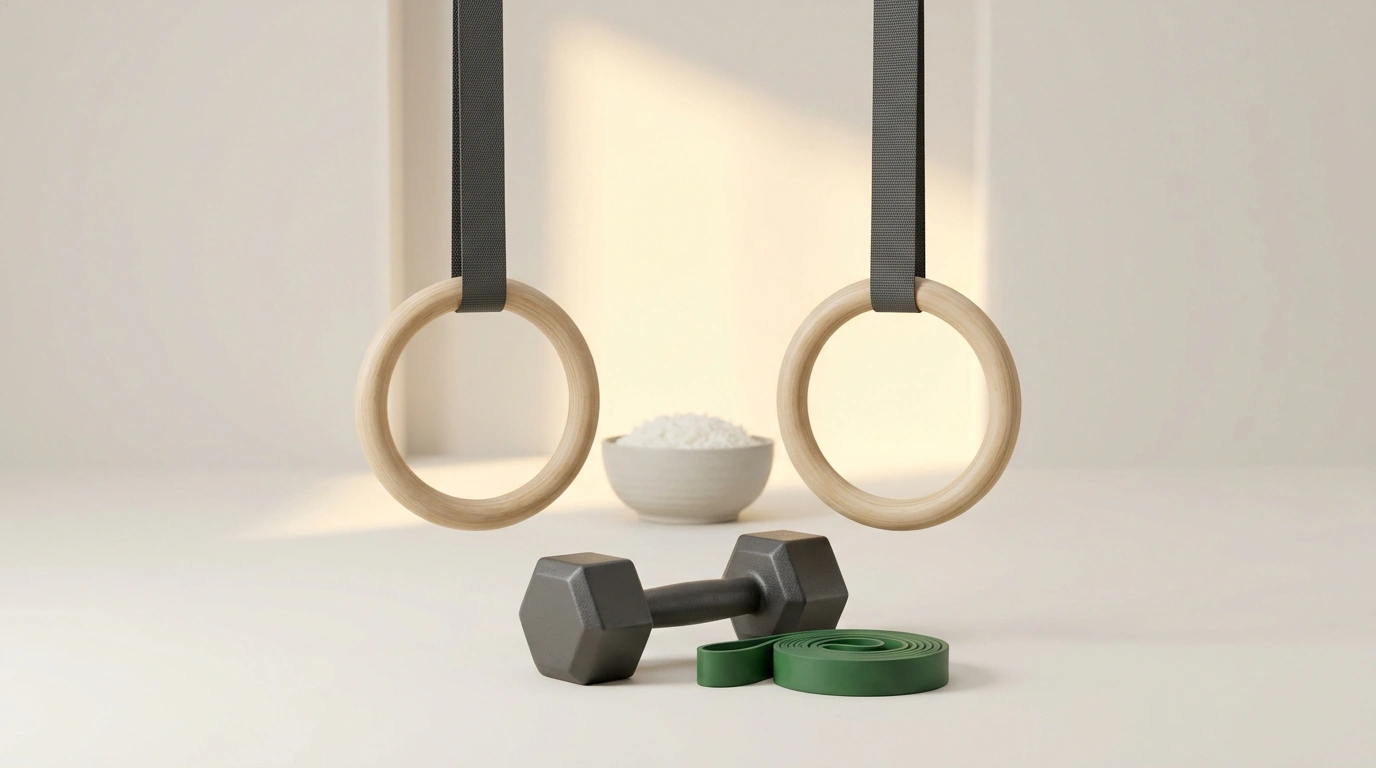
"I could get you leaner on a diet of nothing but protein shakes and ice cream — if you simply controlled your portions," sports scientist Dr. Mike Israetel says in response to the endless debate over "clean" rice. Blunt, yet dead on. When you decide to get in shape, fix your posture, and boost daily energy, the first few weeks often get wasted on empty noise: shopping for trendy gear and fighting over "clean" carbs. Below are two level-headed breakdowns that cut the fluff and leave only what actually works at home.
A home gym under $100: start with pulling, not cheap gadgets
At first, a hundred bucks looks like a great excuse to fill your cart with random gear: a couple of resistance bands, an ab roller, and a cheap pull-up bar that just hooks over a doorframe. In reality, half of that stuff gathers dust under your bed within a month, and your back still gets zero real work.
Hampton from Hybrid Calisthenics advises putting quality over quantity on a tight budget and fixing the biggest weak spot of no-gear training: pulling exercises. These are moves where you pull your body toward a bar or pull weight toward yourself, like pull-ups and horizontal rows. You can do push-ups and squats right on the floor, yet you can barely train your back, rear shoulders, biceps, or posture properly without something solid to pull on.
On hook-over doorframe bars, Hampton is completely blunt: "I know they're cheap and tempting, but I've literally seen people fall off them." Spend most of your budget on gear that won't rip off the frame on your third rep:
- Gymnastics rings are ideal if you have a sturdy bar at home or at a nearby park to hang them from. Rings cover vertical pull-ups, horizontal rows, dips, and core work.
- A screw-in doorway pull-up bar costs about the same as a hook-on bar, yet if you can drill into the frame and mount it solidly, it holds much more safely.
- A freestanding pull-up tower is sturdy, though it eats up floor space and usually only fits a $100 budget secondhand. If your room is tiny, tall dip bars (parallettes) can work as a backup.
Once pulling is covered, spend what's left on focused extras. One solid dumbbell or kettlebell (a dumbbell is usually cheaper) won't be super heavy, yet it's great for finishing off smaller muscles like shoulders and arms. If you still have cash left, grab a resistance band. It helps you learn your first clean pull-ups and works great for warm-ups and joint care. Hampton's final tip stays grounded: "Rings, a dumbbell — and if there's change left, buy some water."
Buying Priorities on a $100 Budget
- First, get a solid anchor for pulling: gymnastics rings or a firmly mounted doorway pull-up bar.
- With the rest, buy one good dumbbell or kettlebell for isolated shoulder and arm work.
- If change remains, pick up a resistance band to assist pull-ups and support joint warm-ups.
White vs. brown rice: why arguing over 'clean carbs' distracts from results
The exact same thing happens with food: people miss the basics and obsess over tiny details. Renaissance Periodization co-founder Dr. Mike Israetel says people carrying noticeable extra weight regularly ask him which rice is better for fat loss, white or brown. The hope is obvious: swap your side dish for the "right" one, and abs will appear.
Reality is much simpler. Israetel cuts through the illusion with a funny exaggeration: if someone eats roughly "18,000 calories" in two days, their carb source changes nothing at all. His line about protein shakes and ice cream isn't advice to live on dessert (you still need solid protein, veggies, and micronutrients for health). It's a sharp reminder of energy balance. Until you control total food volume, the type of grain is just background noise.
To check this claim calmly, just look at USDA FoodData Central numbers for cooked rice with no oil or salt:
| Nutrient (100 g cooked rice) | White rice | Brown rice |
|---|---|---|
| Calories | ~130 kcal | ~112–123 kcal |
| Fiber | 0.4 g | 1.6–1.8 g |
| Carbs | 28.2 g | 23.5–25.6 g |
| Protein | 2.7 g | 2.3–2.7 g |
| Fat | 0.3 g | 0.8–1.0 g |
The calorie gap here is tiny — one extra spoonful of sauce or oil wipes it out completely. Brown rice does pack more fiber and keeps you full a bit longer, yet if you're overeating overall portions, that small edge disappears.
So who actually needs to care about rice color? Competitive bodybuilders during carb loading, a short protocol one or two days before stepping on stage when they eat massive amounts of carbs (Israetel mentions 1,200 g) to fill out muscles without bloating their stomach. At that extreme level, digestion speed matters: brown rice sits heavier, while white rice clears faster.
For a regular guy, Israetel compares the rice debate to fueling a daily driver car: "Just pump regular gas! You're not driving a Formula 1 car. Your engine won't blow up, and you won't owe $12,000 for a spark plug because you used the 'wrong' fuel." Eat whichever rice tastes better and feels best on your stomach, and watch your portion size. That single habit delivers results far faster than arguing over grains.