You're getting ready for a date or an important meeting. You put on a sharp blazer, a fresh turtleneck, wipe down your leather boots, and check the mirror: everything fits clean. Then, in the hallway, you throw an old sporty puffer jacket over it. Just like that, all your outfit work goes straight down the drain.
Stylist Andrey Mayfair puts it bluntly in his breakdown of classic men's coats: a shapeless puffer over a blazer or suit instantly turns a put-together guy into "a schoolboy or someone heading to a garden plot." The issue isn't only how it looks from the outside. Narrow armholes and soft jacket padding literally crush a blazer's shoulder line. The fabric wrinkles, the lapels twist, and when you take your jacket off indoors, you already look rumpled.
A puffer is unbeatable at minus twenty or out in the country. Yet in the city during cold weather, your outerwear decides within three seconds whether people see you as a confident, well-groomed man or just a random passerby.
Right away, the usual excuse pops up about "harsh winters with freezing frosts." Let's do basic calendar math. In mild and temperate climates, transitional seasons stretch out: at least two months in fall, two months in spring, plus mild winter thaws. That means you can easily wear a coat for four months a year, a full third of the calendar. As Mayfair fairly asks in his companion post, is that really not enough?
The real issue is different: many guys tried on the first random coat they saw at a fast-fashion store, saw a sack or a stubby cutoff in the mirror, and decided "coats aren't for me." In truth, you just need to pick one of five proven cuts that matches your actual wardrobe.
Five men's coat styles for different lifestyles
The biggest mistake is buying a coat that doesn't match the clothes you wear every day. If your closet holds three hoodies and two pairs of jeans, a strict suit coat will gather dust on a hanger. Here is how five core silhouettes split up city life:
| Model | Who and where it fits | What to wear it with | Key feature |
|---|---|---|---|
| Single-breasted structured | Business meetings, classic style | Suits, blazers, dress trousers, oxfords, derbies, Chelsea boots | Firm shoulders frame your posture; knee-length or longer |
| Peacoat | Drivers and casual wear | Heavy jeans, turtlenecks, chunky boots | Short double-breasted cut, doesn't bunch up while driving, double chest layer |
| Raglan coat | Street style to office | Oversized hoodies, sweatshirts, blazers, flannel suits | No shoulder pads; sleeve and shoulder cut as one piece |
| Duffle coat | Smart-casual and preppy | Corduroy, jeans, chinos, thin liner puffer in deep cold | Only classic wool coat with a historic hood and toggle buttons |
| Double-breasted polo / ulster | Bold, standout style | Tailoring and confident smart-casual | Double row of buttons, deep overlap, wide peaked lapels |
Now let's look under the hood of each cut so you don't get lost in terms at the rack.
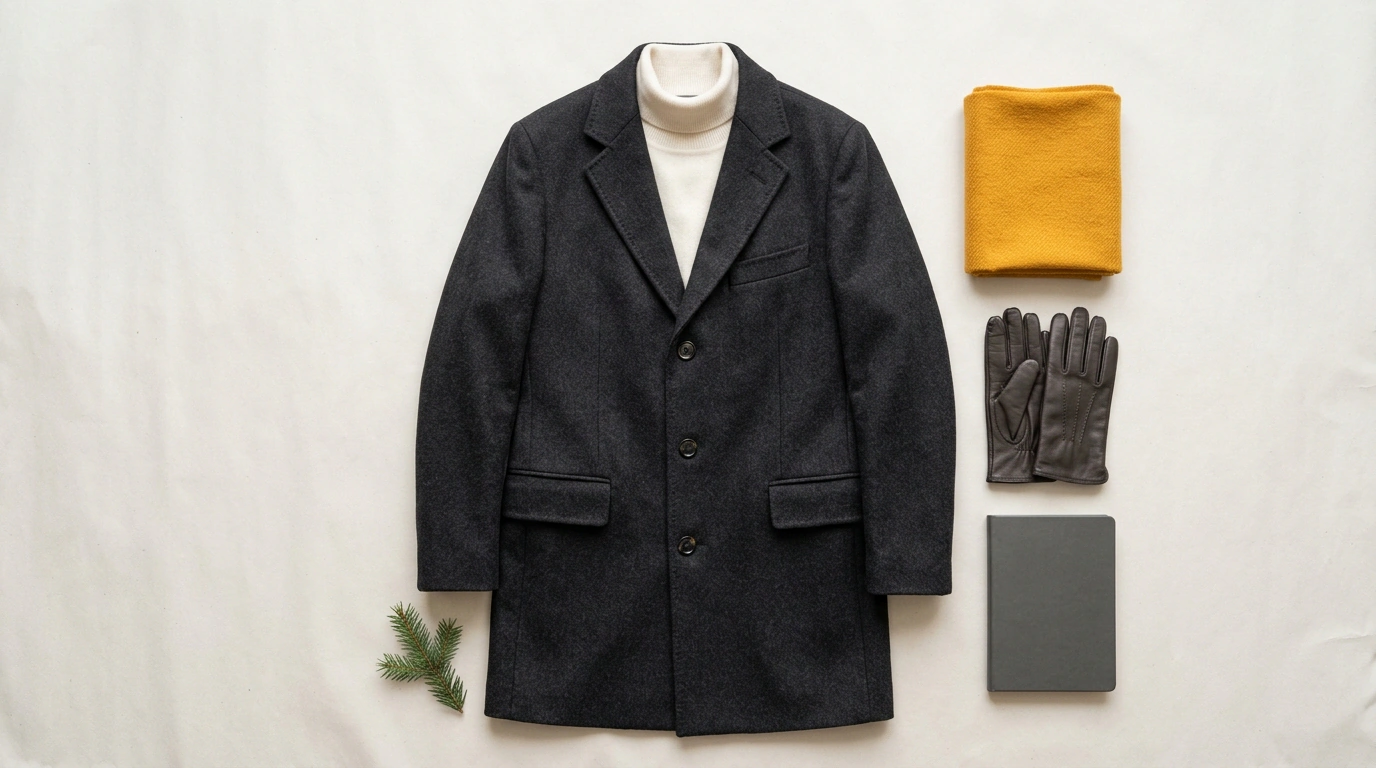
Single-breasted with structured shoulders is the true foundation. "Structured shoulders" mean firm internal padding that holds a crisp upper line. Even if you don't live at the gym five days a week, this cut straightens your posture and gives you a more athletic frame.
Forget oversized fits here: this style should follow your body cleanly. Go for navy, charcoal gray, or brown. For a slightly softer look, light gray herringbone works great. Mayfair advises skipping black, though: dark navy always looks richer and more alive.
The peacoat is a lifesaver if you drive a lot and don't wear blazers every day. It's a cropped double-breasted wool coat with wide lapels, born in the British Royal Navy. Long coat tails get in the way behind the wheel and crease at your lower back, while a peacoat sits short and neat.
Its naval roots give it a masculine silhouette and a double layer of thick fabric across the chest to block wind. The classic color is navy blue. Pair it with heavy jeans, a high-neck sweater, and sturdy boots, though cleaner shoes work fine too.
The raglan coat is the most underrated option on the street. A "raglan sleeve" means there's no stiff shoulder seam or padding: the sleeve is cut in one continuous piece with the shoulder, sloping smoothly from the collar.
It sounds like a tiny tailoring detail, yet in real life it solves a major headache. Raglan is the only coat that naturally fits over a bulky hoodie or an oversized sweatshirt. Tomorrow, you can throw the exact same coat over a blazer or flannel suit, and it still looks sharp. If you want one coat for everything, start by trying on a raglan.
The duffle coat is another nod to the British Navy and the only classic wool coat with a traditional hood. You can spot it in one second by its large wooden or horn toggle buttons shaped like tusks on rope loops. A duffle coat easily replaces an everyday casual jacket, pairs well with corduroy, chinos, and jeans, and leaves room to layer a thin down liner underneath in freezing weather.
Double-breasted polo or ulster coat is top-tier style. It features two rows of buttons, a deep front wrap, and wide peaked lapels. This cut takes confidence because you can't blend into the crowd in it. Pop the collar on a windy evening, and you'll turn heads effortlessly.
Three anti-trends that make a coat look cheap
According to Andrey Mayfair, up to eighty percent of men look awkward in coats not because of their build, but because they fall for the same three fast-fashion traps. You can spot and skip them before even reaching the rack.
Short coats that aren't peacoats. Cropped single-breasted coats cut your body proportions in half and rarely sit right. As Mayfair bluntly notes, brands put them on shelves out of sheer greed to save fabric.
Hybrids with sewn-in knit hoods, zippers, or zip-out bibs. Trying to mash a tailored coat and a sweatshirt together always looks cheap and tasteless. Want a hood? Buy a duffle coat or wear a separate thick hoodie under a raglan. Want full zipper wind protection? Buy a proper casual jacket and skip the hybrids.
'Plastic' synthetic blends. Cheap polyester doesn't breathe, pills quickly, and looks low-grade. A decent coat uses merino wool, cashmere, alpaca, or camel hair. For perspective on the industry ceiling, the rarest cloth is Peruvian vicuña, where a three-meter cut costs 3–5 million rubles. You don't need anything that extreme, of course, but the rule is clear: the base must be wool.
Dodging those three traps is half the battle. Next, check the care tag and nail the fit in the dressing room.
Fabric weight, blend, and fitting without mistakes
Flip over the inner label: two numbers tell you right away if a coat will keep you warm and hold its shape after two seasons.
Pure 100% wool is the classic ideal, yet for city wear there's a smart adjustment. Menswear guides like BonneGueule and Bradic agree on a sweet spot: 80–90% wool and 10–20% polyamide (nylon). A small share of polyamide doesn't turn the coat into "plastic." Instead, it reinforces high-friction areas like cuffs, pockets, and underarms, helping the coat keep its shape. Once synthetics pass 20–30%, though, the fabric breathes less and traps less warmth.
The second check is fabric weight (GSM, grams per square meter), which measures how heavy one square meter of cloth is. For a warm fall-to-winter coat that blocks wind and holds structure over a blazer, the working standard is heavy overcoat wool at 500–600 g/m² (about 15–18 oz per square yard). Mid-season coats can be lighter, but for real cold, look for dense heavy cloth.
And follow one golden rule in the fitting room: never try on a coat wearing just a T-shirt. Walk into the store wearing the exact blazer or thick hoodie you plan to layer under it in the city. Button it up and check two spots. On a classic structured coat, the shoulder seam should sit cleanly over your blazer's shoulder with no pulling or tight armholes, and the coat sleeve must cover your blazer sleeve completely (ideally 1–1.5 cm longer). If you live in bulky hoodies and a classic cut pinches your shoulders, don't size up two sizes. Switch to a raglan cut, and the fit falls right into place.