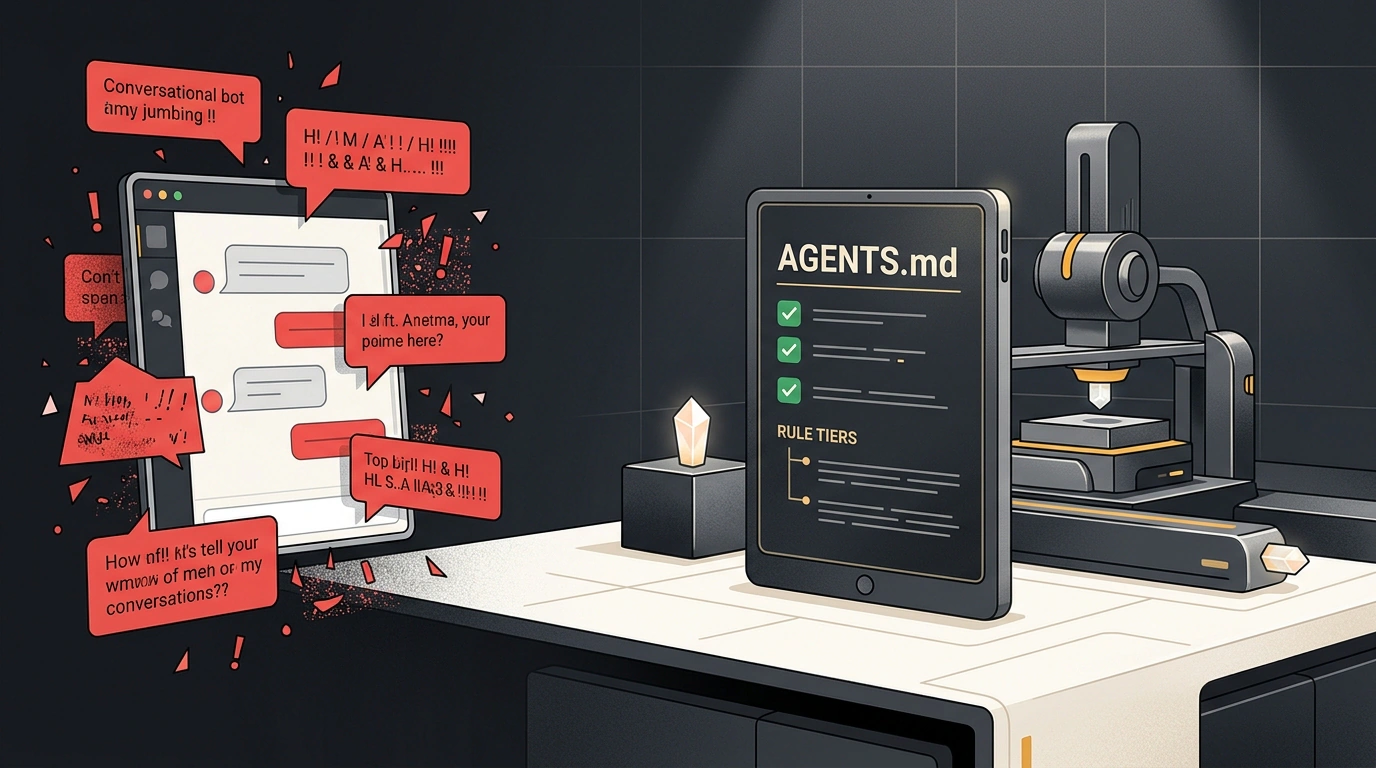
When one of the industry's most productive systems engineers—Mitchell Hashimoto, creator of Vagrant, Terraform, Consul, and the Ghostty terminal—shares how he works with AI, it pays to listen. In a detailed engineering essay, Hashimoto admits that his first attempts to bring neural networks into daily coding were frustrating. Constant switching between code editor and web chat, copying snippets, and fixing hallucinations by hand took more energy than just writing the code himself.
To turn AI from a trendy toy into a real productivity lever, Hashimoto had to rebuild his workflow from the ground up. He moved from casual chat dialogs to autonomous background agents backed by strict programmatic guardrails.
The trap of the chat window and snippet copying
The biggest mistake most programmers make is trying to collaborate with a model through a standard chatbot UI. In mature, years-old "brownfield" projects with complex architecture, chat hits a wall fast. The model can't see neighboring modules, can't run the build, and doesn't know how its solution fits the rest of the codebase. As a result, the human ends up acting as a manual bridge, pasting compiler errors back into the chat.
The first fundamental step is ditching web chats for local agentic tools like Claude Code, Cursor, or Aider. An agent must have direct access to read and edit project files, run shell commands, and call system utilities. Only then does the feedback loop close inside the machine.
Five stages of maturity: from reproducing work to overnight agents
Hashimoto's method for working with agents expands autonomy step by step:
- Reproduce Your Own Work. Before handing an agent an unknown task, give it a problem you just solved manually. Without showing your finished code, watch what paths the model takes, where it stumbles, and which tools it needs. This shows you the real limits of a given LLM without risking production.
- End-of-Day Agents. Hashimoto spends the last 20–30 minutes before logging off launching background research agents. While he rests, an autonomous script explores third-party dependency architectures, reviews open GitHub bug reports, and prepares a summary for his morning coffee.
- Outsource the Slam Dunks. Routine tasks with predictable outcomes—edge-case unit tests, standard JSON parsing, data structure migrations—go straight to a background agent while the human focuses on architecture.
- Harness Engineering. Autonomous success depends less on how smart the model is and more on how strict your rules are. An
AGENTS.mdfile in the repository root acts as a manifest of architectural constraints and check commands. - Full Parallelization. In a mature setup, a developer keeps at least one background agent running at all times, reviewing its artifacts only during breaks between deep-thinking blocks.
The AGENTS.md contract and silent automation scripts
The AGENTS.md file serves as both a technical spec and a rulebook for the repository. It locks down required validation steps and hard prohibitions:
# AGENTS.md — Project Engineering Rules

## Environment and Automated Validation
- Check for a clean repository before editing: `git status`
- Run race-detection tests: `go test -race ./...`
- Check style and linter: `golangci-lint run`

## Architectural Rules
- Do not add third-party libraries without explicit approval in the task.
- All public methods must return custom typed errors.
- Do not disable existing test assertions just to make a run pass.

## Handoff Workflow
1. Make sure all tests pass without errors.
2. Write a summary of your changes in summary.md.
The second critical piece is eliminating noise. Hashimoto stresses that pop-up notifications and alert sounds from an agent destroy an engineer's focus. Launch scripts should run quietly in the background and write output to an isolated log:
#!/usr/bin/env bash
set -euo pipefail

# Autonomous context gathering on open bugs via GitHub CLI
gh issue list --label "bug" --limit 5 --json number,title,body > /tmp/open_bugs.json

# Background agent launch without noisy interactive notifications
claude --print \
  --append-system-prompt "Проанализируй баги из /tmp/open_bugs.json, сопоставь с кодовой базой и подготовь план решений в report.md. Никаких правок в git не коммить." \
  "Выполни утренний триаж задач" > /tmp/triage_agent.log 2>&1 &

echo "Фоновый агент запущен в тихом режиме (PID: $!). Результаты будут готовы к утру."
The main lesson: why silence beats speed
Hashimoto's core insight comes down to attention psychology. An agent shouldn't be a chatty coworker tapping you on the shoulder every two minutes. The best agent is a quiet intern locked inside a solid sandbox with clear instructions and a suite of automated tests.
The human defines the architecture, sets invariants, and performs the final review, while the AI handles the rough draft. If the agent's output fails automated tests or breaks AGENTS.md rules, it gets rejected before the developer ever sees it. That approach lets you scale personal output without burning out or losing control of the system.