Almost every engineer has heard this familiar line from management during morning standup: "Deadlines are tight, let's throw together a working version tonight, ship it to prod, and refactor and add tests later." To the business, it looks like a shining example of agility and delivery speed. Behind that initial rush of a fast release, however, lies a trap that can stall product development for months.
Software architect and HowProgrammingWorks founder Timur Shemsedinov broke down the economics of development in detail. His conclusion is clear: rushing and skipping upfront design is the most expensive illusion in IT, multiplying total task costs by up to ten times.
The illusion of speed: where saved hours actually go
When a developer writes code under a burning deadline, their brain naturally grabs the first working solution it finds. There's no time to think about context boundaries, extensible data models, or isolating side effects—the only goal is closing the ticket. In the moment, a task estimated at two weeks of system design feels "conquered" in two days.
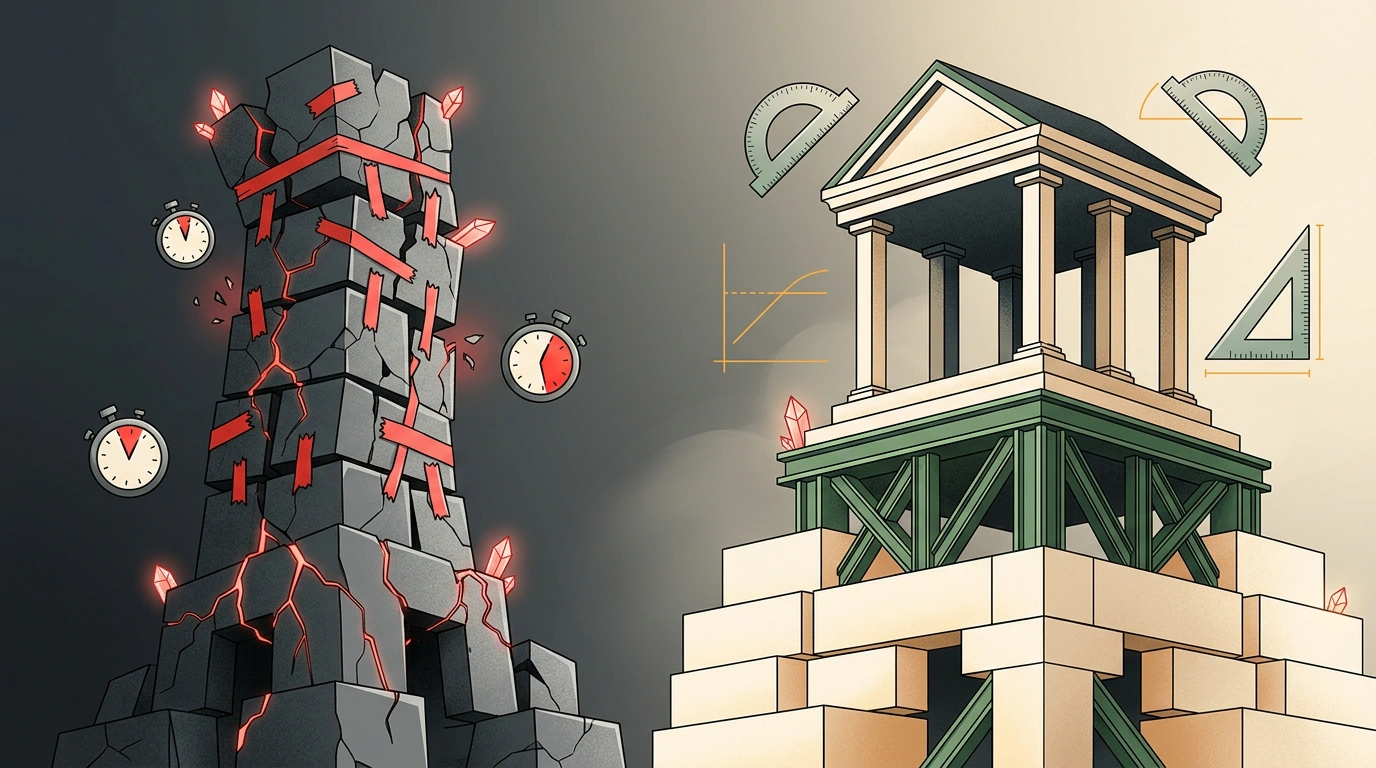
Software engineering follows the laws of structural engineering, not sprinting. If you pour a house foundation straight into mud using an untested mix, cracks will appear on the walls as soon as you build the second floor. Days saved at the start quickly turn into an avalanche of hidden overhead:
- Endless on-call nights and emergency hotfixes caused by unexpected regressions in neighboring modules;
- Manual re-testing of user flows because the architecture makes reliable automated tests impossible;
- Lost context during handoffs: a new engineer can barely untangle the web of hidden mutual dependencies.
The math of cost overruns: why crunch costs ten times more
A common planning mistake is measuring a feature's cost solely by the time from branch creation to merge request. The true price of a feature is its Total Cost of Ownership (TCO) over one to two years of operation.
In a crunch-driven workflow, a team spends 10% of its time writing initial code and 90% cleaning up the fallout: hunting intermittent bugs, helping support, compensating angry users, and eventually rewriting the system from scratch. With a planned approach, the ratio flips. Up to 30–40% goes to research and architecture, while implementation and long-term maintenance take minimal effort. Total person-hours lost to chronic rushing easily hit that tenfold multiplier.
The psychological toll is just as destructive. Living constantly on a powder keg burns out strong senior engineers and turns team culture into chaotic firefighting.
Architectural runway: how R&D investments pay for future features
The antidote to cascading technical debt is systematic R&D and a solid architectural base. Experienced tech leads reserve 10% to 20% of engineering time not for direct product tickets, but for exploring technologies, prototyping shared libraries, and documenting Architecture Decision Records (ADRs).
When a team has tested building blocks ready—event-handling abstractions, unified external API clients, isolated domain entities—assembling each new feature goes much faster. It's like building with Lego: with clean, standard bricks, you can build a new castle in half an hour. Trying to tape broken scraps together means constant repairs.
Finding the balance: when prototypes help and when they hurt
Does this mean every startup should spend months drawing UML diagrams before writing a single line of code? Of course not. In engineering management, knowing where the trade-off sits is crucial:
- Product-Market Fit stage (Pre-seed / Seed): building disposable prototypes ("hack it together in a day") makes sense when testing whether a business hypothesis works. The non-negotiable rule is agreement upfront: this code is throwaway material and gets deleted once metrics are validated.
- Mature products and critical infrastructure: here, rushing turns into sabotage against business stability. Every new feature must pass a Definition of Ready (DoR) check so architectural integration is verified before active coding starts.
- The trap of Analysis Paralysis: the opposite extreme is endless R&D and infinite meetings with nothing shipped to production. Architecture isn't about building an eternal monument to abstractions—it's about making changes predictable and safe.
Being able to explain a simple truth to business leaders—"investing in architecture today saves millions tomorrow"—is one of the clearest signs of a mature engineering team.