Issue November 5Daily digest · 15 items
In this issueReviewed 68 sources, gathered 15 items
Engineering scene of a UI accessibility audit showing modal keyboard navigation and WCAG 2.2 test reports on a laptop screen.
ArticleFrontendTestingDevelopmentAutomation

Automating UI Accessibility Checks with WCAG 2.2 Scenarios and Playwright

Static linters like axe-core or Lighthouse catch at best a third of web accessibility issues: they spot a missing alt on an image, yet are powerless against a keyboard trap in a modal.

TetraLogical's ready-made BDD templates bring WCAG 2.2 criteria verification to live browser tests in Playwright. Now focus checks when closing a dialog or arrow-key navigation across tabs run right in CI/CD without manually launching a screen reader. Still, not everyone manages to keep the right balance between automation and manual screen-reader testing.


👍 19
Библиотека фронтендераTetraLogical Accessible Components LibraryTetraLogical Accessible Components GitHub Repository
November 5
Infographic patent-style blueprint of a Go goroutine tree capturing the root cause of cancellation via context.WithCancelCause.
ArticleGoArchitectureDevelopmentBackend

Managing Cancellation in Go: Propagating and Analyzing Causes via context.WithCancelCause

When a single background worker crashes in a high-load Go service, the standard context.WithCancel mechanism turns incident triage into a detective story: hundreds of concurrent goroutines dutifully log the same faceless context canceled error.

The context.WithCancelCause function and context.Cause bring transparency back to cancellation control: the first recorded error is captured in the context tree and propagated upward without being overwritten. Still, cleanly separating a transient network glitch from a fatal service shutdown in a complex hierarchy rarely works on the first try.

👍 25
Библиотека Go-разработчикаGo context package documentation
November 5
Engineering still life of a workspace with an open algorithms notebook and a distributed server architecture blueprint on a dark wooden desk.
LongreadArchitectureDevelopmentAlgorithmsProgramming

Beyond LeetCode: How Systems Engineering and Real-World Service Architecture Work

Big Tech interviews have spent decades measuring engineering skill by how fast you solve competitive LeetCode puzzles. Yet being able to invert a binary tree in twenty minutes says nothing about how someone will design a network protocol or handle garbage collector pauses.

Real server platforms rest on completely different disciplines: binary socket framing, zero-allocation buffer pools, finite state machines, and failure isolation. Still, not everyone makes the leap from ideal isolated functions to fault-tolerant distributed systems.

👍 25
Node.js Ukraine / MetarhiaHowProgrammingWorks System Programming Courses Repository
November 5
News · November 55 news items

Mounting Secrets into Kubernetes Pods via Secrets Store CSI Driver

Storing passwords in etcd is risky even with base64, and spawning static Secret manifests for every service is a sure path to chaos during rotation. The Secrets Store CSI driver solves the problem cleanly: it mounts keys from external vaults straight into pod memory as a tmpfs volume, keeping the cluster's system database clean.

SQL Query Execution Order: Why SELECT Runs Almost Last

SQL syntax creates a persistent illusion: we write a query starting with SELECT, yet the relational engine evaluates column projection almost at the very end. The pipeline starts with FROM and JOIN, continues with WHERE and GROUP BY filters, and only then moves to field selection, ORDER BY sorting, and limits.

Sharding, Partitioning, and Replication: Fundamental Differences in DBMS Architecture

Partitioning, replication, and sharding are often confused, even though they solve completely different bottlenecks. Replication duplicates a database for failover resilience and read scaling, partitioning slices a table into sections within one server, and sharding spreads data across independent machines when disk capacity runs out.

Nuxt CLI v4: Adapting the Command-Line Interface for AI Coding Agents

Interactive CLIs with spinners and dialog menus are convenient for humans, yet baffle coding agents like Cursor and Claude Code. The updated Nuxt CLI v4 adapts commands for LLMs: adding clean JSON output, smart version delegation, and a native Model Context Protocol server.

Managing Rate Limits in Claude Code: CLAUDE_CODE_RETRY_WATCHDOG Variables

Running a long refactoring overnight in Claude Code often hits the five-hour message limit: the process exits with an error, and in the morning you have to start over. The CLAUDE_CODE_RETRY_WATCHDOG variable puts the agent into watchdog sleep mode and resumes work automatically.

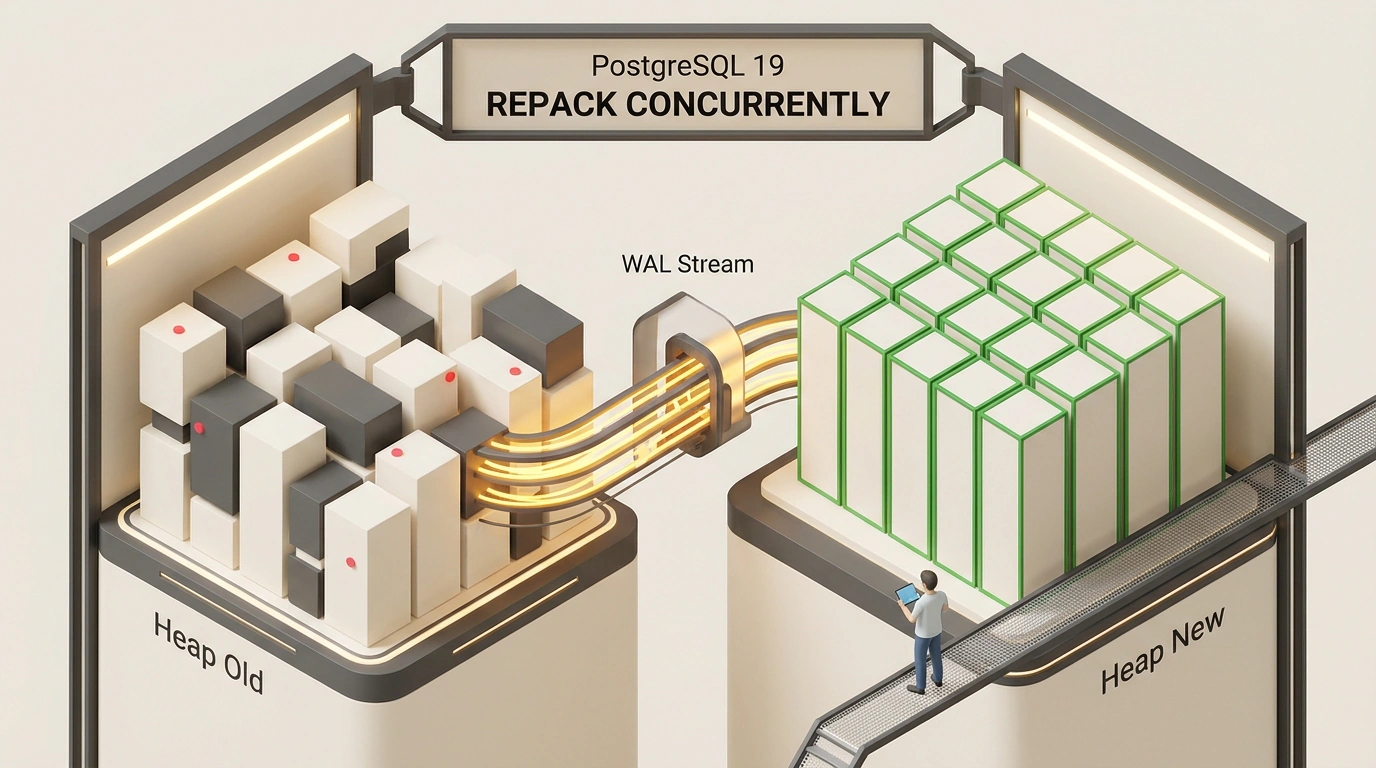
Isometric architectural cutaway of the online table repacking process with REPACK CONCURRENTLY in PostgreSQL 19 without blocking transactions.
ArticlePostgreSQLDatabasesDevelopmentOptimization

The REPACK Command in PostgreSQL 19: Built-In Online Table Compaction Without Downtime

PostgreSQL's VACUUM FULL command has been a DBA nightmare for years: it compacts bloated tables, yet requires an exclusive lock and halts every query to the database.

The upcoming PostgreSQL 19 release introduces the built-in REPACK CONCURRENTLY command. It uses WAL logical decoding to move data on the fly into a compact file without dropping connections or needing third-party C extensions like pg_repack. Still, the new command's appetite for disk headroom and RAM can surprise even seasoned DBAs.

👍 31
Postgres WeeklyPostgres 19 REPACK CONCURRENTLY Deep Dive (Snowflake Engineering)
November 5
Modular Bauhaus-style still life with four geometric blocks symbolizing tools in the PostgreSQL ecosystem.
Thematic roundup4 sectionsPostgreSQLDatabasesDevelopmentTools

PostgreSQL Ecosystem: Key Releases of Tools, Extensions, and Drivers

The PostgreSQL ecosystem grows not only through major DBMS releases, but also through the tools around the core. A fresh round of updates tackles four infrastructure bottlenecks at once:

pgModeler 2.0 splits complex schemas across independent canvases; PostGIS 3.7.0 speeds up geo-queries and adds Float16 rasters; the Postgres.js 4.0 driver gets a non-blocking scheduler and SCRAM protection against traffic interception; and TimescaleDB 2.31 compresses integer metrics by another 10% with the new AIC algorithm. Still, getting this whole zoo to work smoothly in a single production pipeline rarely happens without a few rough edges.

👍 12
Postgres WeeklypgModeler 2.0 AnnouncementPostGIS 3.7.0 Release NotesPostgres.js 4.0 Release Notes+1
November 5
Dynamic European comic-style illustration of interactively dragging a task card with a reactive draft in Vue DnD Kit 3.0.
ArticleVueFrontendDevelopmentJavaScript

Vue DnD Kit 3.0: A Ground-Up Rewrite of the Drag & Drop Library for Vue 3

Building Drag and Drop lists in Vue felt like walking through a minefield for a long time: Vue DnD Kit v2 suffered from quadratic target-lookup complexity, CSS style resets, and fifty-plus hidden TypeScript bugs.

In version 3.0, the author scrapped the old code completely and rewrote the library from scratch. The new architecture introduced a reactive draft concept, automatic FLIP animations without TransitionGroup, and nested tree support. Still, letting go of familiar low-level hooks means rethinking old habits.

👍 25
Node.JS [ru]Vue DnD Kit GitHub RepositoryVue DnD Kit 3.0 Architecture Article (Habr)
November 5
Studio product still life featuring three transparent layers of user session data and a tiered retention scale.
ArticleArchitectureData StorageDevelopmentOptimization

Session Recording Storage Architecture: Why Heatmaps Outweigh Traces and How Retention Works

A naive "delete everything older than 30 days" retention policy in user session recording systems simultaneously drains budgets on disk storage and destroys valuable logs: 97% of space is eaten by heavy DOM mutations, while lightweight error stack traces get wiped right before the first regression.

The experience of the Russian service Broux proves the value of tiered retention: raw video-like streams rotate out in a couple of weeks, while diagnostics are kept for years. Still, tuning heatmap canvas scoring without bloating the database is no trivial feat.

👍 28
Node.JS [ru]Broux Session Replay Architecture Case Study (Habr)rrweb Open Source Session Replay Library
November 5
Cinematic split-frame monitor shot demonstrating the Adaptive Dark Mode color matrix in Safari 27.3.
ArticleCSSFrontendBrowsersDevelopment

Adaptive Dark Mode in Safari 27.3: How WebKit Adapts Light Sites Using a Color Matrix

Nearly 40% of users browse the web with system dark mode enabled, yet only one in ten websites supports it natively. Inverter extensions solve the problem crudely: turning faces in photos into negatives and breaking buttons.

In Safari 27.3 beta, WebKit introduced the Adaptive Dark Mode algorithm based on a mathematical matrix: only background lightness is inverted while preserving the original Oklab hue, graphics, and WCAG 4.5:1 contrast. Still, few developers know the nuances of controlling adaptation via meta tags yet.

👍 26
WebKit BlogWebKit Adaptive Dark Mode Specification and Announcement
November 5
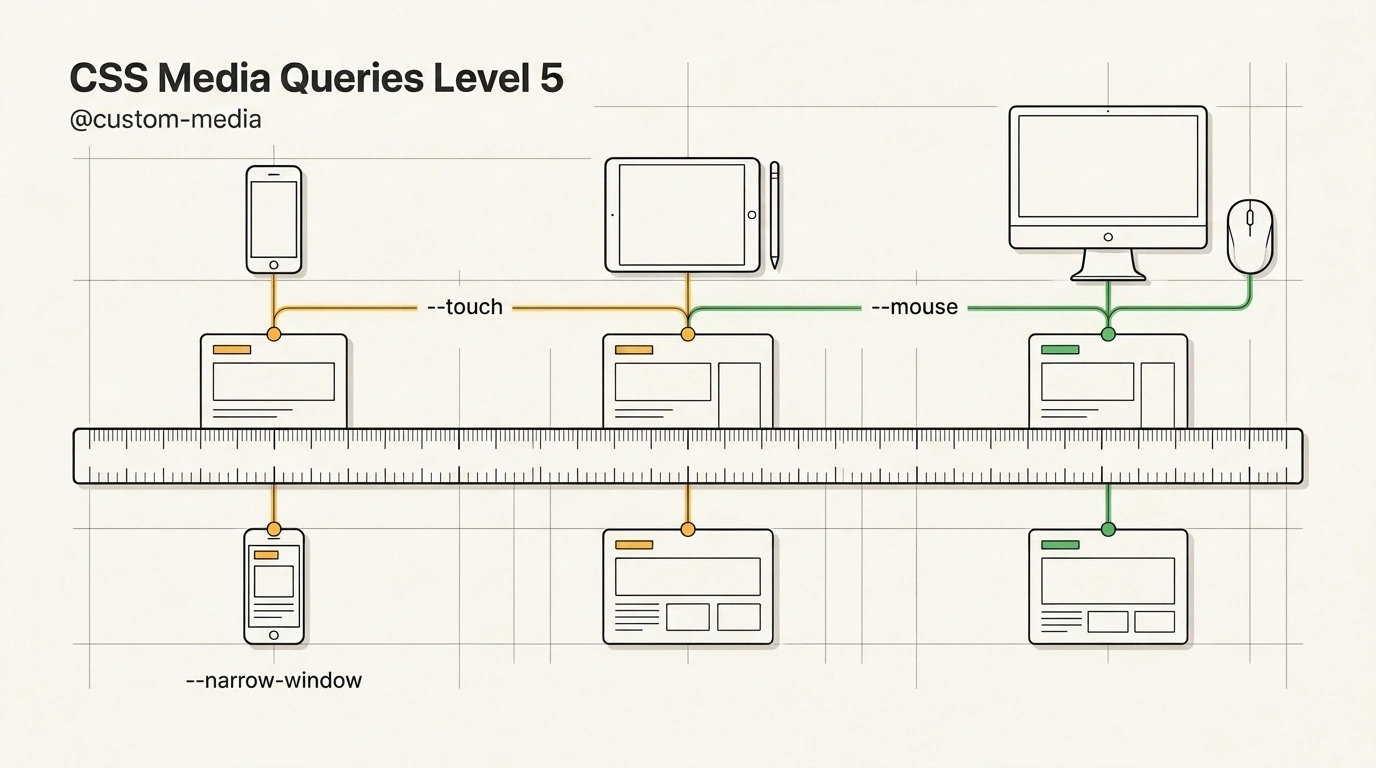
Engineering blueprint of a responsive layout with a modular breakpoint scale and semantic custom-media queries.
ArticleCSSFrontendDevelopmentResponsive Design

Named Media Queries in CSS: @custom-media Presets for Responsive Design

Media queries with hardcoded pixels like max-width: 768px have bred bugs for decades: a one-pixel typo breaks the grid, and splitting devices into tablets and smartphones stops making sense the moment you plug a mouse into an iPad Pro.

The CSS Media Queries Level 5 specification introduces the @custom-media at-rule for naming media expressions with semantic variables. Presets let you detect actual input modalities and modular breakpoints in 100px steps. Still, until browsers enable it widely, PostCSS remains indispensable.

👍 22
Веб-стандартыW3C CSS Media Queries Level 5 Custom Media SpecificationMaster.dev Useful Custom Media Presets
November 5
Surrealist still life featuring a Canvas, live HTML blocks, and geometric shapes with squircle rounding in Chrome 157.
ArticleChromeFrontendDevelopmentBrowsers

What's New in Chrome 157: HTML Rendering on Canvas, the corner Property, and Streaming HTML

Drawing styled text on Canvas required manual coordinate math and SVG hacks for years, while CSS corner rounding was limited to circles.

The new Chrome 157 release breaks those barriers: native drawElement brings live HTML markup onto the canvas, the corner property adds superellipse support, and streamHTML hooks streaming parsing into the Fetch API. Still, not everyone manages to prepare infrastructure for the update without breaking legacy polyfills.

👍 30
Веб-стандартыChromeStatus Chrome 157 Release Notes
November 5