If you have ever tried selling clothes, smartphone cases, or cosmetics on marketplaces, you are probably used to a simple routine: pack a hundred units into a box, slap on the barcodes, drop them off at the nearest warehouse, and sit back watching the buyout chart. But the moment you enter the furniture category, that familiar picture shatters into pieces.
There are no lightweight boxes here for a sorting robot to cheerfully toss onto a conveyor belt. Every item here means dozens of kilograms of laminated chipboard, solid wood, fragile mirrored fronts, and hardware that seems eager to get lost in transit. More importantly, the math is completely different. If a newcomer makes a single mistake choosing a fulfillment model, storage fees for a couple of unsold dressers in Koledino will instantly eat up the store's entire net profit for the month.
Let's break this mechanism down to the last screw. Wildberries experts — Olga Serkina, who oversees the development of key partners in the furniture category, and Mikhail Skomarokha, who leads the seller-managed delivery direction — laid out the inner workings of furniture operations. I cross-referenced their recommendations with real warehouse practices, oversized-cargo delivery regulations, and marketplace tariffs. In this guide, we will look at how to build a hybrid logistics setup using FBO, FBS, and DBW models, calculate unit economics with a calculator in hand for different types of furniture, and figure out how to pack goods so they reach the buyer intact.
Anatomy of the Furniture Category: Why Standard Trading Rules Break Here
Why has selling furniture on Wildberries become a separate discipline with its own strict laws? It comes down to three key factors that set this niche apart from a classic product business:
First, physical dimensions and weight. A furniture catalog mixes tiny wall shelves weighing a couple of kilograms with massive three-section sliding-door wardrobes pushing a hundred kilograms. The marketplace divides this entire lineup into three clear tiers:
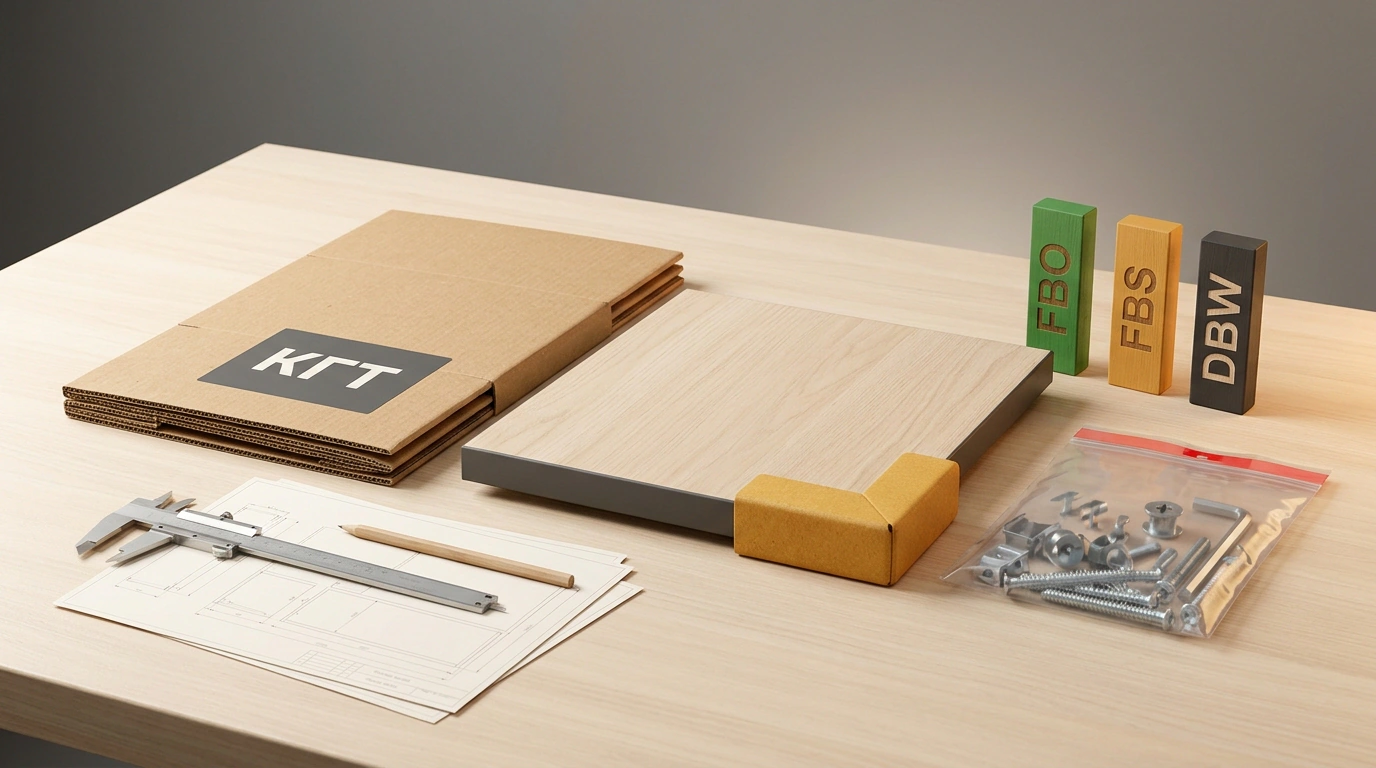
- МГТ (Small-Sized Goods): coffee tables, nightstands, benches, ottomans, wall shelves, and disassembled chairs. These items fit within standard box limits, are easily accepted by most sorting centers, and generate the lion's share of turnover at marketplace warehouses.
- КГТ+ (Oversized Goods, Extended Category): items weighing up to 25 kg where one side measures from 121 to 200 cm, or the sum of three dimensions falls in the 200 to 280 cm range. Wildberries designates specialized hubs and pickup points with cargo zones for these items.
- СГТ (Extra-Oversized Goods): products heavier than 25 kg or with dimensions exceeding the upper КГТ+ threshold. This includes straight and corner sofas, solid-wood beds, kitchen sets, wardrobes, and stone countertops. Regular pickup points are physically unable to accept such cargo — delivery is handled exclusively by couriers straight to the buyer's door.
Second, turnover speed. While a trendy T-shirt or face cream turns over in 15–25 days, the average sell-through period for furniture is 45 to 90 days. People buy furniture deliberately: they measure bedroom niches with a tape measure, consult with family, and compare upholstery shades against wallpaper colors. If you load a batch of a slower-moving item into a central warehouse with paid storage per cubic decimeter, the marketplace's storage bill will turn your business into a charity.
Third, sensitivity to transit and the cost of returns. If a buyer refuses a sweater, it goes neatly back into its bag and rides back to the warehouse at the base reverse-logistics rate. If a laminated dresser corner gets chipped in transit or a vanity mirror cracks, the seller gets back a broken piece of furniture and is charged 1,000 to 3,500 rubles for return shipping, plus disposal or expensive restoration costs.
At the same time, buyer expectations are rising rapidly. According to the platform's internal statistics, over 85% of furniture buyers in key regions expect their order within 1–2 days. The marketplace's ranking algorithms are ruthless: if your product is far from the customer and promises a week-long delivery, the listing immediately drops in search results, yielding ground to competitors with localized stock. The main systemic mistake beginners make is trying to force their entire furniture catalog into a single mold: either shipping everything to the marketplace warehouse or selling everything from their own warehouse. A smart approach works the exact opposite way — through intelligent matrix segmentation.
The FBO Model: When Delivery Speed Pays Off Cubic-Decimeter Tariffs
The FBO scheme (Fulfillment by Operator, or FBW in Wildberries terminology) is classic marketplace fulfillment. You deliver a batch of furniture to a regional distribution center (Koledino, Elektrostal, Kazan, Tula, Yekaterinburg, Krasnodar), and the marketplace handles everything else: rack placement, retail order picking, packing, and final delivery to a pickup point or by courier.
FBO's trump card is phenomenal delivery speed. When a buyer in Moscow or Kazan sees the "delivery tomorrow" badge, the probability of a click and order multiplies compared to a listing promising to bring a nightstand in 4–5 days. On top of that, the search algorithm gives a substantial regional boost to listings whose stock physically sits in the buyer's cluster.
The second advantage is scaling without inflating your own headcount. You don't need to keep a weekend shift of packers on Saturday evening or scramble to find a truck to drop off thirty orders within a strict time window.
But speed and automation come at a price, and in furniture those bills can be brutal:
- Paid storage on low turnover: Storage tariffs are calculated from the box volume in cubic decimeters. A compact nightstand in a flat-pack box takes up minimal space, but if you ship a batch of bulky assembled chairs or dressers that take three months to sell, storage fees will easily exceed your net margin.
- Receiving restrictions and slot shortages: Far from every Wildberries warehouse accepts furniture. Central warehouses are frequently overloaded, pallet receiving limits for КГТ get snapped up in seconds, and if dimensions are off by even a couple of centimeters, the shipment gets turned away at the dock.
- Conveyor sorting risks: At giant distribution centers, boxes move along automated lines and are transferred at high speed. If furniture is packed without a safety margin, an impact against a metal rail is guaranteed to crush the corner of a chipboard panel.
The golden rule for a furniture seller on FBO is this: ship strictly your locomotives to marketplace warehouses — Group A items making up the top 10–15% of your catalog. These are products with predictable demand that turn over faster than 30–40 days, strictly disassembled and packed in flat rectangular boxes to IKEA standards. Experimenting with new arrivals or holding slow-moving colors and rare configurations on FBO is a direct path to a cash gap.
The FBS Model: Protecting Working Capital and Safely Testing New Arrivals
The FBS model (Fulfillment by Seller) works fundamentally differently. Your entire inventory stays in your own warehouse, factory, or rented space. You create product listings on Wildberries and broadcast virtual stock levels to the system via API or your seller dashboard. As soon as a buyer places an order, your warehouse gets the signal: a storekeeper picks the item, packs it, applies an individual shipment barcode, and delivers it to the nearest marketplace sorting center within the assigned time slot.
Why has FBS become a true lifeline for furniture businesses?
First, you completely zero out Wildberries paid storage expenses. Goods sit on your own racks, where the cost per square meter is many times lower than the rates at the platform's logistics hubs. If a dresser in a rare "Sonoma oak" finish sells in two months instead of a week, you don't pay the marketplace a single kopeck for idle time.
Second, FBS opens up limitless opportunities for safely expanding your catalog (Group C items). You can put thirty color variations of a coffee table, five styles of milled cabinet fronts, and ten upholstery options for chairs on the storefront. You don't need to manufacture and freeze hundreds of units of each SKU in storage: some items can be made to order in 24–48 hours or kept in stock as blanks and assembled right when an order drops. We covered a similar approach in detail in our piece on FBS logistics on Wildberries, which broke down the regulations for handing off batches without penalties.
Third, FBS is the ideal safety net for your FBO locomotives. Imagine your top shoe rack is selling great out of the Kazan distribution center, but the batch suddenly runs out while the next shipment is stuck on the road. If stock hits zero, the listing will lose search positions within a couple of days that took you months to build. With FBS configured, you instantly turn on factory stock: delivery time for the buyer grows by one or two days, but the listing stays active, sales don't stop, and search rankings hold steady.
The main challenges of FBS are ironclad shipping discipline and the logistics leg. Wildberries closely monitors the seller quality index: if your warehouse delays picking or a driver arrives at the sorting center after the slot closes, the platform issues fines for delivery delays and the listing's ranking coefficient plummets. You also need your own packing station and regular transport to a sorting center that accepts КГТ.
The DBW Model: How to Deliver Extra-Oversized and Premium Goods with Your Own Fleet
What if you manufacture luxury three-seater sofas, beds with velvet upholstered headboards, or massive sliding-door wardrobes? Neither FBO nor standard FBS will help here: sorting centers will simply refuse to accept a 70-kilogram sofa on narrow ramps and manual pallet jacks.
For these tasks, there is the DBW model (Delivery by Wildberries, or DBS — Delivery by Seller). In this setup, the marketplace acts strictly as a storefront and payment gateway. A buyer finds your bed in the Wildberries app and pays for the order, while you organize the entire physical delivery — from loading at the factory to carrying it into the customer's bedroom. You can deliver furniture with your own branded crews or hire specialized freight carriers (PEK, Delovye Linii, DPD, CDEK, Vozovoz).
The DBW model is indispensable in three scenarios:
- Extra-oversized items (СГТ): Anything weighing over 25–30 kg or exceeding 2 meters in length lives strictly on DBW. Sofas, wall units, kitchens, and wardrobe systems are 100% seller-delivery territory.
- Premium segment and high average order value: In DBW, the average order value is traditionally 3–5 times higher than in standard shipments to platform warehouses. A customer buying a designer dining table for 60,000 rubles expects careful handling, neat carry-in without scratching the parquet, and an advance call from a polite driver.
- Full-cycle service offerings: In standard marketplace courier delivery, a driver often leaves boxes at the building entrance if the elevator is broken, and certainly won't assemble the furniture. Under DBW, you can offer full-service delivery: carrying up to the floor, bringing inside the apartment, professional on-site assembly, and removing packing cardboard. Buyers gladly pay extra for that convenience, and refusals upon delivery drop close to zero.
An added bonus of DBW is cargo safety. Furniture crews transport items in vans with padded walls and tie-down straps, with no tossing on transfer docks. Plus, you can operate on a made-to-order basis, starting material cutting only after receiving a confirmed order from the buyer.
Unit Economics Made Simple: Breaking Down Costs on a Nightstand, Chair, and Three-Seater Sofa
To see how a logistics model affects the real money in your pocket, let's take off the rose-colored glasses and calculate unit economics for three real products using concrete numbers.
Example 1. Nightstand (Matrix A, МГТ)
A compact laminated-chipboard nightstand in a flat-pack box. Package dimensions: 45 × 40 × 15 cm, weight 8 kg. Retail price on Wildberries: 2,400 rubles. Production cost with basic hardware: 900 rubles.
Calculating the FBO option:
- Marketplace commission (15%): 360 rubles.
- Base Wildberries logistics to pickup point: about 190 rubles.
- Paid warehouse storage at a brisk 25-day turnover: about 45 rubles per unit.
- Batch delivery to WB warehouse (per unit on a pallet): 50 rubles.
- Total direct platform and logistics expenses: 645 rubles.
- Seller net profit: 2,400 − 900 − 645 = 855 rubles (35.6% margin).
Calculating the FBS option:
- Marketplace commission (15%): 360 rubles.
- WB logistics from seller warehouse to pickup point: about 210 rubles.
- Delivery by own transport to WB sorting center: 40 rubles.
- Storage in own warehouse: 0 rubles (effectively included in workshop rent).
- Individual packing and labeling: 50 rubles.
- Total expenses: 660 rubles.
- Net profit: 2,400 − 900 − 660 = 840 rubles (35.0% margin).
At first glance, the margin difference is pennies — just 15 rubles! But here is the catch: a nightstand on FBO with a "delivery tomorrow" badge generates 2–3 times more orders than an identical listing on FBS delivering in 3 days. For a fast-moving compact locomotive, FBO wins hands down thanks to gross turnover and regional boosting.
Example 2. Boxed Office Chair (Matrix B, КГТ+)
An ergonomic desk chair with a mesh back. Package dimensions: 75 × 65 × 35 cm, weight 16 kg. Retail price: 8,500 rubles. Production cost: 3,800 rubles.
Calculating FBO:
- Box volume exceeds 170 cubic decimeters. КГТ logistics including dimension coefficients costs 850 rubles.
- Storing this volume at a WB warehouse costs 280 to 350 rubles per month. If the batch sells in 60 days instead of a month, storage drains 600–700 rubles from every chair.
- WB commission (15%): 1,275 rubles.
- With two months of storage, total costs come to: 1,275 + 850 + 650 + 120 (pallet delivery) = 2,895 rubles.
- Net profit: 8,500 − 3,800 − 2,895 = 1,805 rubles.
Calculating FBS:
- The chair sits in a factory stack at your own warehouse (cost around 30 rubles per month).
- Picking and handoff to sorting center on order: 100 rubles.
- WB КГТ+ logistics: 880 rubles.
- WB commission (15%): 1,275 rubles.
- Total costs: 1,275 + 880 + 100 + 30 = 2,285 rubles.
- Net profit: 8,500 − 3,800 − 2,285 = 2,415 rubles.
The difference is over 600 rubles in net profit per unit in favor of FBS! For bulky items with an average sales pace, avoiding draconian marketplace storage tariffs reliably protects your margin.
Example 3. Three-Seater Sleeper Sofa (СГТ)
Folded dimensions: 215 × 95 × 90 cm, weight 68 kg. Retail price: 34,000 rubles. Manufacturing cost: 16,000 rubles.
Neither FBO nor standard FBS will accept this sofa under any circumstances — the item exceeds all sorting-center receiving limits. The only viable path is DBW:
- Marketplace commission: 15% of item price = 5,100 rubles.
- Delivery to customer via specialized freight carrier or furniture van: 2,500 rubles.
- Freight-elevator carry-up service: +500 rubles (paid by the buyer or built into the markup).
- Total fulfillment costs: 5,100 + 2,500 = 7,600 rubles.
- Factory net income: 34,000 − 16,000 − 7,600 = 10,400 rubles in net profit per sofa with zero risk of upholstery damage on a conveyor.
Do not try to compete with large factories on FBO across your entire assortment. Split your matrix into three buckets: keep the top 10% of small fast-moving items on FBO in key regions, ship the core medium-turnover lineup via FBS from your own warehouse, and move oversized and premium goods to DBW. This preserves both delivery speed and your working capital.
Bulletproof Packaging Standards: How to Deliver Fronts and Glass Without Chips or Disposal
If you think wrapping a factory box in two layers of stretch film is enough to ship furniture, you are in for a rude awakening. A Wildberries sorting center will reject that shipment at the very first meter of the dock, and rightly so.
Isometric engineering diagram of protective furniture-panel packaging in five-layer corrugated cardboard with corner profile.
Here are the baseline furniture packaging requirements that separate a profitable seller from a regular in disposal-dispute arbitration:
- Five-layer corrugated cardboard is the non-negotiable standard: Forget cheap three-layer cardboard graded T-21 or T-22. Under the weight of furniture panels, you can poke a finger straight through it. For case furniture and heavy parts, use five-layer corrugated cardboard graded T-24, P-32, or P-33 with enhanced edge-crush resistance.
- Rigid corner and edge protection: 80% of furniture damage on marketplaces is crushed corners from boxes dropping onto their edges. Every corner inside the package must be protected with a U-shaped polyethylene foam profile or a pressed-cardboard corner guard at least 3 mm thick. Even if a loader drops the box from half a meter, the corner guard absorbs the crush while the furniture panel stays intact.
- Isolation of mirror and glass elements: Wardrobe mirrors and glass shelves must be packed in separate inner sleeves. Between glass and any adjacent wood panel, place polyethylene foam at least 5 mm thick or EPS foam sheets with a density of at least 15 kg/m³. On the outside of the box, apply bright "Fragile / Glass" warning labels on all four sides.
- Zero voids inside the box: If you shake the finished box, there should not be the slightest movement inside. Fill every gap with kraft paper, air pillows, or foam offcuts. If a part shifts around inside, it will punch straight through its own box when a truck brakes hard.
Marketplace warehouses scan incoming box dimensions with laser 3D frames. If the actual package volume exceeds the dimensions declared in the listing by even 10%, the platform will recalculate logistics costs with a penalty multiplier for the entire batch and issue a fine for dimension distortion. Measure the box at its outermost protruding points, including tape seams.
Fighting Returns and Missing Hardware: A Factory Margin-Protection Protocol
Do you know the most common and frustrating reason an expensive wardrobe or table worth tens of thousands of rubles gets returned? Not a cutting defect or a cracked tabletop. It is a single missing cam lock, a couple of confirmat screws, or a decorative plastic cap worth three kopecks!
A buyer sets aside Saturday evening, invites a friend or hires an assembler, opens the box, lays out all the parts on the floor — and discovers the manufacturer shorted two screws. Furious, the customer immediately files a defective-item return, leaves a one-star review, and demands the 40-kilogram wardrobe be picked up. The seller pays 2,000 rubles for return shipping, loses listing ranking, and gets back an incomplete item.
To eliminate this absurd scenario, experienced furniture factories implement three simple rules:
- The spare hardware bag principle: Hardware is packed into a thick polyethylene bag at least 80 microns thick, stapled securely with a furniture stapler to the inner wall of the box so it doesn't get lost among packing materials. A mandatory +10% reserve goes into every bag: two extra screws, confirmats, dowels, and caps of each size. If the assembler drops a screw under the baseboard, assembly doesn't grind to a halt.
- Direct factory warranty bridge (anti-return flyer): Place a large color A5 insert right on top of the upper panel with a bold headline: "Don't rush to return the item! We'll fix everything in 24 hours." Include a direct WhatsApp number or Telegram bot for the factory care team: if the buyer spots a chip or missing part, they simply send a photo, and the factory dispatches a CDEK express courier with the needed part straight to their door at its own expense. This simple flyer cuts return rates on furniture listings by 20–25 percentage points.
- Step-by-step video instructions via QR code: Paper assembly diagrams are often poorly printed and confusing for an average buyer. Put a large QR code on the insert linking to a clear assembly video for that specific model. When a buyer can watch every move of the craftsman up close on their smartphone screen, support complaint calls drop nearly in half.
In furniture e-commerce, the winner is not the seller who slashes storefront prices the hardest, but the one who masters supply chain management down to the finest detail: delivering locomotives to marketplace warehouses on time, holding a wide long-tail assortment in their own warehouse, and delivering oversized pieces straight into the apartments of satisfied customers.