Every entrepreneur who scales marketplace turnover to at least a few million rubles a month eventually catches themselves thinking one unsettling thought. You look at the weekly sales report and realize: the business may be yours, but the customers aren't.
They belong to the platform. The marketplace withholds buyer contacts, bans direct communication, suspends accounts for slipping a business card into a parcel, and can hike commissions, change logistics coefficients, or slap on a fine at any moment. And if the search algorithm decides to demote your listing, sales can drop to zero overnight.
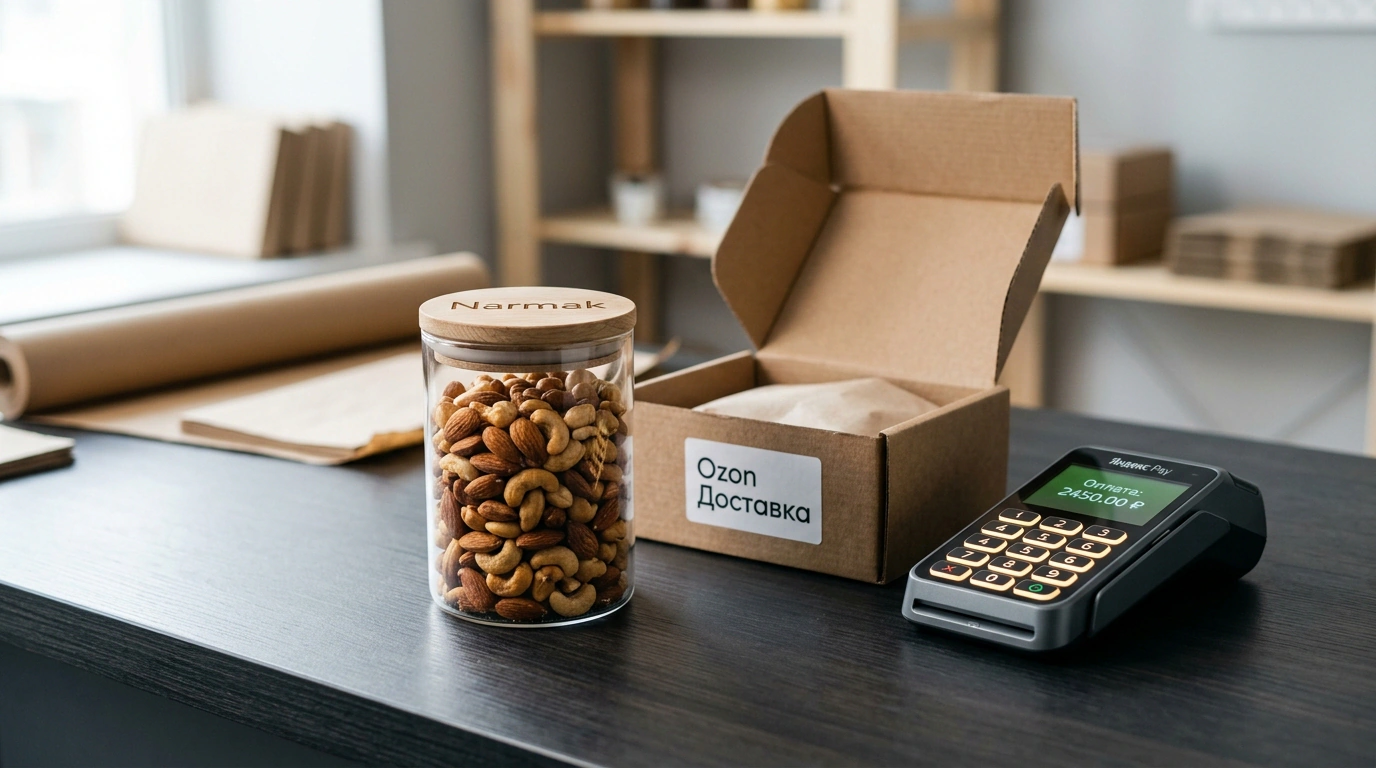
Russian nut-mix and dried-fruit manufacturer Narmak, operating on the market for over 9 years, hit that exact fork in the road. The company had historically sold its lineup successfully on Ozon via FBO, but decided not to put all its eggs in one basket and built its own independent D2C (Direct-to-Consumer) channel. Rather than spending millions of rubles on custom website development and hiring its own fleet of couriers, the team found a clever solution: Narmak combined ready-made services from two giants — Ozon Delivery and Yandex.
Let's break down this case in detail: how the store's tech stack is built, how the unit economics pencil out, and where the real hidden traps lie in this setup.
The Seller's Dilemma: Why Relying on a Single Platform Becomes Dangerous
In food and snack retail, margins are traditionally under heavy pressure. Rising raw-material, packaging, and bagging costs squeeze from one side, while marketplace appetites squeeze from the other.
When you add up the platform's total deductions on the storefront, the picture is stark:
- base sales commission in the nuts and dried-fruits category runs around 18%;
- marketplace warehouse logistics and last-mile delivery take another 10–12%;
- payment processing, paid receiving, and mandatory promo participation push total deductions to 35–40% of the retail price!
Yet financial deductions are only half the problem. The other half is having zero control over LTV (customer lifetime value). Nuts and dried fruits are a textbook repeat-demand product. A customer finishes a one-kilogram jar of select almonds or cashews in 3–4 weeks and is ready to reorder. On a marketplace, you cannot send them a personal reminder or offer a discount on their next order. On their next search, the buyer simply sees a competitor's listing at the top of the screen that happened to cut its price by 20 rubles that day.
That is why Narmak Senior Sales Manager Marina Mozharova and her team set a strategic goal: launch an independent online store and gradually grow direct D2C sales to 70% of the company's total turnover.
The Infrastructure Hybrid: A Site on Yandex KIT and 78,000 Ozon Delivery Pickup Points
Every seller's biggest fear before opening an independent online store is traditional ground-up development. Hiring a web studio, spending six months writing specs, burning a million rubles on front-end coding, and ending up with a buggy site where checkout constantly breaks — only to discover that regional buyers won't order because shipping via Russian Post or a standalone courier costs more than the product itself.
Narmak sidestepped this trap by assembling a hybrid stack from off-the-shelf modules:
- Storefront on the Yandex KIT builder: The site went live in literally a few days using ready-made industry templates. The standout integration feature is direct sync with the Ozon Seller dashboard: the product catalog, high-res studio photos, descriptions, specs, and — most importantly — accumulated ratings and real customer reviews pulled seamlessly onto the new site via a product feed.
- Seamless sign-in via Yandex ID: The biggest conversion killer in standard online stores is forcing shoppers to manually fill out a long form: last name, phone number, address with postal code. Most buyers abandon their carts right at this step. Here, login takes a single click: Yandex ID automatically fills in the name, phone number, and saved delivery address.
- Checkout via Yandex Pay and Split installments: The buyer pays with a saved card in one click without typing card details. For larger orders starting at 1,500 rubles, the Split service is available — four equal interest-free installments. For gift nut sets, this delivered an instant conversion boost.
- Logistics via Ozon Delivery for external sites: Here lies the key innovation. Buyers are used to picking up orders near home. Narmak connected Ozon Delivery, opening up a network of over 78,000 Ozon pickup points across Russia plus door-to-door courier delivery for its website customers. Orders ship from the manufacturer's warehouse, and the buyer picks them up at their familiar neighborhood pickup point, receiving a tracking number straight inside the Ozon mobile app. In our piece on diversifying e-commerce sales channels, we noted how tapping into someone else's mature logistics network erases the boundary between an independent site and a marketplace.
Unit Economics Battle: Comparing Margins on a Gift Set via Marketplace vs. D2C
Let's grab a calculator and compare the real economics of both channels using a specific Narmak bestseller — the 1 kg "Gurman" gift nut set retailing at 1,599 rubles.
Scenario 1. Sale via Ozon Storefront (FBO Model)
- Marketplace retail price: 1,599 rubles.
- Category marketplace commission (18%): 287.8 rubles.
- Warehouse logistics and last-mile to pickup point: about 165 rubles.
- Platform payment processing: about 24 rubles.
- Internal ad spend (at a 10% target ACOS / DRR): 160 rubles.
- Total platform deductions: 636.8 rubles (39.8% of the item price!).
- Seller net revenue: 962.2 rubles.
Scenario 2. Sale via Own Online Store with Ozon Delivery
- Website retail price: 1,599 rubles (with free shipping for the customer).
- Yandex Pay online acquiring (1.8%): 28.8 rubles.
- Ozon Delivery rate for transport and pickup-point handoff: about 170 rubles.
- Yandex KIT CMS subscription fee per order: about 5 rubles.
- Total external service fees: 203.8 rubles (just 12.7% of the retail price!).
- Seller net revenue before marketing: 1,395.2 rubles.
The net difference is +433 rubles on every single jar sold! The seller's net margin jumps by 45% right away.
The company doesn't just pocket this delta — it reinvests it into growth:
- fully subsidizes free delivery to Ozon pickup points on orders over 1,500 rubles;
- slips branded gifts, booklets, and samples of new snack lines into parcels (inclusions that can get you banned on marketplaces);
- funds its own performance marketing to acquire direct audiences.
On top of that, the average order value on the standalone store turned out noticeably higher: shoppers readily order 2–3 premium gift sets at once ("Energiya" 1,000 g at 1,599 rubles, "Dvizheniye" 1,000 g at 1,649 rubles) for colleagues and relatives.
Scaling Limits: Hidden Traps of an Independent Store and Traffic Costs
Sounds like a fairy tale? Don't rush to shut down your marketplace seller account. The hybrid D2C model has one fundamental constraint that excited entrepreneurs often overlook: traffic.
Wildberries and Ozon draw tens of millions of people who already have buying intent. Organic search demand works for you there: if your listing is optimized and carries a strong rating, orders flow in on their own.
On your own website, organic traffic is zero. Zero visitors a day. You have to bring every single buyer by hand:
- set up contextual ads in Yandex Direct;
- buy integrations from healthy-eating bloggers;
- run your own Telegram channel and build brand media.
If customer acquisition cost (CAC) in paid search exceeds those saved 433 rubles, the math flips negative in an instant. That is why Narmak's model only works when a company masters repeat sales: acquiring a customer once through ads, then retaining them with triggered campaigns, loyalty programs, and impeccable product quality.
The second hidden trap is technical discipline. Ozon Delivery integration demands tight warehouse execution: parcels must be packed strictly to courier-service standards, and barcodes and tracking statuses must sync instantly via API. If the integration stalls, the customer won't see their tracking number in the Ozon app and will flood support lines.
A hybrid of marketplace logistics and a standalone site isn't a replacement for selling on Ozon or Wildberries, but a mature next step for a strong product brand ready to build a long-term asset and take ownership of its customer base.
