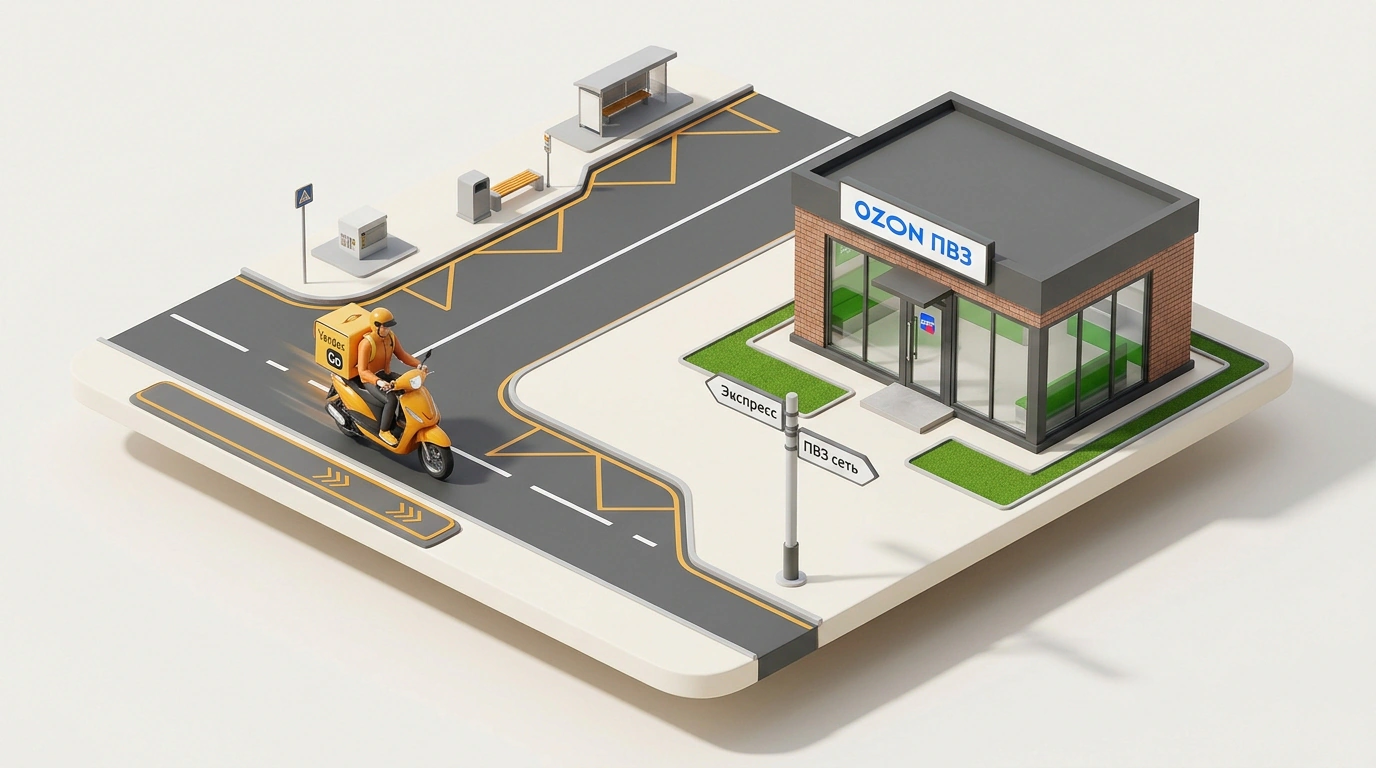
Uzbekistan's market, with its 36-million population and surging cashless payments, has long attracted Russian e-commerce giants. Yet operating in Central Asia by the usual playbook proved tricky: local logistics and geography forced Yandex and Ozon into diametrically opposed strategies.
One giant decided that building a universal marketplace was too expensive and shut down its classic storefront. The other switched into vacuum mode: pouring investment into the market and cutting seller fees in half.
Let's unpack what is happening on this battlefield and what it changes for sellers.
Yandex Changes Course: Why the Marketplace Yielded to Express Delivery
Yandex Go announced a radical restructuring of its e-commerce wing in the republic. Starting November 10, 2026, the Market storefront in Uzbekistan shuts down completely. The platform is closing order intake under the familiar models:
- FBS (fulfillment by seller): where the seller stores and packs goods while the marketplace handles line-haul transit;
- DBS (delivery by seller): direct order fulfillment by the store.
Existing buyer obligations and seller payouts will wind down normally, but Yandex no longer plans to build out a "long tail" of millions of non-food items.
Instead, the company is betting on where it already has built-in strength — the Yandex Go courier fleet and 15–30 minute delivery:
- "Lavka" — a network of local dark stores carrying groceries and everyday essentials in Tashkent;
- "Magaziny" — delivery of goods from partner retail chains (pharmacies, cosmetics, electronics).
The economics are clear: distribution centers and a pickup-point network demand billions in investment. Yandex chose not to get dragged into a war with Uzum Market and Ozon, opting instead to monetize its couriers. And it is working: over 2026, the number of "Magaziny" partners doubled to 500 retail chains, while express-delivery orders grew 3x.
Ozon's Offensive: $24 Million in Investment, Doubled Pickup Points, and Commission Discounts
While Yandex winds down classic product listings, Ozon is moving with the scale of its Russian expansion five years ago.
The marketplace officially announced a plan to double its pickup-point network in Uzbekistan by the end of 2027. Today, the platform's physical footprint relies on 100 company-owned flagship pickup points and a partnership with the national postal service "Uzbekiston Pochtasi", spanning 1,400 branches nationwide.
To fill that network with goods, Ozon rolled out powerful incentives for sellers:
- 50% commission cut: rates for local manufacturers were slashed in half;
- $24 million in investment: the company is allocating roughly $12 million to platform advertising and another $12 million to subsidizing attractive buyer prices.
That sparked an immediate surge: over the first 10 months of 2026, local sellers' turnover on Ozon grew nearly 5x, while the number of active sellers more than doubled.
Compare the terms: in Russia, marketplaces methodically raise base commissions toward 20–25%. In Uzbekistan, during the land-grab phase, Ozon is willing to share margin and subsidize sales. For Central Asian sellers, 2026–2027 is a golden window: a chance to gather reviews cheaply, lock in top search spots, and establish a storefront presence before fees inevitably rise.
In our piece on Russian marketplaces expanding into the CIS, we noted that for Russian sellers, Ozon's 1,500-point network opens a direct cross-border sales channel into a 36-million consumer market without registering a foreign legal entity.
