In seller chats, I constantly see even veteran sellers trip over the topic of dropping off inventory at ПВЗ (pickup points) and ППЗ (drop-off points). Some mean the familiar FBS model (fulfilling from your own warehouse, bringing already-ordered individual parcels to the counter), while others mean stocking a batch in advance on a point’s shelves—something that long operated only in a closed test.
Now Ozon has opened direct and transit shipments to all ПВЗ and ППЗ across Russia for every seller, with no turnover or rating restrictions. Any neighborhood point has turned into an accessible mini-warehouse: but does it pay for you to carry boxes there instead of sending a truck to a distant hub like Koledino, and where are the hidden reverse costs?
Neighborhood Drop-Off and Cluster Cross-Docking: Routes and the QR-Code Rule
Shipping to point shelves runs under the FBO model (the platform handles storage and customer handoff) via the “Create shipment to ПВЗ” button in the «Заявки на поставку» section of Ozon Seller. If you know a specific neighborhood with brisk demand or are testing a batch near your warehouse, you choose a direct shipment to the needed ПВЗ or ППЗ and bring the boxes at your chosen timeslot. If you need to cover an entire cluster of nearby cities without driving to each point manually, you book cross-docking: drop the cargo at one convenient window by your timeslot, and Ozon distributes it across the zone’s points (our guide to planning Ozon shipments helps estimate volumes).
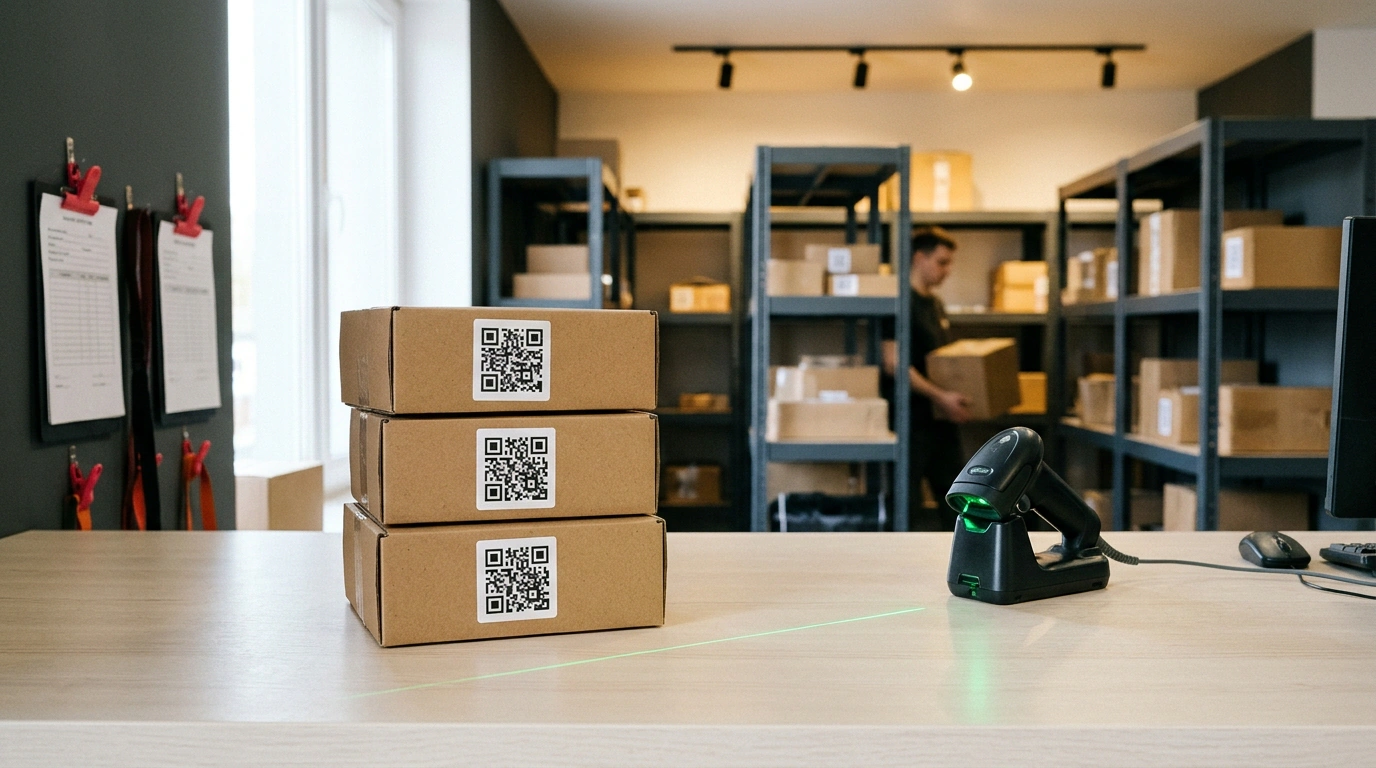
The cramped layout of city points dictates the packaging rule. A ПВЗ is a small storage room with shelves and no conveyors, so every single unit must be pre-labeled with a unique QR code generated inside the shipment request. If you bring boxes with only factory barcodes, the counter operator physically won’t accept the batch.
A 3 p.p. Commission Discount and Zero Storage Through Late January
Unit-by-unit QR labeling takes extra packing time, yet through January 31, 2027 inclusive, Ozon offsets it with two perks: sales commission in nearly all categories is cut by 3 percentage points off the base FBO rate (minus three percent of the retail price), and shelf placement at points costs 0 ₽.
I ran the calculator right away on a fast-moving winter batch—100 thermal mugs priced at 1,500 ₽ each, which you could either van over to the central Koledino warehouse or walk into a nearby ПВЗ. On standard FBO at a 19% commission, the platform withholds 285 ₽ per mug, whereas at a ПВЗ through late January the rate drops to 16% (240 ₽): you keep 45 ₽ per unit and 4,500 ₽ across the hundred. Free shelving and skipping a truck hire to the Moscow suburbs save another 3,000–5,000 ₽ in forwarding costs.
As a result, thousands of rubles stay in your working capital instead of going to carriers and commissions, while nearby shoppers see fast local delivery and order more readily. Until February, the nearest ПВЗ easily beats the distant hub on net margin—all you pay for it is sticking on QR labels by hand.
The February 1 Tariff Flip: Why Slow-Moving Stock Will Eat Your Margin
Starting February 1, 2027, both perks switch off at once: commission returns to standard FBO rates, and point owners introduce a fee of 0.2 ₽ per 1 liter of item volume per day. At large warehouses the platform often grants long grace periods (details are in the breakdown of year-long free storage on Ozon), whereas at a ПВЗ every single day on the shelf becomes paid.
Let’s return to our hundred thermal mugs if demand dips. One mug’s packaging takes up 1.5 liters: if the batch stalls into February, the meter starts ticking at 100 × 1.5 L × 0.2 ₽ = 30 ₽ per day—that’s 900 ₽ a month or 1,800 ₽ over 60 days of sitting idle, on top of full FBO commission.
In my view, this is where a strict assortment filter kicks in: a standard ПВЗ back room holds only 300–400 liters (about 200–300 units of small goods), so bulky boxes or slow movers will hit receiving limits and burn margin daily. Ozon itself explicitly advises sending only SKUs that sell through in 7–14 days.
You certainly don’t need to overhaul all your logistics overnight or try to forecast demand across dozens of cities at the start. Nearly three preferential months through late January give you a comfortable margin of safety with zero shelf fees. Pick one compact, fast-moving SKU, stick unique QR codes on a trial box, and drop it at a nearby ПВЗ—a couple of weeks of live sales will show your sell-through speed and help decide whether to keep that stock at points come February.