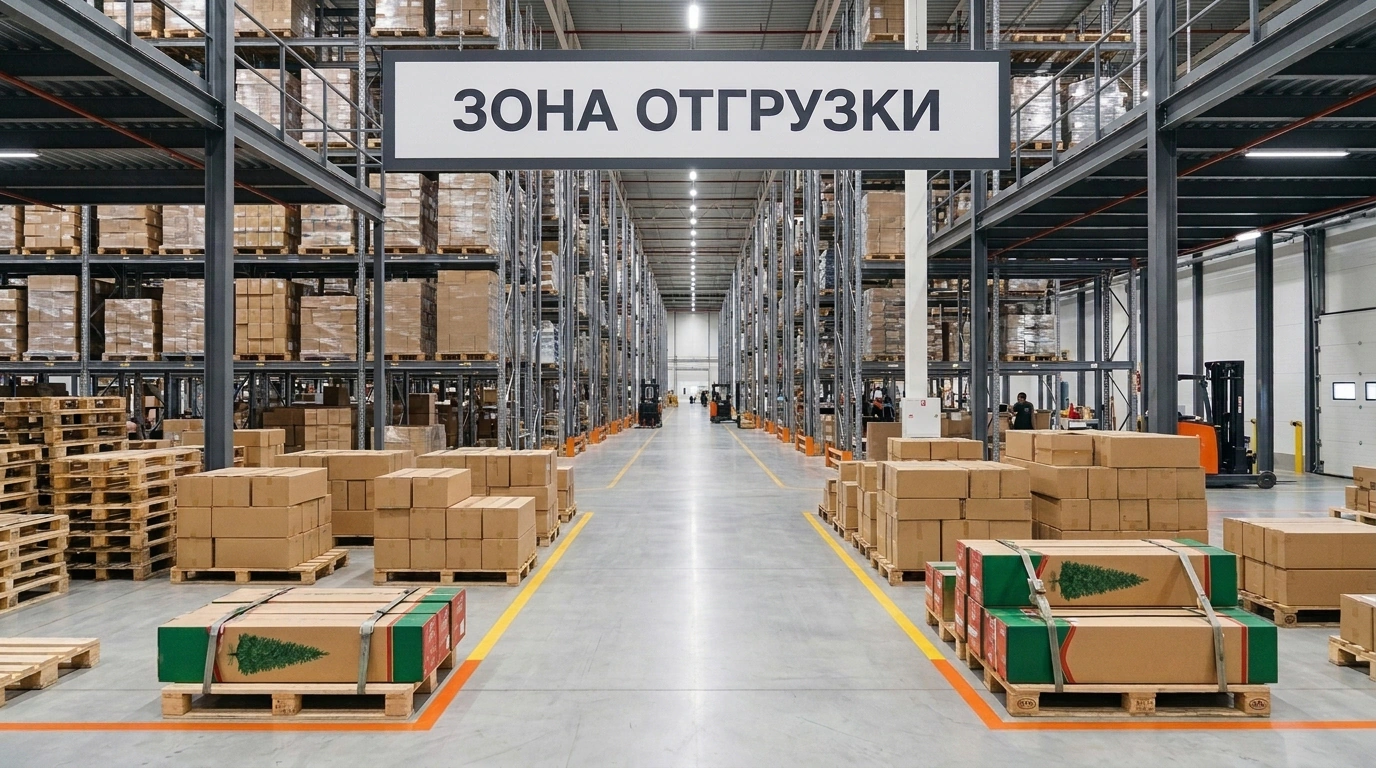
Before peak season, sellers often drift toward two extremes. One is packing a marketplace warehouse to the brim at the last minute and watching paid storage and size penalties eat the margin. The other is keeping all stock in-house and trying to deliver peak orders yourself while couriers fall behind and the next batch stalls in production.
Different demand windows require different logistics setups. For year-end sales, it pays to grab discounted shelves at Yandex Market. Fragile bulky holiday items are safer to ship yourself on Wildberries, while spring home-goods restocks already need planning in November.
Yandex Market: Open Slots at Sofyino and Discounted Storage Through December 31
Ahead of Black Friday and New Year demand, Yandex Market for Sellers opened free supply slots starting November 23, 2026, at the Sofyino-1 and Sofyino-2 warehouses. A slot is a booked time window when the warehouse accepts your truck. Both facilities in the Ramensky district operate 24/7, require an entry pass, and accept boxes up to 200 cm in combined dimensions and up to 25 kg, or pallets up to 500 kg.
The main incentive to ship there in November is discounted storage through December 31, 2026, where Yandex Market waives extra storage fees across all categories. Per Yandex Market help docs and a SelSup guide, this applies to the FBY model, where Market stores your stock and packs and delivers orders.
Since September 1, 2026, every FBY batch gets a free storage period starting the day after secondary acceptance: 365 days for clothing, shoes, and accessories, 120 days for standard goods, and 30 days for bulky items (KGT). If stock doesn't sell within that window, a 90% discount applies to over-limit storage through December 31, 2026. Daily rates drop from 2.5 ₽ to 0.25 ₽ per liter for standard goods and apparel, and from 0.25 ₽ to 0.03 ₽ per liter for KGT, rounded up.
A marketplace warehouse works like a giant train-station locker: as long as your pass is active and the box fits, logistics stay cheap. Yet the size rules are strict. Sofyino-1 (building 3/1) accepts standard items up to 70 × 50 × 50 cm and 15 kg, while Sofyino-2 (building 2/1) takes only up to 50 × 32 × 32 cm and 7 kg. Anything heavier than 15 kg or with one side from 70 to 180 cm must go to the separate Sofyino-KGT hub (quarter 4/218, building 4) strictly on sturdy wooden pallets. Because the discount ends on January 1, 2027, check your batch dates ahead of time in the Excel report on the 'Stock' page in your dashboard.
Wildberries: How to Sell Christmas Trees Using the DBS Model
For a short December spike in bulky goods, a different logic applies. According to the WB Global channel, Wildberries shoppers are already adding +82 new search queries for Christmas trees every day. Sending fluffy boxes to marketplace warehouses is risky: receiving has strict size caps, conveyors easily crush packaging, and unsold January stock turns into expensive dead weight.
For trees, WB recommends the DBS ('Showcase') model—delivery by the seller. The marketplace brings traffic and processes payments, while you handle storage, packing, and doorstep delivery. Boxes skip sorting centers, avoiding both warehouse size limits and marketplace storage fees.
Before launching, WB Global advises covering three basics. First, open only the delivery zones where your couriers or carrier can actually deliver a tree on time. Second, upload detailed photos and descriptions: shoppers can't touch the tree through a screen, so they check height, fullness, and branch material. Third, bundle related items like stands, string lights, and ornaments to raise average order value.
However, DBS only scales as far as your real delivery capacity. You carry full responsibility for delivery speed, transit damage, and returns, and shipping costs must be baked into your price. Overestimating your regional reach in December leads to delays, cancellations, fines, and a drop in your delivery rating.
Curtains and Rods on WB: Why Spring Stock Is Calculated in November
While warehouses process holiday shipments, the prep window for spring categories has already opened. According to SellerDen, Wildberries expects peak demand for curtains and curtain rods in mid-April and advises launching ads in March and April before interest tops out.
You plan the schedule backward from the finish line for each specific SKU. Check your current stock, add manufacturing or purchasing lead time plus shipping and warehouse receiving time, and count backward from March. Your batch needs to hit the shelf before March ads start, not arrive in mid-April after the peak.
Rods and long roller blinds also need a packaging check against WB Partners guidelines. WB classifies items up to 25 kg with one side from 121 to 200 cm—or a three-side sum from 201 to 280 cm—as KGT+. Cargo from 25 to 100 kg, with a side up to 400 cm or a three-side sum up to 1,200 cm, falls into SGT (oversized goods), where DBS is often cheaper from the start. Note that WB's update includes no unit forecast or expected category growth percentage, so counting back from March gets your stock there on time without guaranteeing sales volume.