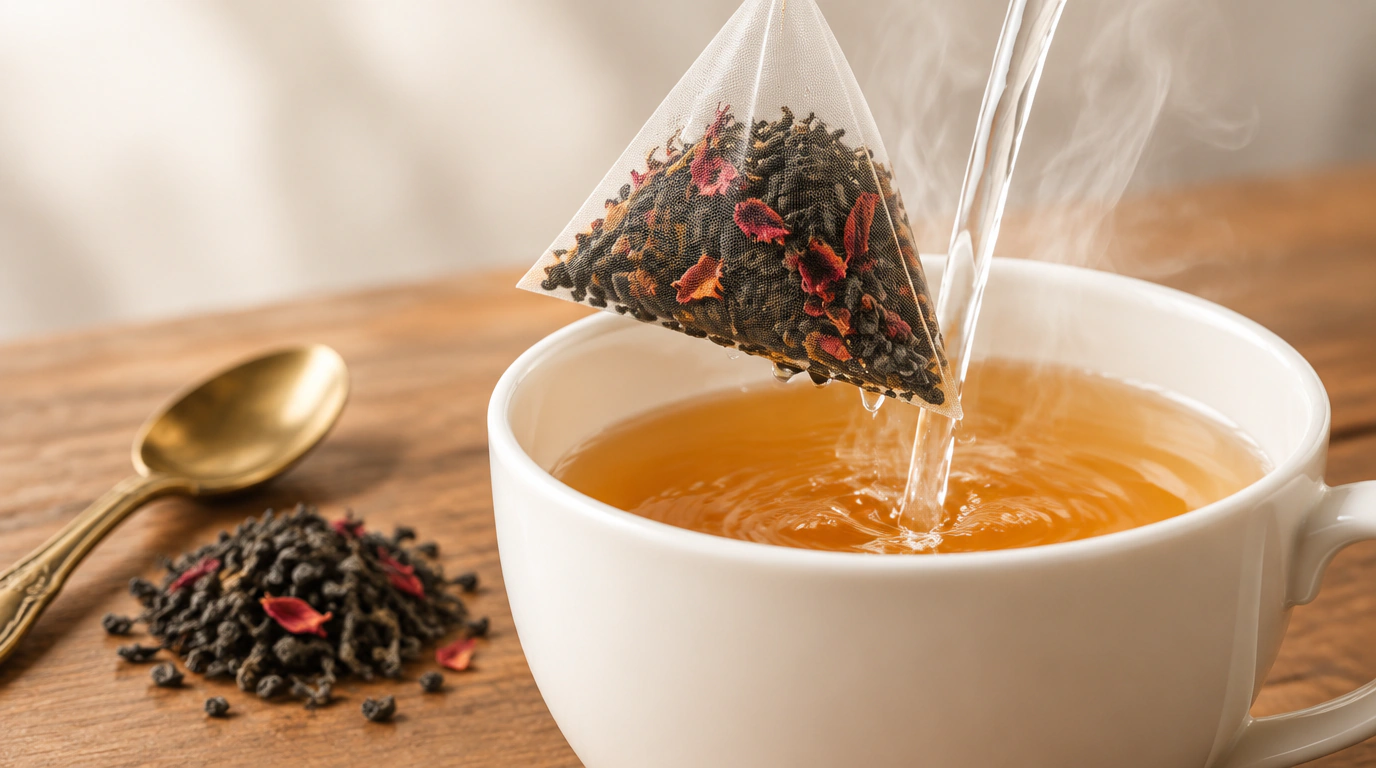
Picture a familiar moment: it's your mid-afternoon break at work, and you pull a sleek, translucent mesh pyramid out of a pretty box. Through the sheer sides, you can see whole rolled tea leaves, dried berries, and cornflower petals. It looks upscale, high-tech, and miles ahead of dusty old paper tea bags. You drop the pyramid into your mug, pour in boiling water... and right alongside that fragrant steep, you brew yourself a dense cocktail of synthetic polymers and hormone-disrupting chemicals.
Endocrinologist Zukhra Pavlova highlighted a recent study published in npj Science of Food (part of the Nature Portfolio). Researchers ran chemical and microscopic analyses on what actually leaches into water when a plastic tea bag meets boiling temperatures. The numbers are striking enough to make you rethink how you steep your daily cup.
Anatomy of the Experiment: Boiling Water vs. Synthetics
The research team approached the question with meticulous precision: they compared 14 popular brands of tea sold in plastic pyramid bags against 14 brands of classic loose-leaf tea.
The test setup mirrored a normal kitchen or office tea break: water heated to exactly 95 °C, steeped for a standard 3 minutes. Next, the researchers filtered the brewed tea through specialized membranes and examined the residue using infrared spectroscopy (ATR-FTIR) and high-resolution optical microscopy.
They wanted clear answers to two questions:
- How many physical polymer fragments shed off the mesh under hot water?
- Which chemicals migrate out of the plastic into the tea while it steeps?
The Microplastic Counter: 2,500 Polymer Fibers Per Cup
Even seasoned toxicologists were taken aback by the particle counts. In every standard cup of tea brewed from a translucent pyramid bag, researchers counted between 555 and 2,498 microplastic particles larger than 100 micrometers.
Spectral analysis confirmed a 100% match: all of those particles were polyamide (PA)—the synthetic nylon used to weave the pyramid mesh. At 95 °C, polymer bonds undergo rapid hydrolytic breakdown. Boiling water softens the ultra-fine threads, causing them to crack and shed thousands of microscopic barbs and fiber fragments straight into your drink.
And what about plain loose-leaf tea? It contained just 0.3 to 2.4 particles per cup—roughly 500 to 1,000 times fewer! Even that tiny background trace consisted mostly of stray dust that inevitably settles on leaves during factory drying and packaging. The contrast is stark: a couple of random specks per pot versus thousands of synthetic fibers in every mug.
Keep in mind that the team only counted larger particles visible under a standard microscope. Nanoparticles (smaller than 1 micron)—tiny enough to slip across the gut lining into the bloodstream—can't even be counted with this method and may number in the billions.
Bisphenol A and Endocrine Disruptors: Hidden Hormonal Noise
Physical nylon shards are only half the story. The other half is purely chemical.
In every sample brewed from plastic tea bags, scientists detected active leaching of free bisphenol A (BPA) and phthalate plasticizers. BPA is a xenoestrogen—a chemical recognized by both the World Health Organization and the European Food Safety Authority (EFSA) as a potent endocrine disruptor.
A BPA molecule happens to mimic the shape of our own primary estrogen, 17-beta-estradiol. That lets it trick cellular receptors, binding to them and firing off false biochemical signals. Even at tiny concentrations, BPA can interfere with thyroid function, disrupt glucose metabolism, raise insulin resistance risk, and affect reproductive health.
In the npj Science of Food study, a single cup of tea steeped in a nylon pyramid delivered up to 21.7% of the EFSA daily safety limit for BPA. Now picture an office worker who drinks four or five mugs a day. The daily safety threshold gets crossed from tea bags alone—before you even count plastic food containers or bottled water.
Pregnant women, nursing mothers, and young children are especially vulnerable to these xenoestrogens: during critical stages of organ development, even low-level hormonal interference carries well-documented risks.
Why "Corn-Based Bioplastic" Doesn't Save You
Some specialty tea brands reassure shoppers: "Our pyramids aren't made from nylon—they're made from biodegradable cornstarch (polylactic acid, or PLA)."
That sounds eco-friendly, yet the physics inside your mug don't care. PLA is still a thermoplastic polymer. When it meets 95 °C water, it undergoes accelerated hydrolysis just like nylon. Instead of polyamide, your cup receives lactic acid oligomers, PLA microparticles, and the industrial plasticizers added to keep the seams strong. Your body doesn't care what plant the polymer started from if it breaks down into microplastics in boiling water.
Switching to a safer daily brew is easier than it sounds:
- Reach for regular loose-leaf tea. Not only is it dramatically cleaner, it usually tastes better and holds richer aromatic oils.
- Steep your tea in chemically inert materials: borosilicate glass, clay, porcelain, or food-grade stainless steel.
- Give dry leaves a quick rinse in a strainer with cool filtered water before steeping to wash away surface processing dust.
- When you truly need the convenience of tea bags (like while traveling), stick to classic rectangular unbleached paper bags without plastic mesh or glue—held together with a staple or cotton thread.
Common Sense Over Panic
There is no need to panic or throw out everything in your kitchen: your liver and kidneys run a capable detoxification system that clears moderate amounts of foreign compounds every day.
Still, when we are talking about a daily habit repeated three or four times a day for years, cutting out an obvious, proven source of synthetic debris is an easy win. Tea should bring you warmth, calm, and antioxidants—not a side serving of microplastics.