Most weight-loss attempts follow the exact same script: an enthusiastic Monday start, cutting out sweets, strict calorie counting... and by Friday, gnawing hunger smashes through every rule until you find yourself staring into an open fridge.
Fitness gurus love to shame people for those slip-ups, blaming weak willpower. Physiology tells a very different story. Trying to outmuscle biological hunger with sheer willpower is a losing battle from day one. Hunger is an ancient survival program: once your brain senses a famine, it cranks up ghrelin to maximum volume and pushes you to hunt down calories at any cost.
Coach and conditioning specialist Artyom pulled together 6 practical tools backed by PubMed research to help you manage appetite physiologically.
1. Keep Protein Front and Center
Protein is your strongest ally during fat loss. It carries the highest thermic effect of food—your body burns up to 20–30% of protein's calories just digesting and processing it. Amino acids also send a strong, lasting satiety signal to the brain.
Artyom suggests a straightforward target: your height in centimeters minus 20–30 grams (so for a 165 cm woman, roughly 135–140 g of protein daily; slightly higher for men). Including cottage cheese, eggs, poultry, fish, or lean meat at each meal builds reliable protection against late-night raids on the pantry.
2. Sleep at Least 7–8 Hours: The Muscle-Loss Experiment
Sleep's impact on fat loss is massive. In a landmark University of Chicago study (Annals of Internal Medicine, PMID 20921542), two groups followed the exact same calorie deficit—one slept 8.5 hours a night, while the other slept just 5.5 hours.
The outcome stunned researchers: both groups lost 3 kg overall, yet the well-rested group lost more than half of that weight as body fat. In the sleep-deprived group, fat loss dropped by 55%, while lean muscle loss jumped by 60%! Short sleep spikes cortisol and ghrelin, pushing your body to burn muscle while clinging stubbornly to fat stores. We've already explained why sleep deprivation is your diet's worst enemy.
3. Trick Stomach Receptors With Fiber Volume
Your stomach can't count calories—it gauges fullness by physical stretch in its smooth-muscle walls. When food presses against stretch receptors, signals zip up the vagus nerve to your brainstem: food has arrived, time to dial down appetite.
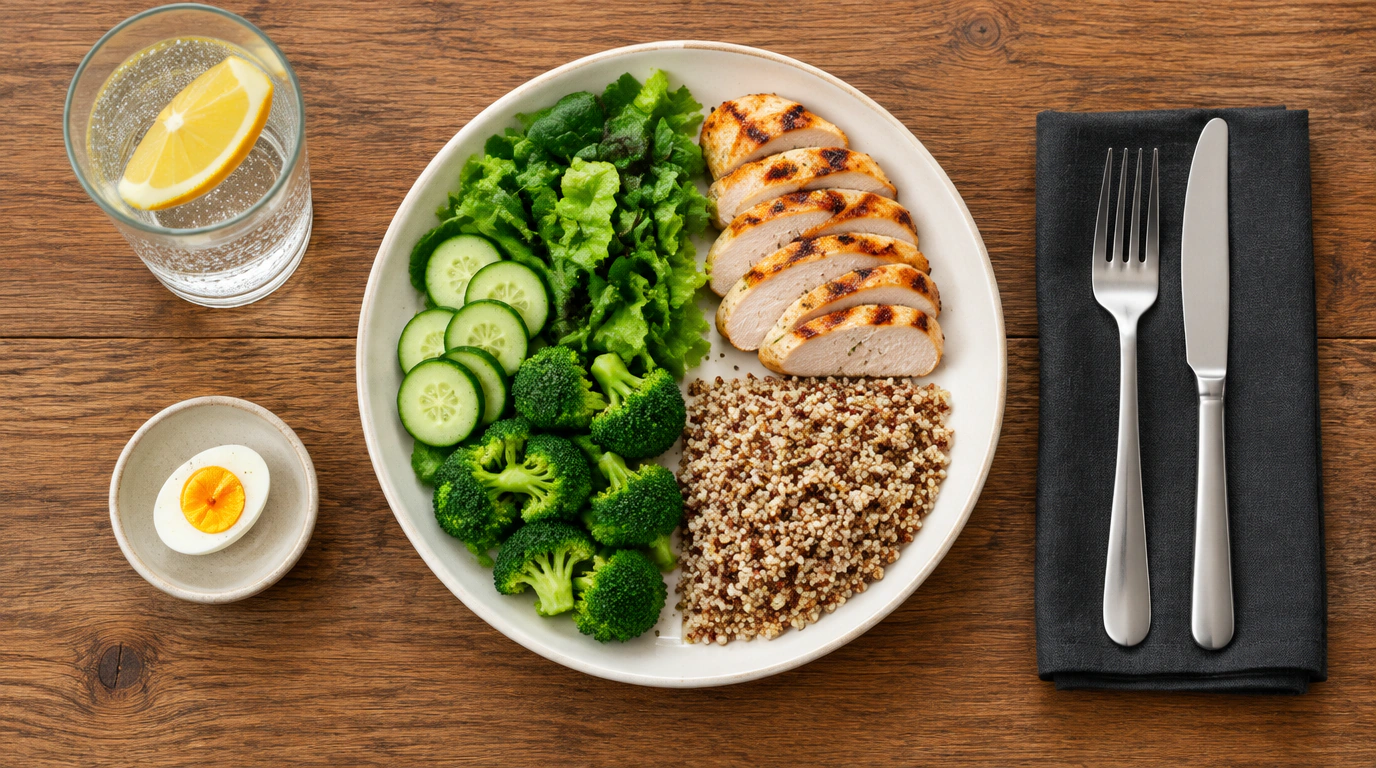
Fill half your plate with cucumbers, cabbage, leafy greens, or zucchini, and your stomach feels pleasantly full for a laughable 50–70 kcal. Aim for 25–35 grams of fiber a day to keep digestion comfortable and hunger quiet for hours.
4. Don't Fear Zero-Calorie Drinks
Plenty of dieters avoid sugar-free drinks out of fear that artificial sweeteners trigger uncontrollable cravings. A meta-analysis of clinical trials (PMID 33168917) showed that drinks sweetened with sucralose or aspartame do not cause overeating compared with plain water. Herbal tea, sparkling mineral water, or a cold zero-sugar soda can fill stomach volume and help you ride out an afternoon snack craving effortlessly.
5. Pair Strength Training With Everyday Walking
Contrary to popular belief, exercise doesn't automatically send hunger spiraling out of control. PubMed research (PMID 38081545) shows regular resistance training improves the release of satiety hormones like peptide YY and GLP-1. Lifting protects lean muscle from breakdown, while casual daily walking (NEAT—non-exercise activity thermogenesis) burns steady calories without taxing your nervous system.
6 evidence-based steps to tame hunger spikes
- Calculate your daily protein target (height in cm minus 20–30 g) and split it across 3–4 meals
- Protect your sleep: aim for 7–8 hours in a cool, dark bedroom
- Add a generous portion of fresh or cooked vegetables to both lunch and dinner
- Keep zero-calorie drinks handy to bridge temporary appetite waves
- Lift weights 2–3 times a week to preserve lean muscle mass
- Log 8,000–10,000 steps of everyday movement outdoors each day
The Bottom Line
Losing weight doesn't have to feel like monastic punishment. By managing meal volume, sleep, and protein, you turn off your brain's hunger alarm and make steady progress calm and predictable.