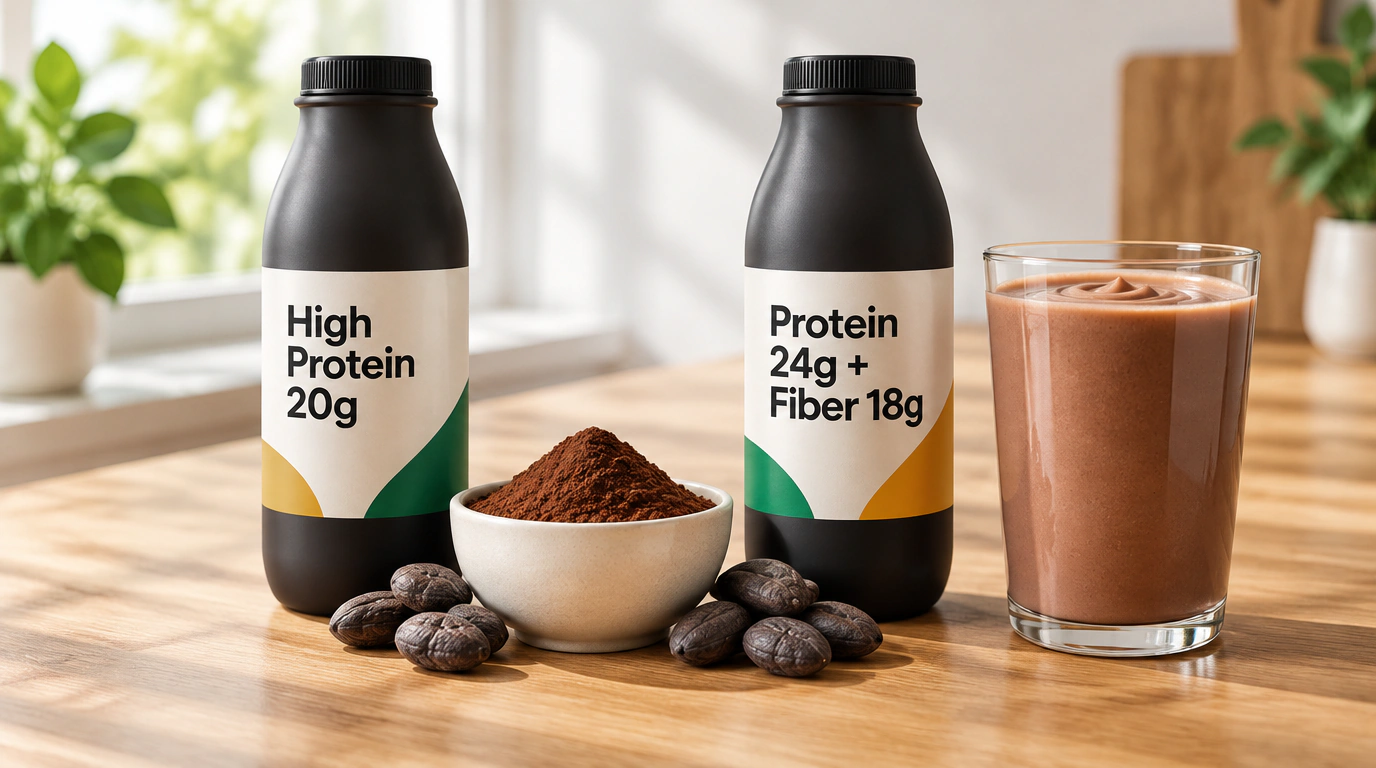
You walk up to the supermarket cooler, grab a bottle labeled "High Protein. 0% Sugar," flip it over... and flinch. Instead of simple pantry staples, the ingredient list reads like a chemistry exam: E407, E955, E950—and in some bottles, even a silicone antifoaming agent (E900) and potassium hydroxide (E525). Any reasonable person's first instinct is to put the bottle right back on the shelf. Do you really have to swallow a lab's worth of industrial chemicals just to get twenty grams of protein?
Food chemist Olga Kosnikova (creator of the Scary Chemistry project) decided to cut through the fearmongering. She pitted two popular chocolate protein shakes against each other—Ehrmann Hyper High Protein and Bombbar Milk Shake Protein—and broke down their formulas piece by piece. Let's look under the hood to see what these ingredients actually do, why those E-numbers are there, and which bottle does a better job for your specific goal.
Round 1: Protein Base and Texture Showdown
Both brands are trying to solve the exact same puzzle: how to pack 20–24 grams of protein into a ready-to-drink shake with zero added table sugar and only 55–60 kcal per 100 ml.
Ehrmann builds its formula on skim milk, cream, and milk protein (casein), delivering an exact 20 g of protein in a 250 ml bottle. Bombbar packs 24 g of protein into 350 ml (6.86 g per 100 ml). One key detail: both shakes are lactose-free. The manufacturers add the enzyme lactase, which splits the complex milk sugar lactose right in the bottle into two simpler sugars—glucose and galactose.
There is a neat food-science trick at work here: the calorie count doesn't drop by a single joule (still 4 kcal per gram of carbs), yet a blend of glucose and galactose tastes noticeably sweeter to your tongue than intact lactose. That gives the shake a gentle natural sweetness before any sweeteners are even added—and lets people with lactose intolerance drink it without worrying about stomach cramps.
When it comes to texture, though, the two drinks are worlds apart. Ehrmann goes down like melted vanilla-chocolate ice cream: completely smooth and silky. That mouthfeel comes from carrageenan (E407), a natural polysaccharide extracted from red seaweed. It forms a delicate gel network that keeps cocoa particles suspended so they don't sink to the bottom as sludge. Bombbar feels thicker and slightly grainy because it relies on a triple thickener system: carrageenan, gellan gum, and tara gum.
Round 2: Sweet Physics—A Duo vs. a Solo Act
The sugar is gone, yet a chocolate shake still needs to taste sweet. Here, the two brands took completely different routes.
Ehrmann went with the industry gold standard: a synergistic blend of sucralose (E955) and acesulfame potassium (E950). Sucralose is 600 times sweeter than sugar, while acesulfame K is 200 times sweeter. Why do food scientists rarely use them alone? It comes down to how your taste buds work. Sucralose clings to sweet receptors (T1R2/T1R3) and lets go slowly, leaving a lingering, clingy aftertaste. Acesulfame K hits fast with an instant burst of sweetness, but on its own it can taste slightly bitter. Paired together, they balance each other's timing, creating a clean sweetness that feels remarkably close to real sugar.
Bombbar opted for a single-sweetener approach using pure sucralose. As a result, it keeps that classic drawn-out artificial aftertaste that turns so many people off sports nutrition drinks. On flavor balance, Ehrmann takes this round effortlessly.
If you are picking out a sugar-free dessert or shake and hate that lingering sweetener aftertaste, look for a blend of two or three sweeteners (such as sucralose plus acesulfame K). Combining different molecules masks each one's weak spots and fools your taste buds much more smoothly.
Round 3: Why Is There Silicone and Lye in My Milk?
The two ingredients on Ehrmann's label that raise the most eyebrows are the antifoaming agent E900 and potassium hydroxide (E525).
Olga Kosnikova explains what actually happens on the factory floor. When hundreds of liters of high-protein milk concentrate get whipped together in massive industrial tanks, they instantly foam up like a giant cappuccino. Without something to knock that foam down, the mixture overflows the vat and the bottling machine can't measure accurate portions.
So food technologists add a microscopic trace of dimethylpolysiloxane (E900)—around 0.00025% per bottle. It is an inert silicone polymer that lowers the surface tension of bubbles. The European Food Safety Authority (EFSA) confirms it is biologically inert, barely absorbed in the digestive tract (less than 0.1%), and passes straight out of the body. The acceptable daily intake is 17 mg per kg of body weight—a 70 kg adult would have to chug hundreds of liters of shakes in a single sitting to approach it.
And what about potassium hydroxide (E525)? That is simply food-grade alkali used for Dutch-processing cocoa. Raw cocoa beans are naturally acidic (around pH 5.2). A tiny amount of alkali neutralizes that acidity to pH 7.0, deepening the cocoa into a rich dark color, smoothing out harsh bitterness, and helping the powder disperse evenly in milk. The alkali is completely used up in that chemical reaction long before the drink ever hits the bottle.
Round 4: The 18-Gram Fiber Trump Card
At this point, it looks like Ehrmann is running away with the trophy. Then you flip to Bombbar's nutrition panel, and the whole picture shifts.
Each bottle of Bombbar hides a massive 18 grams of soluble fiber (5 g per 100 ml). With a daily fiber target of 25–30 grams, one shake covers over 60% of your entire day's needs.
That fiber comes from polydextrose (E1200), a synthesized prebiotic fiber made from glucose, sorbitol, and citric acid. Human stomach enzymes cannot break down its branched chains, so it delivers only 1 kcal per gram. Instead, it travels intact to your colon, where gut bacteria ferment it into butyric acid (butyrate) to nourish the cells lining your gut wall.
Carrying 18 grams of fiber is exactly why Bombbar sacrifices that silky texture and feels thicker. In return, it delivers serious staying power: soluble fiber swells and signals satiety receptors for 3–4 hours. We've previously explored why balancing protein and satiety matters on a diet.
Both shakes contain milk casein, so they are strictly off-limits if you have a true milk protein allergy. Also, 18 g of polydextrose all at once can cause temporary stomach rumbling or gas if your gut isn't used to it—ease prebiotics into your routine gradually.
Which One Should You Grab?
There are no hidden poisons lurking in these ready-to-drink protein shakes: every E-number on the label is doing a specific engineering job—taming factory foam, keeping cocoa suspended, or feeding your gut microbes.
Choosing between them comes down to what you need right now:
- Ehrmann Hyper High Protein is the clear dessert winner. If you want a genuinely delicious, silky chocolate treat alongside your coffee with zero added sugar and 20 g of protein, this is the one.
- Bombbar Milk Shake Protein is a practical hunger-management tool. It trades away some dessert-like smoothness, but 24 g of protein plus 18 g of prebiotic fiber will keep hunger locked down for hours.
Pick the bottle that fits your goal, and don't let intimidating E-codes scare you off—knowing a little food chemistry brings far more peace of mind than label myths ever will.