Behind the short word "flavoring" on a chocolate bar wrapper or a can of low-calorie soda lie months of invisible laboratory work. Long before a food technologist mixes cocoa, water, and sweetener in a factory vat, biotechnologists screen hundreds of thousands of natural extracts in closed research centers—amid sterile microplates, optical sensors, and cell cultures that buyers never see.
It is this behind-the-scenes scientific kitchen that regularly spawns frightening rumors on social media: viral videos claim corporations secretly slip "human embryonic cells" into sweets to trigger addiction. When the unfamiliar code HEK293 pops up in a family group chat, even a skeptic can feel uneasy—so let's calmly sort out whether embryonic cells are really added to chocolate and soda, and why biotech needed this cell line in the first place.
From Loud Headlines to a Dutch Lab: Where the HEK293 Line Came From
Food chemist Olga Kosnikova unpacked the latest wave of panic around the "Overton window" and "industrial cannibalism" in her channel «Страшная химия». The creators of such videos—some YouTube clips rack up 2 million views—tell viewers to search the code HEK293 themselves, misreading the Latin letters like the Russian word for hake fish. You open a reference guide, see the real expansion Human Embryonic Kidney, and spot mentions of contracts between biotech labs and food giants. Without molecular biology context, a discovery like that easily throws people off balance.
What always surprises me here is the contrast between grim speculation and the real history of science. The HEK293 line was created in 1973 by Canadian biologist Frank Graham at Leiden University in the Netherlands, working in Professor Alex van der Eb's laboratory. Ordinary human cells divide only a handful of times in a Petri dish and die, so Graham inserted fragments of adenovirus type 5 DNA into embryonic kidney cells, switching off their "aging counter." The researcher's 293rd experiment succeeded—and that serial number from the lab notebook stuck as the name.
Whether that long-ago sample was taken after a spontaneous miscarriage or a medical termination of pregnancy, decades later even Graham himself could not recall for sure. What matters more is this: over 50 years have passed, and the original tissue no longer exists. The cells gained laboratory "immortality"—the ability to divide endlessly in flasks as long as there is a warm culture medium of water, amino acids, sugars, and salts. In the same way, the HeLa line has lived on since 1951 from a tumor biopsy of 31-year-old Henrietta Lacks: her cells doubled every 20–24 hours and helped create the polio vaccine. Modern generations of HEK293 are like a baker's sourdough starter that has been fed in sterile incubators for half a century without new donors, used to test cancer drugs, neuroreceptors, and vaccines.
A Living Sensor in a Test Tube: How Cells Test Sweet-Taste Receptors
But why did beverage and dessert makers need a medical cell culture? Take a concrete food-lab task: technologists need to cut added sugar in a lemonade by 30–50% without losing a clean sweet taste. Scientists face a library of hundreds of thousands of natural molecules, looking for a new plant-based sweetener or natural sweetness enhancer. Testing unstudied vials on living people is impossible and unsafe: a taster's taste buds would fatigue by the tenth sample, and the compounds' toxicology has not yet been studied.
In 2002, biologists at the US company Senomyx offered a solution in a paper for the scientific journal PNAS, moving taste screening in vitro (into a test tube, outside a living organism). On the human tongue, sweet taste is recognized by a pair of proteins—the T1R2 and T1R3 receptors. Put simply, it is a double keyhole on the cell membrane: when a sugar or sweetener molecule lands in it, the lock clicks and sends a signal to the brain.
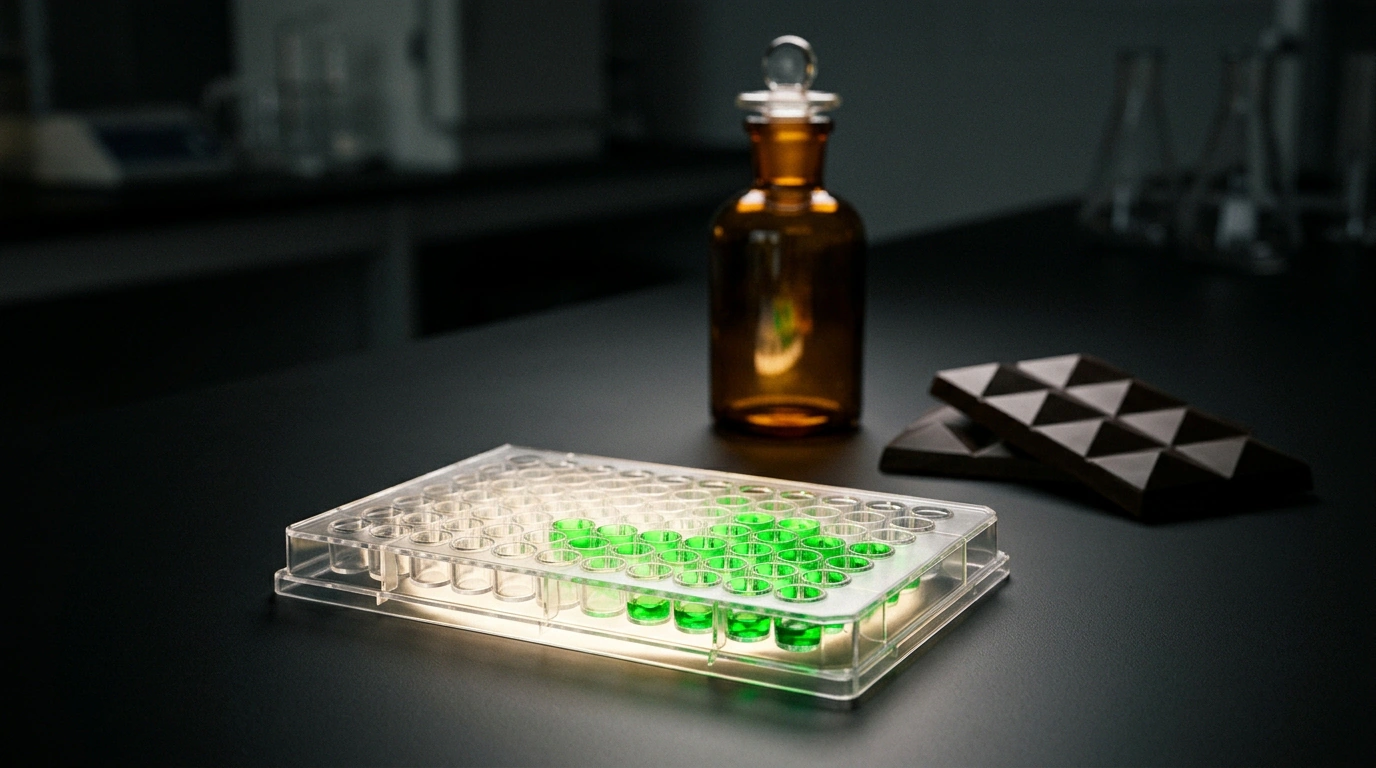
The researchers inserted the genes for T1R2 and T1R3 receptors into HEK293 cells, equipped them with a signaling protein and a calcium-sensitive glowing dye, and dispensed them into microplate wells in nanoliter droplets. When a robot adds a candidate plant sweetener to a well and the molecule fits the T1R2/T1R3 receptor, a calcium response occurs inside the cell: calcium ions are released into the solution, the dye flashes with light, and an optical photometer measures the flash brightness in fractions of a second.
The practical payoff is huge: instead of multi-year trials on volunteers or animals, robots screen hundreds of thousands of compounds in plastic plates in a matter of days. By the brightness of the flash, biologists identify zero-calorie modulator molecules that boost the perception of ordinary sugar by 2–4 times. Technologists get a candidate that lets them cut sugar in a drink nearly in half, while the cell plate itself never leaves the laboratory.
The Boundary Between Test Tube and Factory: Why Cells Are Not—and Cannot Be—in Finished Food
It is right at this junction that the main sleight of hand in "embryo additive" videos is born. Fearmongers describe the work of Senomyx (acquired in 2018 by the Swiss fragrance and flavor group Firmenich) with brands like Nestlé, PepsiCo, and Kraft Foods as if scientists grow HEK293 biomass in vats and truck it to candy factories. Viewers are fed a straight line: if taste was tested on cells, then cells ended up inside the chocolate wrapper.
In reality, a blank wall separates the analytical assay from the food production line. The moment the photometer catches the calcium flash and points to a promising plant-sweetener molecule, the HEK293 cells' mission is over—the plastic plate is disposed of right at the research center. What goes to manufacturing is not a vial of biological material, but only the chemical formula of the discovered compound, which follows a strict path:
- The molecule is synthesized from scratch chemically or extracted from plants at an ordinary plant where cell lines are nowhere in sight.
- The pure compound undergoes toxicological review by regulators—the US FDA under GRAS safety status and the European EFSA.
- Into the finished drink or dessert, the approved flavoring is added in parts per million per kilogram or liter of product.
Calling a cellular biosensor an ingredient is like seeing a rubber crash-test dummy in an auto safety test and assuming pieces of the dummy are baked into the engine of every new car. Finicky cells survive only in a sterile incubator: there is physically no way for them to end up in hot chocolate or soda. And you can read about how approved sweeteners actually work in sugar-free drinks in our breakdown of chocolate protein shake ingredients.
Anatomy of a Conspiracy Theory and Common Sense at the Store Shelf
Why is this myth so persistent? The first wave of protests rose in 2011–2012 in the US, when activists demanded that Senomyx's partners drop any research involving fetal cell lines. Corporations like PepsiCo and Campbell Soup had to issue denials and wind down contracts to calm shareholders, and click-chasers still recycle those old headlines today.
Under calm scrutiny, such stories give themselves away with glaring blunders. One detail from Olga Kosnikova's breakdown made me smile: conspiracy theorists scare parents with Kinder Surprise eggs from "wicked Nestlé," without even checking that the Kinder brand belongs to Italy's Ferrero, which never worked with Senomyx. Just as naive is the "cannibalism addiction" theory: your hand reaches for a second square of chocolate because of the mix of sugar, cocoa butter, and familiar habits, as clearly shown in our breakdown of the physiology and culture of chocolate cravings.
When someone forwards a video about a "secret code" in food, separate two questions: what instrument tested the molecule in the lab, and what actually went into the factory vat. Only purified substances that have passed toxicological review make it into recipes, while brand mix-ups and shouts about the "Overton window" infallibly give away clickbait.
When caring for your health, a sense of proportion is always more reliable than panic boycotts. It makes complete sense to flip over a chocolate bar or a bottle of soda to check the amount of ordinary sugar and extra calories—their regular excess truly affects weight and well-being. By contrast, hunting labels for traces of imaginary cells and fearing unfamiliar biotech terms does not protect your body; it only turns an ordinary dinner into a source of chronic anxiety.