In this breakdown, we'll answer a specific question: why can you wake up exhausted for months and lose hair with a textbook complete blood count—and which exact markers reveal your true iron stores before overt anemia sets in?
When you have no energy in the morning, it's easiest to blame poor sleep or the weather. But as endocrinologist Zukhra Pavlova points out, chronic fatigue often hides latent (hidden) iron deficiency that a basic screening test misses.
The Illusion of a Normal Test: Why Hemoglobin Is the Last to Drop
Let's look at a real scenario. A 32-year-old woman visits a clinic complaining of fatigue and brittle nails. Her complete blood count shows hemoglobin at 128 g/L (with the normal range for women starting at 120 g/L), and the doctor reassures her: "You don't have anemia—take some vitamins." So why does she have no energy?
I compare iron metabolism to a household budget. About 65–70% of the trace element works in the "operating cash register"—inside red blood cell hemoglobin, carrying oxygen. Another 20–25% sits in reserve—in the protein complex ferritin in the liver, spleen, and bone marrow—while the rest works in muscles (myoglobin) and cellular enzymes.
A strict chain of command applies here: when losses exceed intake, the body protects oxygen delivery to the very last. As stores dwindle, the body drains its ferritin warehouses and shortchanges skin, hair, and muscles just to keep hemoglobin steady. That's why a complete blood count stays normal until tissue depots are nearly empty.
Symptoms of Tissue Starvation: From Diffuse Hair Loss to Craving Ice and Chalk
Once reserves are depleted, fast-dividing cells and muscle tone take the first hit:
- Fatigue and hypoxia: feeling worn out even after 8–9 hours of sleep, and shortness of breath when climbing stairs.
- Hair and nails: diffuse hair shedding, dry skin, transverse ridging, and brittle nails.
- Nervous system and altered cravings: anxiety, irritability, and a strange urge to chew ice, chalk, or inhale the smell of gasoline, paint, and damp earth.
At higher risk are women with heavy periods, pregnant and breastfeeding women, people who avoid meat, and patients with GI malabsorption (gastritis, celiac disease). We covered how to tell micronutrient shortfalls apart from plain tiredness in our piece on burnout, depression, and hidden deficiencies.
The Lab Panel: Why Ferritin Is More Informative Than Serum Iron
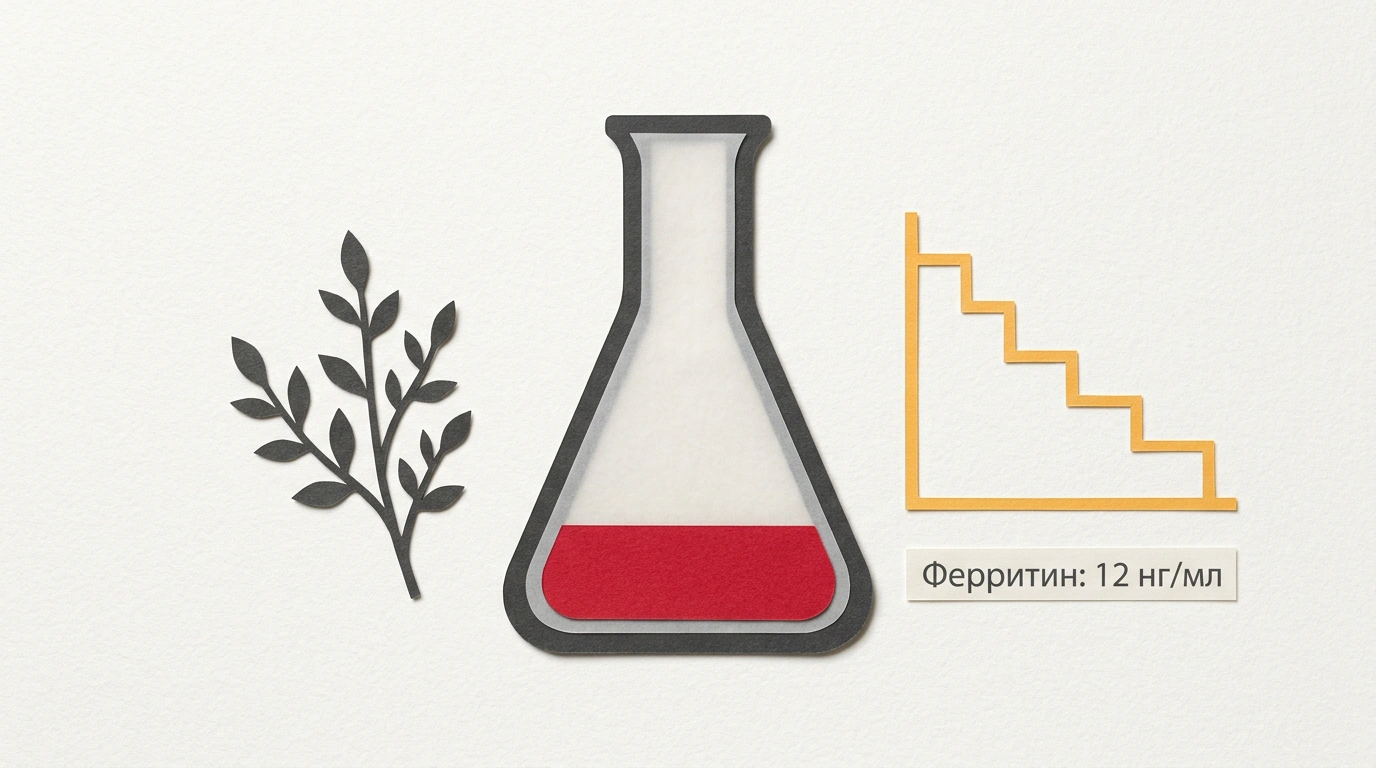
Back to our patient: a biochemical panel reveals her ferritin is 12 ng/mL. According to WHO guidelines, a level below 15 µg/L (ng/mL) in adults means completely depleted stores, while a clinical target threshold is 30–40 ng/mL or higher. That's why her tissues were starving despite textbook hemoglobin.
Testing "serum iron" alone is pointless: it fluctuates over 24 hours and depends on last night's dinner. As confirmed by a clinical review in NIH/NCBI, you need a combination of markers:
- Ferritin — the primary marker of tissue stores.
- C-reactive protein (CRP) — a check for inflammation. Ferritin is an acute-phase protein: during a cold or inflammation it can falsely spike to 80–120 ng/mL, masking a deficiency (we discussed this in our article on why a single ferritin number isn't a diagnosis).
- Transferrin and transferrin saturation — against a normal range of 20–50%, a drop below 16–20% exposes tissue starvation.
Plate vs. Pill: Heme Iron Bioavailability and the Risks of Self-Medicating
It's tempting to load up on buckwheat and apples or order a bottle of "Iron" online, but let's calculate what skipping proper testing actually costs.
From red meat, liver, turkey, and fish we get heme iron, which is absorbed at 15–35%; a serving of red meat 2–3 times a week maintains balance well. In buckwheat, spinach, and apples, the iron is non-heme: it is absorbed at only 2–8% and is blocked by tannins in tea and coffee as well as calcium. You can't refill empty stores with porridge alone, yet taking pills blindly is dangerous too.
The body has no mechanism for rapidly excreting excess iron. Without a confirmed deficiency—or in hemochromatosis—excess iron acts as an oxidant, damaging the GI lining, liver, and blood vessels. Self-treating can also mask hidden blood loss in the stomach or intestines (ulcers, polyps), delaying a necessary doctor's visit.
Any pill gives only temporary relief if the root cause of blood or iron loss isn't addressed. So before buying a supplement, ask yourself one quick check question: am I about to take iron blindly based on symptoms—or do I have ferritin, transferrin saturation, and a doctor's plan to find the source of the loss?