When an awkward turn of your head on the pillow locks up your neck and your lower back aches by evening, people usually pick one of two tactics. The first is blaming the age on your passport, rubbing gel on your shoulder, and moving as little as possible. The second is forcing yourself into the gym for heavy strength training—only to wonder why the back of your head feels even more like stone after squats.
Both paths miss the main point: it's neither aging nor weak willpower. Studying biomechanics coach Olga Kutuzova's breakdown (РАСТЯЖКА С КУТУЗОВОЙ) and the anatomy of muscle chains, I noticed a simple pattern: the body doesn't break down after thirty—it faithfully adapts to the posture it spends the day in. And you can break that chain of tension without grueling workouts.
The Domino Cascade: How Crossing Your Legs Links Your Foot to the Back of Your Head
A telling case was shared by one of Olga Kutuzova's followers—a 28-year-old woman. At twenty, she could dance all night at a club and run to morning classes without fatigue. Now she trains consistently for two hours a week, yet even after a 30-minute walk her back aches and her toes cramp.
In our youth, sitting was broken up by dashes between classes; today we sit for 8 hours at a computer and with a smartphone, swap walking for taxis, and carry a bag on one shoulder. The habit of sitting cross-legged tilts the pelvis, compresses the sciatic nerve area, and locks up the ankle, triggering a "domino effect":
- Foot and shin: a cramped foot arch (hence the toe cramps) pulls on the calf muscle via the Achilles tendon.
- Thigh and pelvis: the calf tugs on the hamstrings, robbing the pelvis of mobility.
- Lower back and neck: trying to hold the torso upright over a tilted base, the spinal erectors and trapezius lock into spasm.
A Sweater Made of Fascia: Why Your Lower Back Works Overtime for Switched-Off Glutes
Why do your back and neck pay the price for a seated posture? Studies on postural adaptation (PubMed) highlight two mechanisms.
The first is reciprocal inhibition. From prolonged sitting, the hip flexors and hamstrings shorten, and the nervous system reflexively "switches off" the gluteus maximus. Without the pelvis's main stabilizer, the quadratus lumborum and thoracolumbar fascia take over the load: on a walk, your lower back is literally doing the walking for your sleeping glutes.
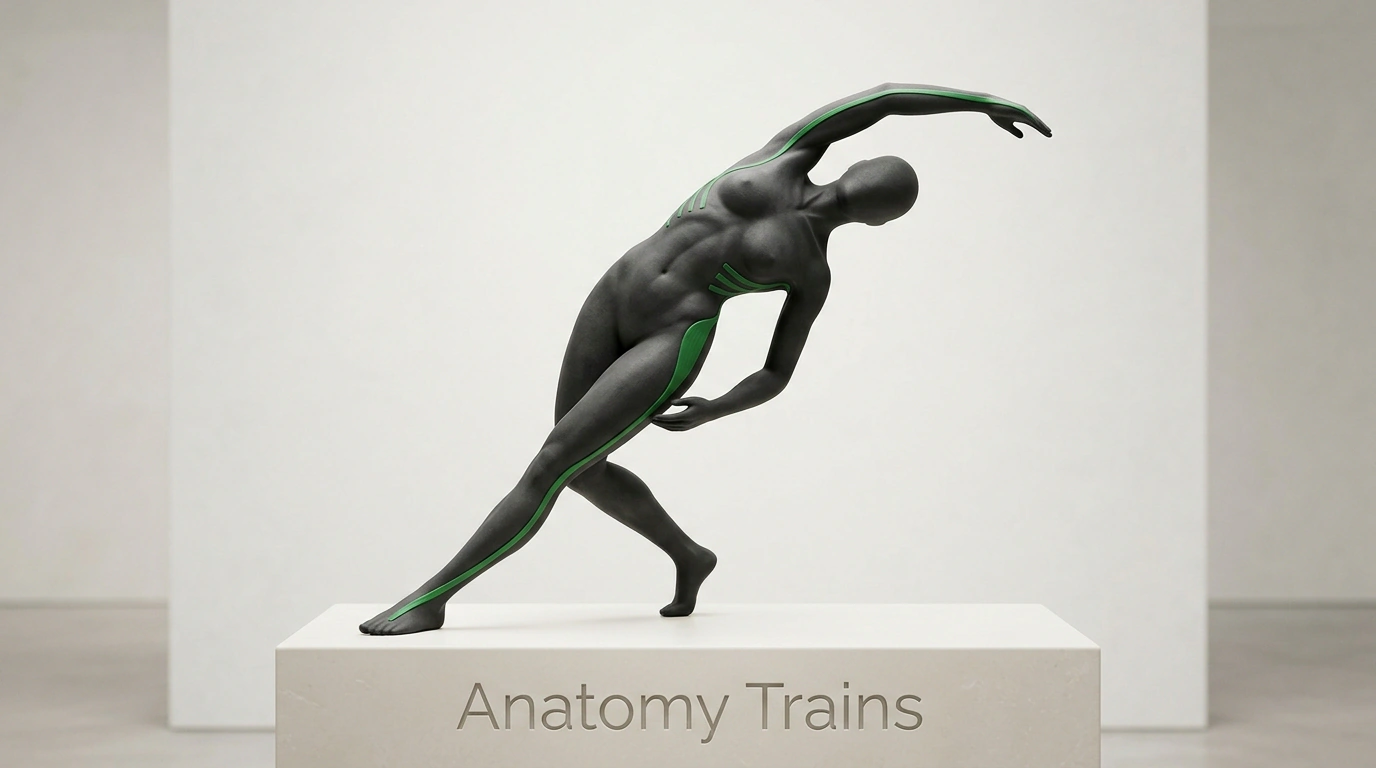
The second mechanism was described by Thomas Myers in the "Anatomy Trains" model (Anatomy Trains). Muscles are wrapped in a continuous sleeve of connective tissue—fascia. Picture a knitted sweater: if you sit on its hem near the hip, the pulled seam tugs on the collar and starts pressing on your neck.
In the body, that seam is the lateral myofascial line—running from the foot and fibular muscles through the iliotibial band of the thigh, gluteus medius, obliques, and intercostal spaces up to the base of the skull behind the ear. Together with the latissimus dorsi, it links the pelvis, ribs, and shoulder. When sitting cross-legged tightens one side, the rib cage tilts and the neck turns to stone. Forcing your shoulder blades together won't help here—we already covered why you shouldn't forcibly straighten your back when your shoulders are locked up.
The Mechanics of Side Stretches: Cross-Step, Hand Position, and Breathing into the Ribs
To smooth out that tight "seam" from foot to neck, Olga Kutuzova recommends a side-stretch exercise:
- Cross-step. Stand with feet hip-width apart and step your right foot back and across behind your left. Begin leaning with weight grounded in the right foot, and at the top of the reach shift your weight onto the front, slightly bent left leg, opening the pelvis.
- Dropped shoulder blade and active hand. Reach your right arm out and overhead into a side bend to the left, keeping the shoulder blade down away from your ear. Flex the wrist: pull your fingers back toward you, pushing an imaginary side wall with the heel of your palm and then the ceiling at the top, engaging the arm fascia and latissimus dorsi.
- Breathe into the ribs. At the peak of the side bend, inhale into your lower right ribs, using the diaphragm to expand the intercostal muscles from the inside. Exhale as you lower the arm with the flexed hand and return your weight to both feet.
Move strictly in the lateral plane without leaning forward. If you have hip osteoarthritis or femoroacetabular impingement, keep the cross-step minimal and pain-free.
A Three-Minute Reset at Your Desk
Do 4–6 smooth repetitions per side in rhythm with your breath. The routine takes 3 minutes by your desk every two to three hours of work, with no mat required (and in the evening, you can pair it with back and neck decompression on a rolled blanket).
Don't worry if you mix up your supporting leg the first time or forget to flex your hand on the exhale. Perfect choreography isn't the point: even a couple of calm side breaths in the middle of the day tell your ribs, lower back, and neck that the fascial "sweater" is no longer pulling and you can move freely.