After eight or nine hours at a desk, your body sends unmistakable signals: your shoulders creep up toward your ears, the spot between your shoulder blades burns like a hot poker, your neck feels locked in concrete, and by evening a dull ache settles at the base of your skull. "Tech neck" and office stiffness are familiar to anyone who earns a living in front of a screen.
Your first instinct might be to book a massage, yet a therapist only loosens tight trapezius muscles temporarily. Tomorrow you sit back down at your laptop, slouch forward, and the knot snaps right back.
Stretching and healthy-movement coach Alyona Kutuzova recommends a simple evening reset you can do at home without stepping into a gym. I checked the biomechanics of thoracic mobilization in the Journal of Physical Therapy Science.
Let's look at how a simple rolled-up blanket melts static tension out of your spine—and why a hard plastic foam roller actually makes things worse here.
Why a Hard Foam Roller Fails for Relaxation
When your back aches, the classic move is grabbing a firm, ridged foam roller and crunching your spine over it.
In evening relaxation biomechanics, that's a major mistake:
- A rigid plastic cylinder creates an unstable, painful surface;
- Your body reflexively guards against the discomfort: deep spinal and neck stabilizers clench even tighter to keep your balance;
- Instead of releasing tension, you end up with a fresh muscle spasm.
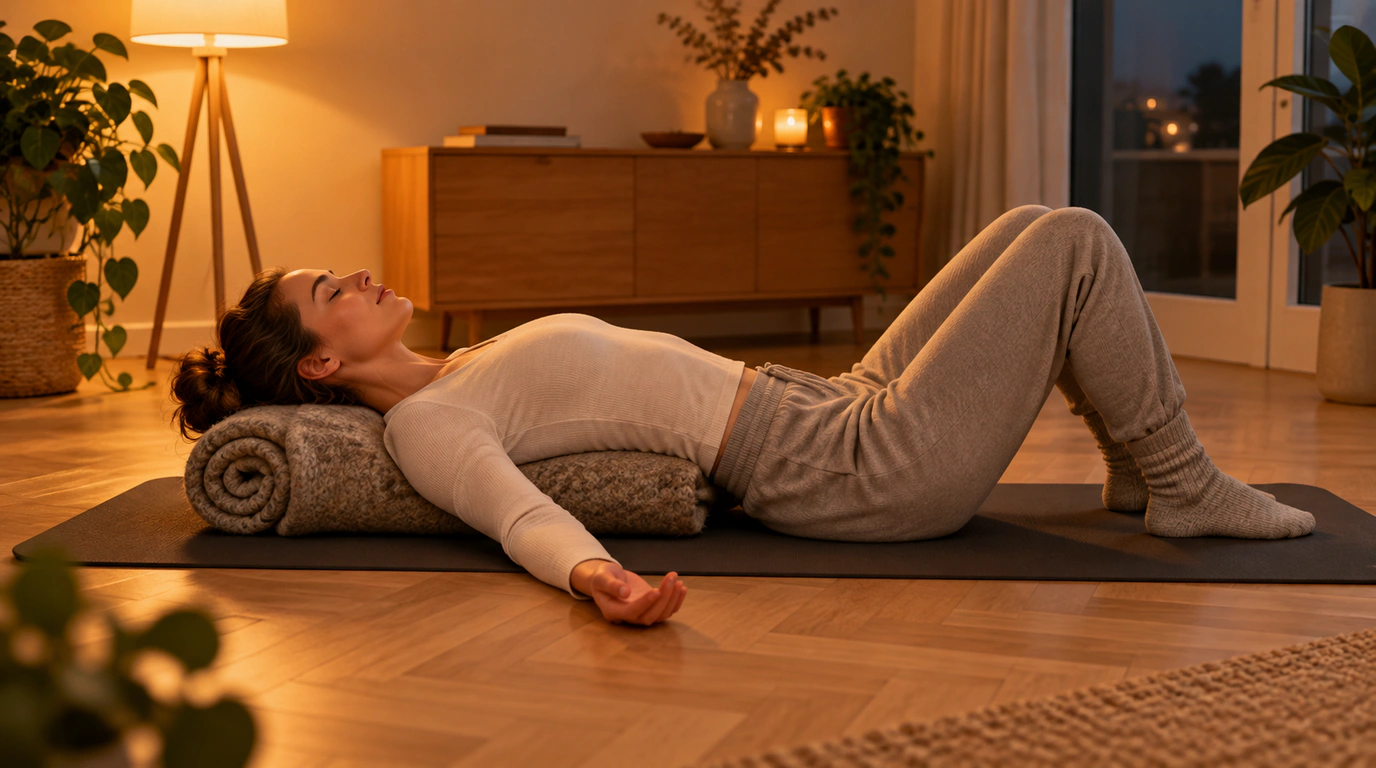
For passive decompression, you need moderately yielding support: a yoga bolster or a tightly rolled wool blanket 12–15 centimeters in diameter. The blanket molds gently beneath the curve of your spine, letting your body fully surrender to gravity.
We previously examined the biomechanics of static strain in our article on upper-back tension and why massage alone won't fix it without movement.
The Anatomical Rule: Keep Your Pelvis on the Floor!
When lying lengthwise along the bolster, follow one non-negotiable rule: your pelvis must stay on the mat, never perched up on the roll.
If your hips sit on the bolster, your lower back collapses into an uncontrolled arch, jamming your lumbar facet joints (L4–S1). When your pelvis rests flat on the floor with knees bent at 90°, your lower back stays neutral and the stretch isolates your stiff thoracic spine instead.
Research in the Journal of Physical Therapy Science confirms that passive thoracic extension over a soft bolster restores costovertebral joint mobility and improves diaphragm excursion.
Never sit straight up off the bolster like you're doing a crunch. Rising from an extended spine causes a sharp spike in intradiscal pressure. To finish the session, gently roll onto your right side, press up with your hands, and then come to a seated position.
10-Minute Evening Bolster Routine
- Roll a firm blanket into a snug cylinder 12–15 cm in diameter
- Lie with your spine along the roll: pelvis on the floor, head supported, feet flat on the mat
- Do 8–10 slow rounds of opening your arms wide ('tree hug') on a deep inhale
- Do 8–10 alternating scissor arm reaches overhead and down to mobilize your shoulder blades
- Rest passively for 2 minutes: arms open wide, palms up, breathing deeply into your belly
- Roll gently onto your side to sit up
Ten quiet minutes of evening decompression peel off the fascial armor of the workday, calm your vagus nerve, and prepare your body for deep, genuinely restorative sleep. Try it tonight—your back will thank you.