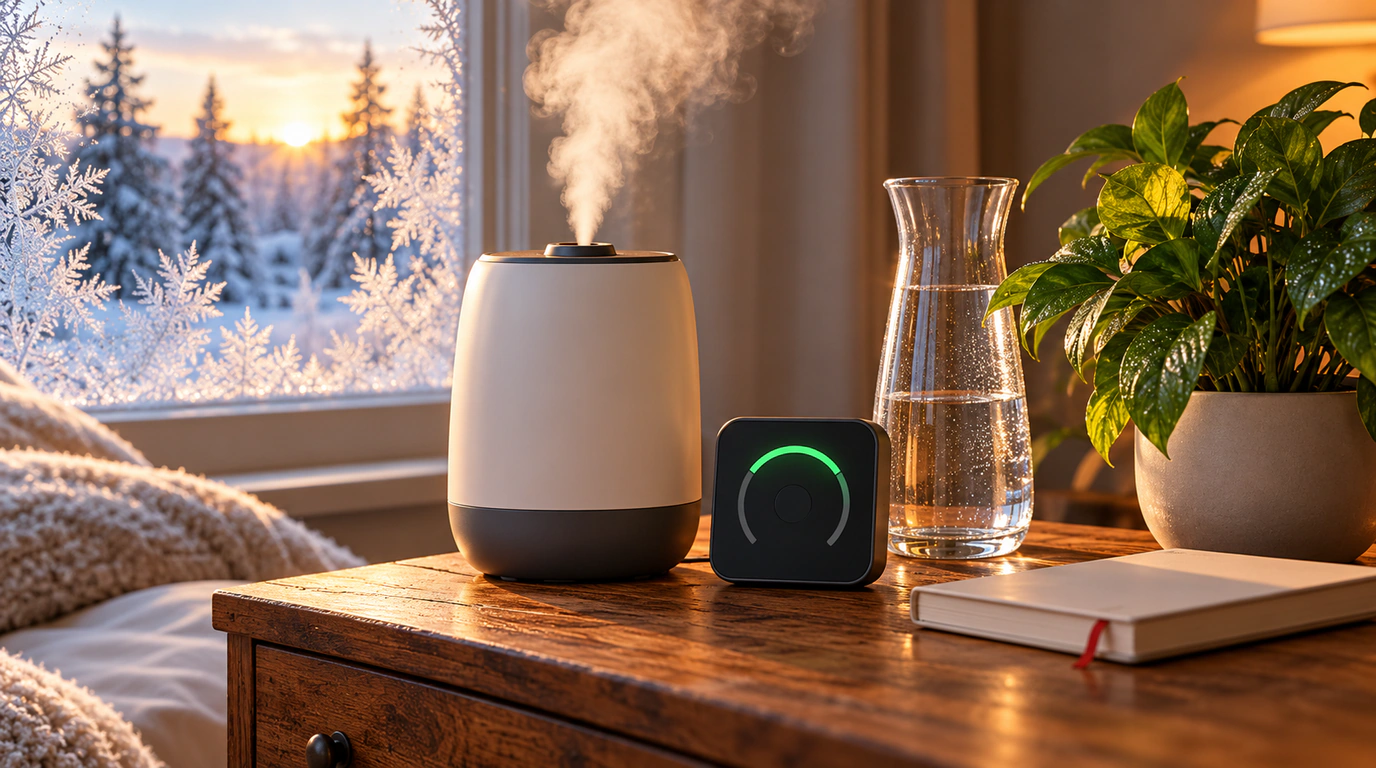
Every heating season starts the same way: you wake up with a parched throat, dry crusts in your nose, watery eyes, and skin practically begging for moisturizer. Any sensible person's first thought is, "Time to turn on the humidifier." We set the device on the nightstand and assume we're protecting our airways from seasonal colds.
But have you ever wondered what's actually inside that cozy cloud of mist? Why can a device meant to protect your health turn into a home generator of hazardous mineral smog and a breeding ground for thermophilic fungi after one small mistake?
I dug into the clinical evidence, official U.S. Environmental Protection Agency (EPA) standards, and medical breakdowns by Dr. Burlakov. Let's take this mechanism apart piece by piece: how dry air helps viruses storm our defenses, why ultrasonic models filled with tap water are risky for your alveoli, and how to build a healthy bedroom microclimate.
The Physics of Winter Air: Why Radiators Dry Your Home Out More Than the Sahara
To see the scale of the problem, let's revisit high school physics. Relative humidity is the percentage of water vapor in the air compared to the maximum amount the air can hold at its current temperature before condensation forms.
And here lies the great winter paradox. Freezing outdoor air at -10 °C physically cannot hold much moisture: its saturation limit is just 2.4 grams of vapor per cubic meter. Even at 80% outdoor humidity, each cubic meter holds a modest 1.9 grams of water.
When we crack a window, that air enters the apartment and gets heated by radiators to +22 °C. Warm air has a completely different capacity: at +22 °C, it can hold up to 19.4 grams of vapor per cubic meter! The actual amount of moisture stays the same (1.9 g), while capacity jumps tenfold. As a result, indoor relative humidity plummets to 10–15%. For comparison, the Sahara Desert averages around 25% humidity year-round. Your apartment turns into an arid desert that greedily pulls water out of your skin and mucous membranes.
We previously looked at how harsh seasonal shifts affect barrier immunity in our article on cold season and proven prevention measures. Overly dry air hits our first line of defense hardest of all.
Mucociliary Clearance: How Dry Air Breaks Your Living Escalator
Our bodies are protected by a natural conveyor belt called mucociliary clearance. The surface of your airways is lined with millions of microscopic hair-like cilia. On top of them sits a two-layer blanket of mucus: a watery bottom layer lets the cilia beat freely, while a sticky top layer traps dust particles and viruses.
The cilia beat in sync up to 15 times per second, working like an escalator. This living conveyor pushes mucus and trapped pathogens up and out toward your throat. When humidity drops below 30%, the mucus dries into a thick crust. The cilia literally get glued down and stop moving. Your living escalator stalls, giving viruses an open path to your epithelial cells.
At the same time, viral aerosols behave differently too. In air at 40–50% humidity, large cough droplets settle quickly to the floor, and the salts inside each droplet concentrate enough to disrupt the influenza virus envelope. In a dry room, droplets evaporate almost instantly into ultralight "droplet nuclei" smaller than 5 micrometers. They float for hours on warm radiator drafts and travel straight into your alveoli.
Turning an ultrasonic humidifier up to max seems like an obvious fix. Yet that's where the hidden danger begins.
An ultrasonic membrane vibrates at 1.7 MHz, mechanically shattering water into a microscopic mist. If you pour in ordinary tap water, the device atomizes dissolved hardness minerals (calcium, magnesium, carbonates). The water evaporates, leaving solid PM2.5 particles suspended in the air that settle deep inside your lung alveoli.
Mineral Smog and 'Humidifier Lung': What Isn't Printed on the Box
Ultrasonic humidifiers are quiet and affordable, but their membrane has no filter—it sprays out everything in the tank. Fine mineral particles smaller than 2.5 micrometers (PM2.5) stay airborne. In a closed room with an ultrasonic unit running on tap water, PM2.5 levels can spike to 200–500 µg/m³ (compared to the WHO safe guideline of up to 15 µg/m³). Your bedroom ends up with particulate concentrations rivaling industrial urban smog, irritating your alveoli and triggering a dry cough.
Infographic cross-section of an ultrasonic humidifier showing a cloud of PM2.5 mineral dust particles alongside a clean stream of demineralized water.
The second threat in any water tank is microbiology. At room temperature, a slimy biofilm of bacteria and mold spores (Aspergillus, Cladosporium) forms on tank walls within 24–48 hours. An ultrasonic unit blasts these microbes straight into the air you breathe. Pulmonologists recognize a specific condition called hypersensitivity pneumonitis, or "humidifier lung," whose symptoms mimic a lingering flu with shortness of breath and chills.
Trying to disinfect the water with chemicals is even more dangerous. In South Korea, widespread use of humidifier disinfectants containing PHMG and PGH caused severe lung fibrosis and hundreds of deaths. That's why you must never add antiseptics, chlorine tablets, or essential oils to humidifier water.
Device Lineup: Ultrasonic, Evaporative, or Steam?
To make sure humidification helps rather than harms, it helps to know how the three main types differ:
- Evaporative humidifiers (air washers):
- A fan blows air through a rotating plastic drum or a moistened wick filter.
- Hardness minerals physically cannot lift off the discs or wick—they stay behind in the basin instead of entering the air. No white dust and no PM2.5, even with regular tap water. They also physically cannot over-humidify a room past 55–60%. Downsides: regular drum cleaning and fan noise.
- Steam vaporizers:
- A heating element boils water and releases warm steam.
- The steam is completely sterile, and minerals stay behind as scale. Downsides: high power draw (300–500 W vs. 25–40 W for ultrasonic) and burn risk around children.
- Ultrasonic models:
- Whisper-quiet and efficient, but they strictly require demineralized water (reverse osmosis) or distilled water.
The Golden Corridor: Why Going Over 50% Humidity Backfires
Official U.S. EPA guidelines set the safe indoor humidity range at 30% to 50%.
Pushing past 50% invites condensation on window frames and wall corners, sparking rapid black mold growth. High humidity above 50% also fuels dust mite (Dermatophagoides) reproduction, whose droppings are a potent household allergen. The sweet spot for your health is keeping humidity squarely between 40% and 50%.
Safe Humidifier Operation Checklist
- Relative humidity is monitored with a standalone hygrometer in the 40–50% range
- Ultrasonic units are filled only with distilled or reverse-osmosis water
- Remaining tank water is dumped daily and the reservoir is wiped dry
- Every 3 days, the working chamber is cleaned with a 3% vinegar solution to remove scale and biofilm
- No antiseptics, alcohol, chlorine, or essential oils are ever added to the tank
Will a humidifier prevent every winter cold? Studies show a modest 10–15% drop in respiratory infections, since hand-to-face contact transmission remains unchanged. What it does brilliantly is solve a basic anatomical problem: it keeps your airway cilia moving, stops you from waking up with a desert-dry mouth, and protects your mucous membranes. Just use clean water and stay on top of tank hygiene.