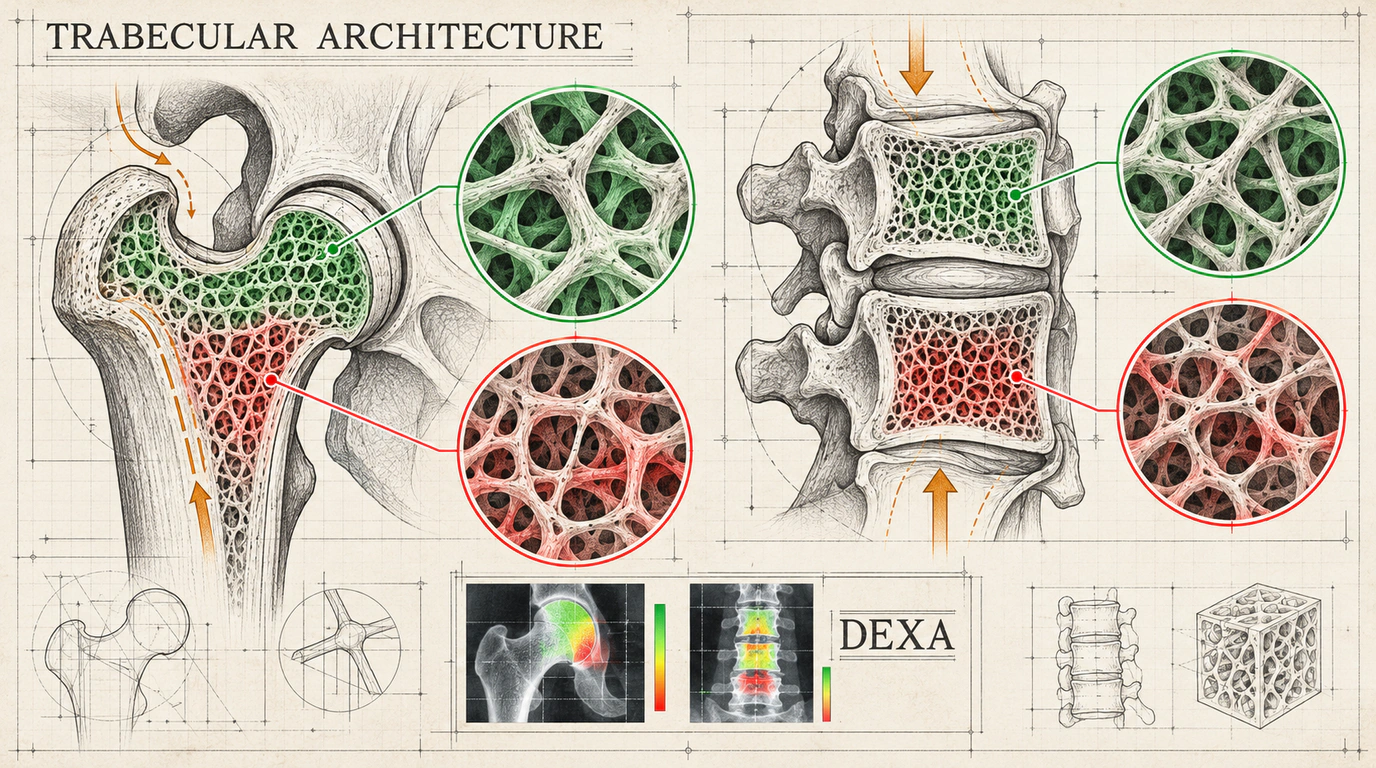
We usually connect musculoskeletal problems with pain: a pinched lower back, a clicking knee, or an aching shoulder gets our attention and sends us to a doctor. Osteoporosis plays by different rules. Physicians call it the "silent epidemic" because bones can lose mineral density for years without a single ache or crackle—right up until your first surprise fracture from a standing-height fall or a rough bump on a bus.
Many people assume osteoporosis only affects the very elderly. In reality, bone matrix thinning starts long before retirement—often right after age 35–40.
Endocrinologist Maxim Kuznetsov recently detailed the everyday habits that accelerate mineral loss, and I checked his points against clinical guidelines from the International Osteoporosis Foundation (IOF). Let's look at how living bone works and what daily choices keep your skeleton strong.
Bone Isn't Stone: How Internal Remodeling Works
It's easy to picture your skeleton as a static steel frame holding up a house. In truth, bone is a living, mineralized connective tissue that constantly rebuilds itself.
Two cellular crews work around the clock inside it:
- Osteoclasts: the demolition crew, dissolving old, micro-damaged bone tissue.
- Osteoblasts: the builders, laying down fresh collagen matrix and packing it with calcium hydroxyapatite crystals.
You hit peak bone mass around ages 25–30—that's your "retirement fund" of bone. After roughly age 35, the balance slowly tilts in both men and women: osteoclasts clear away slightly more than osteoblasts rebuild. In postmenopausal women, falling estrogen can accelerate bone density loss to 2–3% per year.
We previously covered hormonal drivers of bone metabolism in our article on women's health facts and hidden osteoporosis risks. Everyday lifestyle habits can either speed this loss up or noticeably slow it down.
Four Everyday Habits That Drain Calcium
- Doing only non-impact cardio (swimming and cycling): Swimming is fantastic for your lungs, and cycling builds a strong heart. Bones, however, need axial gravitational loading. When bone compresses under walking, running, or lifting weights, it generates a physical piezoelectric effect: mineral crystals produce a tiny electrical charge that directly signals osteoblasts to build new bone. Without axial load for years, bones shed minerals just like astronauts' bones in zero gravity.
- Not eating enough protein: Roughly a third of bone is protein—specifically collagen. If your diet falls short on protein (under 1.0–1.2 g/kg of body weight), calcium has nothing to anchor onto. You can't build a house without structural beams.
- Chronic excess salt: Your kidneys excrete excess sodium hand-in-hand with calcium (calciuria). Heavy fans of chips, deli meats, and salty takeout quietly flush calcium down the drain.
- Zero-carb and ultra-low-calorie crash diets: Starvation disrupts sex hormones and thyroid hormones, which sharply ramps up bone-dissolving osteoclast activity.
Standard X-rays can't spot bone loss until 30% of bone mass is already gone. Real diagnosis uses dual-energy X-ray absorptiometry (DEXA) at the lumbar spine and femoral neck. A T-score above -1.0 is normal, -1.0 to -2.5 indicates osteopenia, and below -2.5 indicates osteoporosis.
Skeleton-Protection Checklist
- Axial loading 2–3 times a week: brisk stair climbing, squats, or moderate strength training
- Daily calcium target of 1,000–1,200 mg from food: aged hard cheese (Parmesan has ~1,200 mg per 100 g), cottage cheese, bone-in sardines, sesame seeds
- Keep salt under 5 g (one teaspoon) per day across all foods
- Maintain healthy blood vitamin D3 levels so your gut can absorb minerals
- Eat enough protein: 1.0–1.2 g per kilogram of body weight daily
Don't rush out to buy handfuls of calcium pills: excessive supplements (>1,500 mg) raise the risk of kidney stones and arterial calcification. Let calcium come from your plate, and give your bones the signal to absorb it through regular weight-bearing movement. Take care of your skeleton early!