Sports cardiologist Prokhor Pavlov shared a telling story in the «Бегать просто» channel about meeting an old friend at the Moscow restaurant «Жажда крови». Sixteen years ago, this friend saw Pavlov running through the streets of Frankfurt, later read his reports from his first Paris Marathon, and thought the cardiologist was crazy. Yet the example worked: by the time of their lunch, the friend had five to seven years of regular running, swimming, and great physical shape under his belt. And there, sitting at a table with bone marrow and tartare while waiting for steaks, this fit man in his early fifties unexpectedly asked the doctor: was it time for him to start taking statins?
The question didn't come out of nowhere. Despite daily exercise and endurance, an exam had turned up plaque in his coronary arteries and a high calcium score. When I looked closely at the details, the puzzle clicked right away: for years, the man's total cholesterol had hovered around 7 mmol/L, and two to three cigarettes a day remained in his routine. This story hits right at a shared illusion: why don't a trained heart and fast legs guarantee clean blood vessels, and what tests does everyone who runs actively after age thirty actually need?
The Invincible Runner Illusion: What Marathon Training Actually Builds
When you train regularly, track your heart rate, and watch your pace improve, it's easy to assume: if I can breeze through dozens of kilometers, my arteries must be in great shape. And aerobic exercise truly does build a huge safety margin. In 2026, the Journal of the American College of Cardiology (JACC) published a study of 24,576 people who reached age 65 without chronic diagnoses: good midlife fitness was linked to a longer life and fewer age-related diseases. Earlier, we already broke down how regular running reshapes heart function and lowers all-cause mortality.
The catch is that athletic endurance and clean coronary arteries describe different aspects of health. Let's break it down simply, like a car. Running upgrades the heart's pumping capacity (increasing stroke volume), weaves a dense network of capillaries around muscles, and teaches muscle cells to use oxygen efficiently (a high $VO_2\text{ max}$). In other words, training tunes the engine and the fuel-injection system in your skeletal muscles.
Atherosclerosis, however, develops inside the walls of the coronary arteries—the fuel lines feeding the heart muscle itself. In the early and middle stages, a stable plaque grows outward into the vessel wall or narrows the lumen by 30–50% without restricting blood flow even at high speeds. That's why a runner can set personal records and feel neither shortness of breath nor chest pain while structural changes are already underway in their artery walls.
The Invisible Distance: What the REACT Study Found in 16,808 People
You might object: "The guy in the story is already in his fifties—what if I'm thirty-five and nothing hurts, where would plaque come from?" To see how early this silent process begins, look at data from the international REACT project in The New England Journal of Medicine (NEJM). Researchers examined residents of Denmark and Spain aged 18 to 70 with no symptoms or cardiovascular diagnoses: carotid and femoral arteries were checked with ultrasound, and coronary arteries with contrast computed tomography (CT angiography).
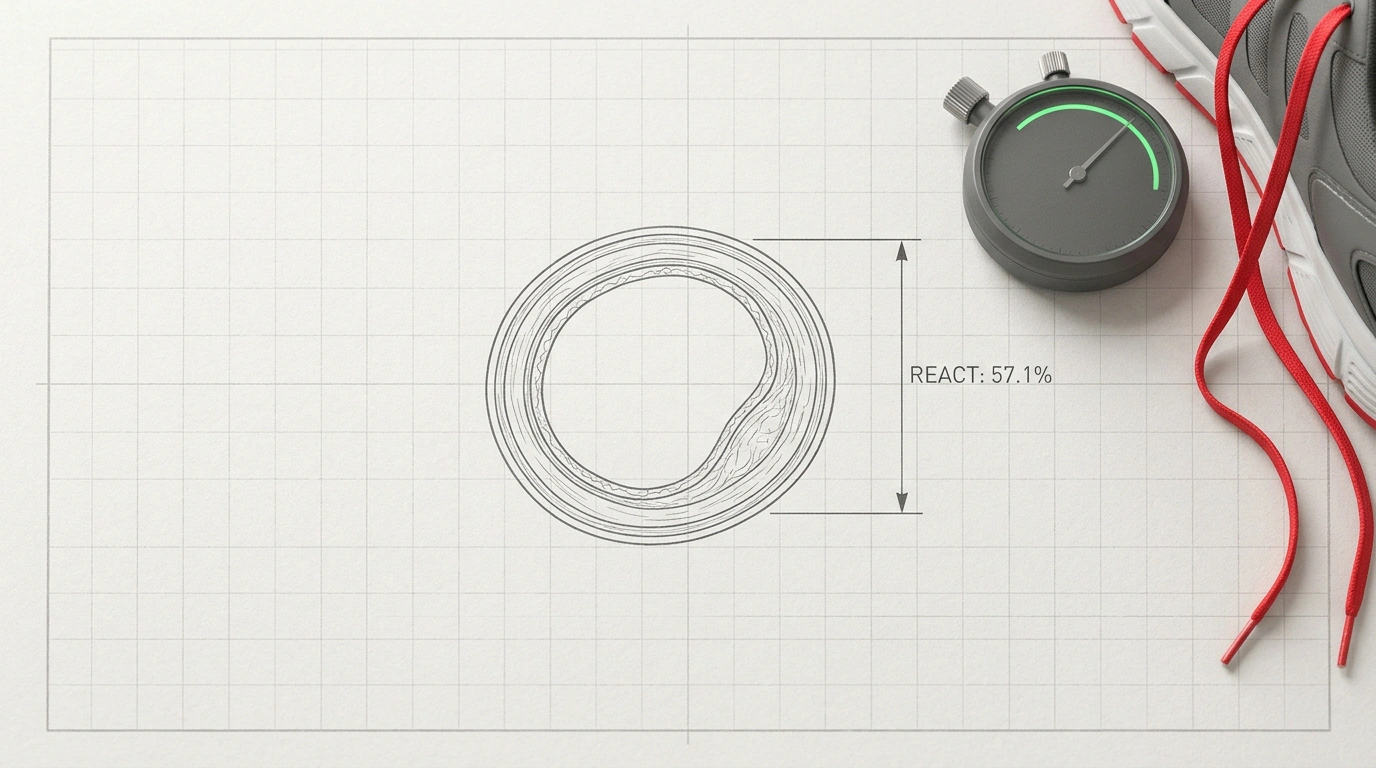
Complete imaging of all three vessel groups was obtained for 13,186 people, and at least one plaque was found in 57.1% of participants:
- Under age 29: hidden plaque was already present in 8.7% of men and 6.7% of women.
- Ages 30 to 39: changes were found in 34.6% of men (one in three!) and 21.3% of women (one in five).
- Age 60 and older: signs of atherosclerosis appeared in more than 90% of those examined.
An important caveat pointed out by Prokhor Pavlov: REACT did not compare runners with sedentary people, so those percentages can't be transferred directly to marathoners. Nor does having a small plaque mean an imminent heart attack. Still, an NEJM editorial underscores the study's main takeaway: atherosclerosis develops silently over decades, long before the first symptoms appear.
Multiplied by Years and the Light-Smoking Trap: Where Plaque Comes From at a Low Resting Heart Rate
So why did Pavlov's athletic friend end up with a high calcium score? Two details from his story vividly illustrate the basic laws of vascular damage.
The first rule is cellular energy and years of high cholesterol. A study published in the European Heart Journal examined the coronary arteries of 322 people aged 15 to 59 (average age 34) who died from trauma. Signs of atherosclerosis were found in 56% of samples, and protein and RNA analysis showed that even before overt immune inflammation begins, levels of proteins responsible for mitochondrial energy production drop inside vessel-wall cells. When the blood carries a lot of low-density lipoproteins (LDL)—the main cholesterol transporters—they slip into the vulnerable artery wall and get trapped there. A cumulative law applies here: both LDL cholesterol concentration and years of exposure matter. That's why saying "my cholesterol has always been like this" doesn't describe a harmless personal norm—it describes decades of vessel bombardment.
The second rule is the nonlinear harm of tobacco. Next to dozens of kilometers of running each week, a couple of cigarettes after lunch seems trivial. Yet a meta-analysis of 141 cohort studies in The BMJ (Hackshaw et al.) proved that just one cigarette a day gives men roughly 46% of the excess relative risk of coronary heart disease caused by a full 20-cigarette pack (and about 31% in women). Tobacco smoke damages the inner lining of blood vessels and promotes clotting, and good running fitness doesn't cancel out that chemical hit.
Smart Diagnostics: Where to Draw the Line Between a Basic Checkup and a CT Scan
How do you check your vessels without falling into unnecessary testing? Each tool here has clear boundaries:
- Blood pressure and family history: it's important to know your resting blood pressure and find out whether close relatives had early heart attacks or strokes (before age 55).
- Full lipid panel: total cholesterol alone won't reveal the share of atherogenic fractions—your doctor needs LDL cholesterol, triglycerides, and, if needed, glucose or HbA1c.
- Lipoprotein(a): ACC/AHA guidelines recommend measuring this genetic marker at least once in adulthood, since elevated levels create independent vascular risk.
- Coronary calcium score when indicated: in the U.S. CARDIA study (3,141 participants), coronary calcium remained linked to heart attack and stroke risk even in highly fit people.
At the same time, CT angiography and calcium scoring aren't needed for every runner without symptoms or risk factors: at low risk, an incidental finding won't change management. It's also crucial to remember the flip side: a zero calcium score does not guarantee clean arteries. It only shows the absence of calcified plaque and doesn't rule out early "soft" plaques, so a clean scan is no excuse to ignore smoking or high LDL.
Chest pain or pressure, unusual shortness of breath for your pace, dizziness, or feeling faint while running require stopping the workout right away and seeing a doctor. If chest pain persists—especially with cold sweats or sudden weakness—call emergency services immediately; past marathon finishes won't protect you here.
Statins and Running Shoes: How to Combine Vessel Protection with Running Fitness
In the case of Prokhor Pavlov's friend—with plaque already found, a high calcium score, years of elevated cholesterol, and smoking—taking statins and quitting tobacco completely become essential protection. A strong pace on your run doesn't erase the indication to lower LDL.
Runners often worry that statins will cause muscle weakness and tank their performance. However, ACC/AHA clinical reviews and controlled trials (including the STOMP study) confirm that in most athletes, statins do not reduce peak oxygen uptake ($VO_2\text{ peak}$) or muscle strength. If muscle discomfort does occur, a doctor evaluates the role of training load and adjusts the regimen: choosing a low dose of rosuvastatin or atorvastatin, changing the dosing schedule, or adding ezetimibe. Nor does finding a plaque mean a ban on sports: if there is no myocardial ischemia or dangerous arrhythmias—along the same lines as building safe exercise under a cardiologist's supervision with atrial fibrillation—running remains part of prevention.
An honest look at your lipid panel, quitting that last cigarette, and timely therapy don't devalue your mileage; they take off your workouts' shoulders a job that exercise can't do alone. After all, we head out for a run not for an illusion of invulnerability, but so that ten and twenty years from now we can still lace up our shoes easily, move freely, and meet friends with a healthy heart.