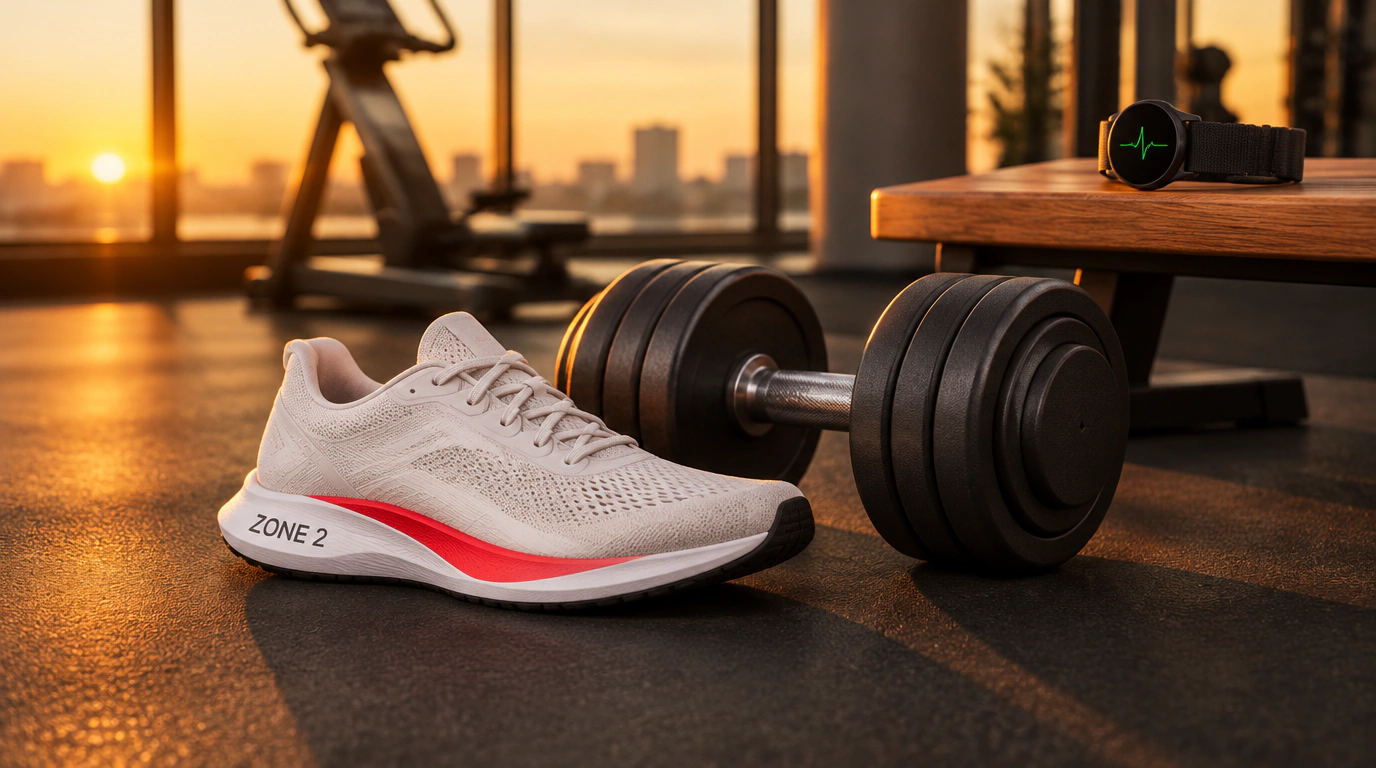
Walk into any gym and glance at the cardio area: usually you'll see people trudging grimly along, trying to slim down for summer. Meanwhile, the regulars in the free-weight zone—powerlifters and bodybuilders—give the treadmills a wide berth.
Strength culture still harbors a stubborn, almost mystical dread of aerobic exercise. You've surely heard these "iron" commandments: "Don't run, cardio will burn off all your muscle!", "Running spikes cortisol and kills anabolism," "A real lifter just rests five minutes between sets—why would you need endurance?"
Coach Sasha Vasilyev of the «Физикл» project spent years following that exact philosophy: four heavy lifting sessions a week and zero endurance work. Yet reviewing modern clinical and epidemiological data led him to completely overhaul his training balance and add roughly two hours of Zone 2 cardio every week.
It turns out that a well-developed respiratory system and a conditioned heart don't get in the way of building strength—they act as your primary biological insurance policy for a long, active life.
Let's unpack the molecular physiology of interference and see how to pair the barbell with running without losing muscle mass.
Fear of Catabolism: Why Iron Lovers Flee the Treadmill
Where did this fear even come from? It actually has a real historical root.
When scientists first described the interference effect in the 1980s, volunteers were put on an insane protocol: five days of heavy squats plus five days of grueling running every week. Under those conditions, leg muscles broke down from energy deficit and overuse injuries, and strength numbers fell.
From that, people drew a false conclusion: "All cardio is poison for hypertrophy."
Science, however, has proved that muscle isn't burned away by aerobic work itself—it's burned by absurd volume, excessive heart rates, and stacking two heavy stressors into the same session. Without those mistakes, cardio acts as a powerful catalyst for muscle recovery.
Longevity Epidemiology: Why VO2max Beats Bicep Size
Let's step back from the mirror for a second and ask a fundamental question: why do we train in the first place?
Big muscles look good, feel great, and are functional. Yet from the standpoint of organism survival, the key biomarker of longevity isn't bicep circumference—it's cardiorespiratory fitness (CRF) and maximal oxygen uptake, VO2max.
In 2018, Cleveland Clinic researchers (Kyle Mandsager et al.) published an analysis of more than 122 thousand patients in JAMA Network Open:
- High fitness cut all-cause mortality risk by 45% compared with low fitness.
- Among patients with existing cardiovascular disease, heart fitness lowered mortality risk by 73%.
- In the Norwegian HUNT study, good cardiorespiratory fitness cut dementia risk by 48%.
A lifter's heart strains against vascular resistance: the left ventricular walls thicken (concentric hypertrophy). Aerobic training, by contrast, stretches the heart chamber through high-volume blood return (eccentric remodeling) and keeps arteries elastic. A strength athlete needs both of those adaptations.
A Meta-Analysis of 96 Thousand People: The Superpower of Hybrid Training
So what wins in the real world: running only, lifting only, or a smart combination of both?
A definitive answer came from a systematic review and meta-analysis published in the British Journal of Sports Medicine (BJSM, 2022) by Coleman and colleagues.
Researchers tracked 96,337 older adults (average age 71) over 9 years, monitoring their physical activity habits and mortality rates:
- Aerobic exercise alone (meeting the WHO guideline of 150 minutes per week) reduced all-cause mortality by 32%.
- Strength training alone 1–2 times per week cut mortality risk by 9–22%.
- Yet combining regular cardio and strength training delivered the strongest protection: a 41% drop in all-cause mortality!
Strength gives us dense bones, resilient joints, fall protection, and defense against age-related sarcopenia. Cardio gives us a tireless cardiac pump, a rich capillary network, and clean, supple arteries. One without the other leaves a gaping hole in your health.
The Molecular Duel of AMPK and mTORC1: Avoiding Adaptation Conflict
How do you merge these two worlds inside a muscle cell so they don't step on each other's toes?
Inside a muscle fiber, two competing molecular sensors operate:
- mTORC1—the master anabolic complex. A heavy lifting set deforms the cell membrane (mechanotransduction), activating mTORC1 and launching synthesis of the contractile proteins actin and myosin.
- AMPK—the cellular energy-control enzyme. Long cardio burns through cellular ATP, piling up AMP. Sensing an energy shortage, the AMPK sensor switches on and orders the cell: "Low energy—halt all expensive construction projects!" And it directly blocks the anabolic mTORC1 complex.
If you step off the squat rack after heavy sets and immediately run a hard 40-minute tempo session at a heart rate of 160 bpm, the AMPK surge will promptly mute the anabolic signal in your quads. You'll burn effort for nothing.
How do you neutralize this conflict? Sports physiology offers three simple rules:
- Separate them in time: Space strength and aerobic sessions by at least 6–8 hours, or ideally put them on different days of the week. In 6–8 hours, the acute mTORC1 activation peak has time to fire and stabilize.
- Control your heart rate: strictly Zone 2: Forget sprints and brutal survival intervals. A strength athlete needs easy, restorative cardio in Zone 2—60–70% of max heart rate, with blood lactate under 2.0 mmol/L. In this zone, mitochondria run on fat oxidation, glycogen isn't deeply depleted, and AMPK activation stays minimal.
- Pick low-impact modalities: Running on hard asphalt brings impact shock and a heavy eccentric landing phase (microtrauma to tendons and shins). If you squat heavy, swap road running for a stationary bike, rowing machine, or brisk uphill walking on a treadmill at an 8–12% incline. Cardiac load stays high while impact stress on your legs drops to zero.
Ideal Zone 2 intensity is easy to gauge with the "talk test": you should be able to speak full sentences out loud calmly and coherently without gasping or pausing between words. If your breathing breaks—slow down.
Practical Protocol: Adding Zone 2 Without Losing Mass
Sasha Vasilyev recommends a step-by-step protocol for lifters to weave an aerobic base into a weekly split:
- Set your targets: If you don't have access to a clinical cardiopulmonary exercise test (CPET), use a rough formula for Zone 2 boundaries: (220 minus age) multiplied by 0.65–0.70. For a 30-year-old athlete, the working heart-rate corridor is roughly 120–135 bpm.
- Starting volume: Begin with two 30–40 minute sessions per week. Put them on non-gym days, or in the evening on a day when you trained upper body in the morning.
- What this gives your muscles in the gym: After 6–8 weeks of consistent Zone 2 work, skeletal muscles sprout a denser capillary network (capillarization) and pack in more mitochondria. In practice, you'll notice a remarkable shift: between heavy working sets of squats or deadlifts, your heart rate drops back to normal not in three or four minutes, but in 60–90 seconds! Muscles clear hydrogen ions and resynthesize phosphocreatine faster. Your training density and recovery capacity skyrocket.
Hybrid Training Checklist
- Cardio heart rate stays strictly in Zone 2 (conversational pace)
- At least 6 hours separate strength training and cardio
- On heavy squat weeks, priority goes to stationary bike or incline walking
- Total weekly aerobic volume is 80–150 minutes
- Daily calories are nudged up slightly to cover the extra energy burn
Don't choose between strength and endurance—build both systems. A strong heart and powerful muscles form an unbreakable foundation for true physical health for decades to come.