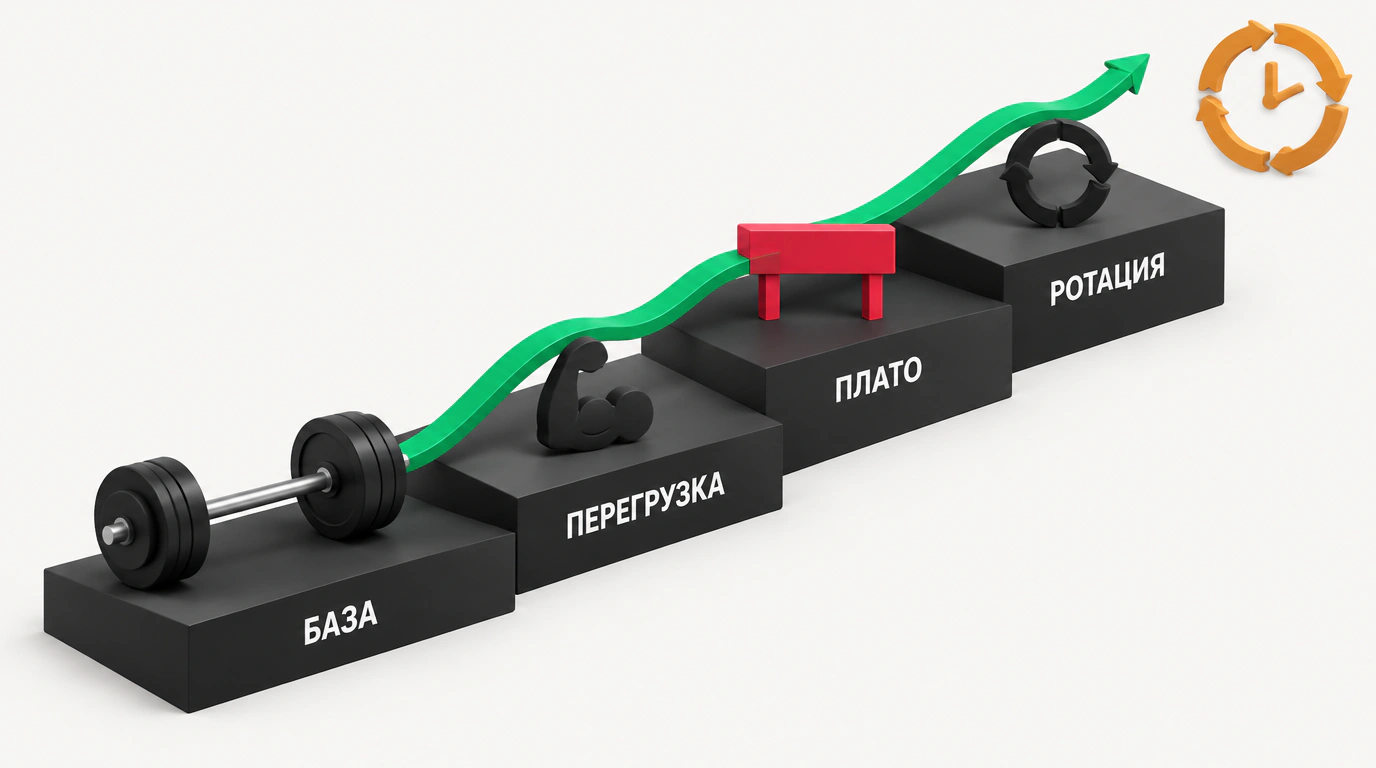
For the first couple of months in the gym, you progressed every week: weights went up, your muscles felt full and toned, and your physique noticeably improved. Then around month four, progress seemed to hit a concrete wall.
The weight on the bar is stuck. Reps won't budge. Your muscles no longer respond with that familiar spark, and going to the gym turns into a dreary chore. You've hit a plateau.
At this point, most people swing to extremes: some stubbornly grind through the exact same routine for months ("just work harder"), while others start randomly swapping machines every week, chasing mythical "muscle confusion."
The FitStars editorial team and sports scientists invite you to look at periodization through the laws of physiology. When does the body adapt to a stimulus, and how do you update your training plan smartly without wrecking your foundation?
Two Extremes: Groundhog Day vs. Chaos
Two mistakes dominate fitness:
- The "consistency" purists: someone runs the exact same program for six months straight. By the SAID principle (Specific Adaptation to Imposed Demands), the body rapidly optimizes energy expenditure. Once coordination is dialed in, mechanical tension stops acting as a growth stimulus. Stagnation sets in.
- The "muscle confusion" victims: they change exercises every single week. Yet the primary law of hypertrophy is progressive overload. A muscle grows when mechanical tension increases systematically over time. When movements change constantly, tracking overload becomes impossible: your energy goes into learning new technique instead of delivering a muscular stimulus.
The right approach: the core movement backbone stays constant, while the stimulus parameters rotate cyclically.
The Sylvester et al. Experiment: Why Novelty Saves Motivation
Why is it so hard for us to do the exact same thing for months on end? It isn't just muscle fatigue—it's the brain's dopamine system.
In 2016, the specialized Journal of Behavioral Medicine published a landmark RCT by Benjamin D. Sylvester and colleagues. The researchers recruited 121 physically inactive students and split them into two parallel groups on a 6-week training protocol:
- The first group followed a strictly fixed exercise routine with zero changes.
- The second received structured variety support: participants regularly rotated movement formats, training angles, implements, and machines while keeping total training volume equal.
The result was statistically clear: the high-variety group showed significantly stronger adherence to the training plan (F(1, 116) = 5.55, p = 0.02) and skipped far fewer sessions.
Mediation analysis proved that the key driver was the subjective experience of novelty (perceived variety, beta = .16, p < .01). The human brain is evolutionarily wired to explore the new and reacts sharply to monotony by dropping baseline dopamine. When workouts turn into "Groundhog Day," intrinsic motivation falls, psychological irritation builds up, and people quit the gym. Thoughtful variety keeps interest alive and makes consistency effortless.
Phases of Adaptation: From Nerves to Saturation
To know when to change a plan, it helps to understand the three phases of the training response:
- Neuromuscular tuning (weeks 1–4): weight increases come from the CNS—your brain learns to synchronize motor neurons and coordinate fibers. Actual hypertrophy is minimal.
- Structural hypertrophy (weeks 5–10): the movement pattern is locked in. Mechanical tension via mTORC1 drives thickening of muscle fibers. This is the window of maximum muscle growth.
- Adaptive saturation (after 8–12 weeks): energy cost drops, microdamage nearly disappears, and progressive overload hits a ceiling.
Science's takeaway: the optimal training block lasts 6–10 weeks. Changing a program sooner than 6 weeks cuts hypertrophy short; holding it past 12 weeks leaves you spinning your wheels.
Rotation Architecture: How to Update Load Without Demolishing the Base
You need to rotate load parameters while preserving the 7 fundamental human movement patterns: squat, hip-hinge, horizontal and vertical push, horizontal and vertical pull, and loaded carries.
Four proven levers for smart updates:
- Rep-range rotation: Don't stay trapped in "classic sets of 10." Brad Schoenfeld's meta-analyses proved that hypertrophy occurs across a wide window from 6 to 25 reps, provided sets are taken close to muscular failure (1–3 reps in reserve). Alternate 6-week blocks:
- Strength block (5–7 reps): emphasis on peak sarcomere mechanical tension and tendon density;
- Hypertrophy block (8–12 reps): optimal balance of tension and metabolic stress;
- Metabolic block (12–15 reps): shorter rests, pump, and stimulation of muscle fiber capillarization.
- Varying angles, implements, and grips: Tilt a dumbbell bench by just 15–30 degrees—and the line of mechanical tension shifts straight to the clavicular fibers of the pectorals. Swap a straight barbell in bent-over rows for a neutral parallel grip or dumbbells: you cut wasted strain on your wrists and forearms while putting the spotlight on your lats.
- Tempo and eccentric emphasis: Instead of constantly piling extra plates onto the bar, change how fast the weight moves. Lower the load slowly and under control for 3–4 seconds, pause for one second at the point of maximum stretch, and press explosively in 1 second. The eccentric phase activates sarcolemmal mechanoreceptors more strongly than the concentric phase, triggering an anabolic signal without risking joint injury.
- Scheduled deload (unloading week): Every 6–8 weeks, build in a deload microcycle: cut training volume by 40–50% (do 2 sets instead of 4) while keeping your usual working weights. This gives connective tissue, periosteum, and the central nervous system time for supercompensation and glycogen restoration.
Change only one parameter in an exercise at a time: either the implement (barbell to dumbbells), or the rep range, or the tempo. Otherwise you'll lose track of progressive overload.
True Plateau or Sleep Debt: The Overtraining Test
Before rewriting your logbook, check what's actually causing the stall:
- True plateau: sleep and appetite are great, technique is crisp, yet working weights haven't budged for 3 weeks. You need a fresh stimulus—new angles or rep ranges.
- Under-recovery (overreaching): weights are dropping, morning resting heart rate is up by 5–8 beats, sleep is broken, and apathy has rolled in. In that case, switching programs will finish your body off. You need a week of rest, 8+ hours of sleep, and proper nutrition.
Checklist Before Changing Your Program
- The program has run without major changes for at least 6–8 weeks
- Sleep is 7.5–8.5 hours a night, with appetite and recovery on track
- Working weights have stalled and haven't progressed for three microcycles
- The new program preserves fundamental biomechanical patterns
- A deload week is scheduled before starting the new strength block
Manage your training deliberately, don't fear planned pauses—and every plateau becomes a springboard to a stronger physique.
