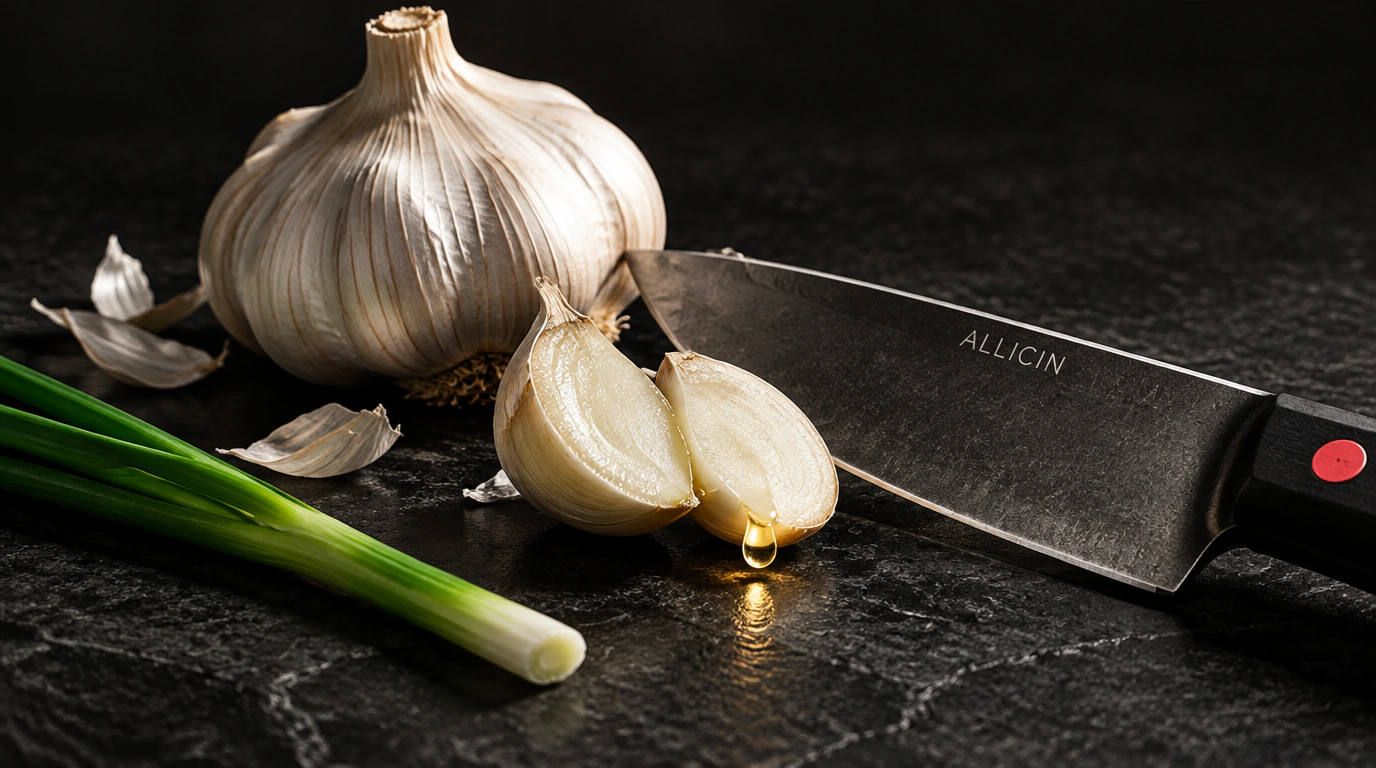
You've probably seen this viral tip on social media: video creators promise a "Tibetan vessel cleanse." The routine is seductively simple: every morning on an empty stomach, you take a whole peeled clove of garlic, swallow it like a pill without chewing, and chase it with a glass of warm water.
Proponents of the method make it sound irresistible: "This way you won't get garlic breath, and the clove reaches your gut intact, where it wipes out parasites, dissolves cholesterol plaques, and floods your blood with a powerful phytoncide—allicin."
Evidence-based physician Nikita Burlakov (channel «Бородатый не пробовал...») dissected this folk ritual through the lens of organic chemistry and normal digestive physiology. The scientific verdict is unambiguous: swallowing whole cloves gives your body zero milligrams of active allicin, while creating a direct risk of a chemical burn to your delicate stomach lining.
Let's look at how garlic's molecular defense system works and why nature locked its benefits behind a mechanical seal.
The Viral Internet Recipe: Why Naturopaths Tell You to Swallow Cloves
The main driver behind this tip's popularity is a simple fear of garlic breath. Plenty of people love garlic, but social life demands fresh breath: not everyone is willing to head into work or meetings after a morning clove.
The "swallow without chewing" idea looks like the perfect loophole: supposedly you get all the phytoncide benefits while keeping neutral breath. In some videos, creators even drag in an enzyme called "myrosinase," claiming it gently activates in the gut.
That's a glaring biological blunder. Myrosinase exists exclusively in the cruciferous family (broccoli, cabbage, mustard, horseradish), where it breaks down glucosinolates to form sulforaphane. Garlic (genus Allium) contains no myrosinase—it relies on the enzyme alliinase, which follows completely different rules.
Allicin Biochemistry: Garlic's Natural Trap
Here is a paradox that stumps folk-medicine fans: a whole, undamaged clove of garlic... contains no allicin at all.
To the plant itself, allicin is a caustic toxin evolved to ward off rodents, caterpillars, and mold. To avoid poisoning its own cells, garlic stores the ingredients of its future weapon in separate compartments:
- Inside the cell cytoplasm sits a sulfur-containing amino acid—alliin.
- Locked away inside isolated vacuoles is an active enzyme—alliinase.
As long as the plant tissue is intact, the substrate and enzyme remain separated by membranes. But the moment you bite into the clove or crush it with a knife, those membranes rupture. Alliinase instantly attacks alliin: hydrolysis produces allylsulfenic acid, which spontaneously condenses into volatile, pungent allicin. That's what burns a pest's mouth.
Remember the core biological rule: without mechanical destruction of the cells, allicin physically cannot form in nature.
What Happens in the Stomach: Acid Denaturation and Mucosal Burns
So what happens when a whole clove drops into your stomach?
The outer cuticle is intact, there was no chewing, and no reaction happened in the mouth. In the stomach, the clove meets hydrochloric acid (pH 1.5–2.0) and the enzyme pepsin.
Alliinase is a protein that is extremely sensitive to acidity. Its sweet spot is a neutral environment (pH 6.5–7.0). Below pH 3.0, alliinase's structure unfolds irreversibly within seconds. The enzyme literally "cooks" in stomach acid before the clove's tough outer shell even breaks down. By the time the garlic disintegrates, there is nothing left to trigger allicin synthesis: the yield of active compound is exactly zero.
Meanwhile, concentrated essential oils slowly seep out of the clove sitting at the bottom of the stomach into a single spot on the mucosa. Instead of mixing with a food bolus, the clove acts like a caustic compress on unprotected epithelium. Regular practice leads to chemical irritation, heartburn, contact erosive gastritis, and worsening reflux.
Swallowing garlic on an empty stomach is strictly off-limits if you have gastritis, peptic ulcer disease, or GERD: essential oils cause a localized mucosal burn within just a few days of doing this.
Evidence-Based Cardiology: Does Garlic Lower Cholesterol?
What if you eat garlic the right way—crushed? Does it scrub cholesterol plaques out of your blood vessels?
In 2007, in Archives of Internal Medicine, Stanford University professor Christopher Gardner published a landmark RCT. For six months, 192 patients with moderately elevated LDL cholesterol received raw garlic (equivalent to 1 clove per day—4 grams), powdered tablets, aged extract, or placebo.
The result: neither raw garlic nor commercial supplements had any statistically significant effect on LDL, HDL, or triglycerides. Garlic does not block cholesterol synthesis in the liver and cannot dissolve a plaque. No garlic enzymes enter systemic circulation in active form: they are broken down in the GI tract just like any other dietary protein.
Meta-analyses confirm only a modest drop in systolic blood pressure of 4–8 mmHg via stimulation of endothelial nitric oxide (NO) and hydrogen sulfide (H2S), so garlic cannot replace heart medications. And as a "natural antibiotic," allicin works only in a test tube: in blood, it is instantly bound by plasma proteins and breaks down within minutes.
The Ten-Minute Rule: Getting the Most Out of Garlic in the Kitchen
Garlic is a wonderful seasoning, rich in antioxidants, that boosts appetite and helps cut back on salt. To get the maximum stable allicin from it, just follow the simple "ten-minute rule":
- Crush it thoroughly: smash it with a knife or garlic press to rupture cell walls.
- Give it a kitchen pause: don't toss it straight into boiling water (alliinase dies at 60 °C). Let the crushed garlic sit on the cutting board for 10–15 minutes at room temperature. During that time, the enzyme synthesizes stable allicin. After that, you can add it to warm dishes or sauces.
Add garlic 1–2 minutes before turning off the heat, or dress fresh salads with it alongside olive oil: fats shield organosulfur compounds from breaking down.
Enjoy garlic for its flavor, spare your stomach the ordeal of swallowing whole cloves, and trust the facts of evidence-based medicine.