If you've ever stepped into a gym or opened a classic bodybuilding magazine, you've almost certainly run into a near-religious dogma: "If you want to grow, eat meat by the kilo."
For years, beginners have been fed a crude formula: boil a kilogram of chicken breast without salt, choke down dry fibers five times a day, down scoops of protein powder, and never touch fat under any circumstances. As a result, strength-training enthusiasts spend astronomical sums at the meat counter and on tubs of isolate, spend hours in the kitchen packing plastic containers, and get rewarded with bloating, stomach heaviness, constipation, and a lasting disgust for food after just a couple of months on this "regimen."
Experienced coach and mentor Alexander Alekseevich suggests tossing out gym folklore and looking at an athlete's meat intake through the lens of evidence-based physiology and evolutionary anthropology. How much protein can our body actually absorb? Why doesn't excess meat turn into biceps? What makes charring steaks in a pan dangerous, and how do you cook meat dishes that stay juicy, safe, and delicious for days ahead?
Let's lay this out cleanly without myths or fanaticism.
The Cult of Chicken Breast: Where the Meat Obsession Came From
To understand the roots of this problem, we have to go back to the "golden era" of bodybuilding in the 1970s and 80s. That's when the myth took hold that hypertrophy requires eating 3–4 grams of protein per kilogram of body weight.
Stage idols really did eat gigantic portions of meat. But the authors of glossy articles conveniently left out one key factor: competing pros were running massive doses of pharmacological support—anabolic steroids. Pharmacology artificially cranks up a cell's ribosomal machinery dozens of times over, forcing muscles to retain nitrogen in unnatural amounts.
When an ordinary person who trains naturally three times a week after an office job tries to copy the diet of an enhanced 110-kilogram bodybuilder, their body quickly surrenders. Pancreatic enzyme systems choke, undigested protein putrefies in the gut, and the kidneys and liver work overtime clearing toxic byproducts of nitrogen metabolism. We already unpacked this paradox in our piece on how much protein the body actually needs, showing why the blind rule "more is always better" falls apart.
The Omnivore's Evolutionary Code: Lessons from Anatomy and Anthropology
Alexander Alekseevich reminds us of an obvious yet often forgotten biological fact: Homo sapiens evolved over hundreds of thousands of years as a flexible omnivore.
Our ancestors survived harsh ice ages and droughts precisely because they were not hyper-specialized predators. Specialized carnivorous hominids and large predators died out at the first climate shifts whenever herds of ungulates disappeared. Humans, meanwhile, switched immediately to plant sources: gathering wild grains, digging up starchy tubers, and foraging berries, nuts, and fruits.
Our entire anatomy screams omnivore:
- We lack huge conical canines and powerful shearing carnassial teeth like cats or dogs, built for ripping raw tendons and crushing bones. Instead, we have broad grinding molars for milling plant fibers and grains.
- Our saliva contains the enzyme amylase, which starts breaking down complex carbohydrates right in the mouth. True carnivores have enzyme-free saliva that serves solely to lubricate chunks of meat.
- Our intestine is about 7–8 meters long—a middle ground between the short tract of a carnivore (3–4 meters, so meat exits the body before it rots) and the enormous, complex gastrointestinal tract of herbivores.
That's why today's ultra-radical trends like the "carnivore diet" (cutting out all plant food and eating only meat and organ meats) are a dangerous evolutionary experiment on your own microbiome and blood vessels. Meat is a valuable part of the diet, but it has to work in symbiosis with plant fiber.
The Biochemistry of Saturation: The Leucine Threshold and the Protein Synthesis Ceiling
Let's peer inside a muscle fiber and see how muscle growth is triggered at the molecular level.
The main engine of muscle hypertrophy is a process called Muscle Protein Synthesis (MPS). For a muscle to grow, the rate of synthesizing new protein must exceed the rate of its natural breakdown (muscle protein breakdown, MPB).
The key intracellular switch that turns on this assembly line is the protein complex mTORC1. And the main biological key that turns that switch is the essential branched-chain amino acid leucine.
In sports science, this phenomenon is known as the "leucine trigger":
- For mTORC1 to launch the assembly of new myofibrils, a specific concentration of leucine must build up in the cell's cytoplasm—roughly 2.5–3.2 grams in a single meal.
- That amount of leucine is found in about 25–35 grams of complete animal protein. Translated into real food, that's roughly 120–160 grams of cooked chicken breast, lean beef, or fish, or 4–5 whole chicken eggs.
So what happens if you eat a massive half-kilogram steak containing 100 grams of pure protein in one sitting? Does your muscle growth double or triple?
Physiology gives a flat answer: no. You hit the "muscle-full effect." Cellular ribosomes rev up to their physiological maximum 90–120 minutes after a meal and run at capacity for about three to four hours. The muscle simply cannot incorporate any more amino acids into sarcomere structures at one time.
Every amino acid arriving beyond ribosomal capacity is shipped to the liver. There it undergoes deamination: the toxic nitrogen group is converted into urea and excreted by the kidneys, while the amino acid's carbon skeleton is oxidized in the Krebs cycle for immediate energy needs or converted into fatty acids. In other words, that giant slab of expensive meat just burns up like ordinary fuel while overloading your liver and kidneys along the way.
Morton's Meta-Analysis: Where the Real Hypertrophy Sweet Spot Lies
If a single meal maxes out at 30–40 grams of protein, what is a strength athlete's actual daily requirement?
The answer came from the largest systematic review and meta-analysis in sports medicine history, published by Robert Morton and Professor Stuart Phillips in the authoritative British Journal of Sports Medicine (BJSM, 2018).
The researchers pooled data from 49 randomized controlled trials involving 1,863 resistance-trained men and women. Using mathematical breakpoint analysis, the scientists pinpointed the exact threshold beyond which increasing protein intake stops producing any additional anabolic effect.
That threshold was 1.62 g per kilogram of body weight per day (95% confidence interval: 1.03–2.20 g/kg/day).
Protein intake above 1.62 g/kg per day yielded no statistically significant extra gain in either fat-free mass (FFM) or maximal strength in compound lifts (1RM).
For a natural 80-kilogram athlete, this means:
- The physiological sweet spot is 130–160 grams of pure protein per day.
- To hit that number, it's enough to eat 300–350 grams of cooked meat or poultry across the day, 2–3 chicken eggs at breakfast, a serving of cottage cheese or fish, and get the remaining 25–30 grams of protein from complex carbs (buckwheat, oats, brown rice, or pasta).
- Expensive powdered isolates and BCAAs become a completely pointless waste of money on a balanced diet like this, as we wrote in our breakdown of sports nutrition myths.
The only clinical exception where the target may briefly rise to 2.2–2.4 g/kg is a harsh contest-prep "cut" with an extreme calorie deficit and very low body fat, when extra protein acts as insurance against muscle catabolism.
Fear of Fat and Hormonal Crash: Why Dry Meat Hurts Your Physique
The second glaring mistake beginner athletes make is a panic-stricken fear of dietary fat. Chasing maximum leanness, lifters buy only bone-dry chicken breast, boil it to the texture of cardboard, trim off the tiniest marbling, and brag that their diet has "zero grams of fat."
That approach delivers a heavy somatic blow to the body:
- Testosterone synthesis crashes: The molecular precursor of all steroid sex hormones (including testosterone) is cholesterol. Controlled clinical studies have shown that keeping dietary fat below 15–20% of daily calories for an extended period leads to a significant 12–15% drop in circulating total and free testosterone in men. Trying to "shred down," the athlete sabotages their own endogenous anabolism.
- Fat-soluble vitamin deficiency: Vitamins A, D, E, and K are absorbed in the small intestine exclusively inside lipid micelles formed by bile acids and dietary fats. Without fat, vitamin D simply never enters the bloodstream—and it is vitamin D that directly regulates muscle contraction strength and sarcomere regeneration.
- Bile stasis and gallstones: Fats entering the duodenum trigger the release of cholecystokinin, a hormone that makes the gallbladder contract vigorously and empty. On a fat-free dry diet, bile stagnates for weeks, thickens into putty-like sludge, and crystallizes into cholesterol stones.
Alexander Alekseevich emphasizes: meat should be moderately fatty and juicy! Turkey thigh, lean beef cuts (silverside, chuck), and skinless chicken thigh meat contain an ideal 5–8% fat, satisfy hunger well, taste rich, and gently stimulate normal biliary tract motility.
Pan Toxicology: Heterocyclic Amines and Kitchen Rules
Yet even the highest-quality farm meat can be turned into a hazardous toxin if cooked the wrong way.
The main kitchen mistake is searing in a smoking-hot skillet or over an open charcoal grill until a crispy black crust forms:
- At temperatures above 150–200 °C, a thermal reaction occurs between free amino acids in meat (especially creatine) and sugars, forming heterocyclic aromatic amines (HCAs: PhIP, MeIQx).
- And when fat droplets drip onto glowing coals or electric grill elements, the fat burns into toxic smoke loaded with polycyclic aromatic hydrocarbons (PAHs, the chief culprit being carcinogenic benzoapyrene). That smoke rises and coats the surface of the steak in a thick layer.
Liver cytochrome P450 enzymes try to detoxify these compounds, but during biotransformation reactive epoxides form that directly damage the DNA of intestinal epithelial cells. It's no accident that the WHO's International Agency for Research on Cancer (IARC) and the World Cancer Research Fund (WCRF) classify processed meat as a Group 1 carcinogen and recommend strictly limiting charred red meat to 350–500 grams cooked per week.
How do you cook safely? The gold standard of a healthy athlete's kitchen is low-temperature, gentle methods:
- Boiling, stewing, slow cooking in a Dutch oven, and steaming. Water temperature never exceeds 100 °C, physically preventing heterocyclic amines from forming. Muscle proteins denature gently, staying easy for digestive enzymes to access.
- Roasting in an oven bag or tightly sealed foil at a moderate oven temperature of 140–160 °C without forming a hard, burnt crust.
Never eat charred, blackened patches of meat from a skillet or grill. Trim off the burnt layer with a knife: that black ash concentrates the highest dose of mutagenic heterocyclic amines and benzoapyrene.
Microbiome vs. Putrefaction: Why Meat Desperately Needs Vegetables
Let's look at one more critical frontier—how meat interacts with the gut microbiome.
The enzymatic capacity of pancreatic proteases (trypsin, chymotrypsin, elastase) has a hard physiological ceiling. When someone eats a giant slab of meat in one meal, there simply aren't enough enzymes to break down the entire polypeptide load.
Undigested protein fragments pass straight through into the distal ileum and cecum. There, putrefactive bacteria greet them. Through bacterial proteolysis, amino acids are converted into a toxic cocktail: indole, skatole, cadaverine, hydrogen sulfide, and cresol. These are the exact compounds that cause foul-smelling gas, disrupt tight junctions in the gut barrier, and fuel subclinical systemic inflammation.
The only reliable shield against this scenario is plant fiber:
- Soluble and insoluble dietary fibers from vegetables, leafy greens, and root crops mechanically speed up transit of the food bolus, bind excess ammonia and toxins, and sweep them out quickly.
- Symbiotic bacteria in the large intestine ferment plant fiber into invaluable short-chain fatty acids (SCFAs)—butyrate, acetate, and propionate. Butyrate serves as the primary fuel for the cells lining the colon (colonocytes), protecting them from mutations and inflammation.
The iron rule of a healthy athlete's plate: for every 100 grams of cooked meat, there should be at least 150–200 grams of fresh, roasted, or stewed vegetables and greens.
Practical Nutrition: Prepping for the Week Without Living at the Stove
The main reason people fall off healthy eating into fast food is everyday fatigue. Few people have the time and energy to cook a fresh portion of meat three times a day after a long work shift.
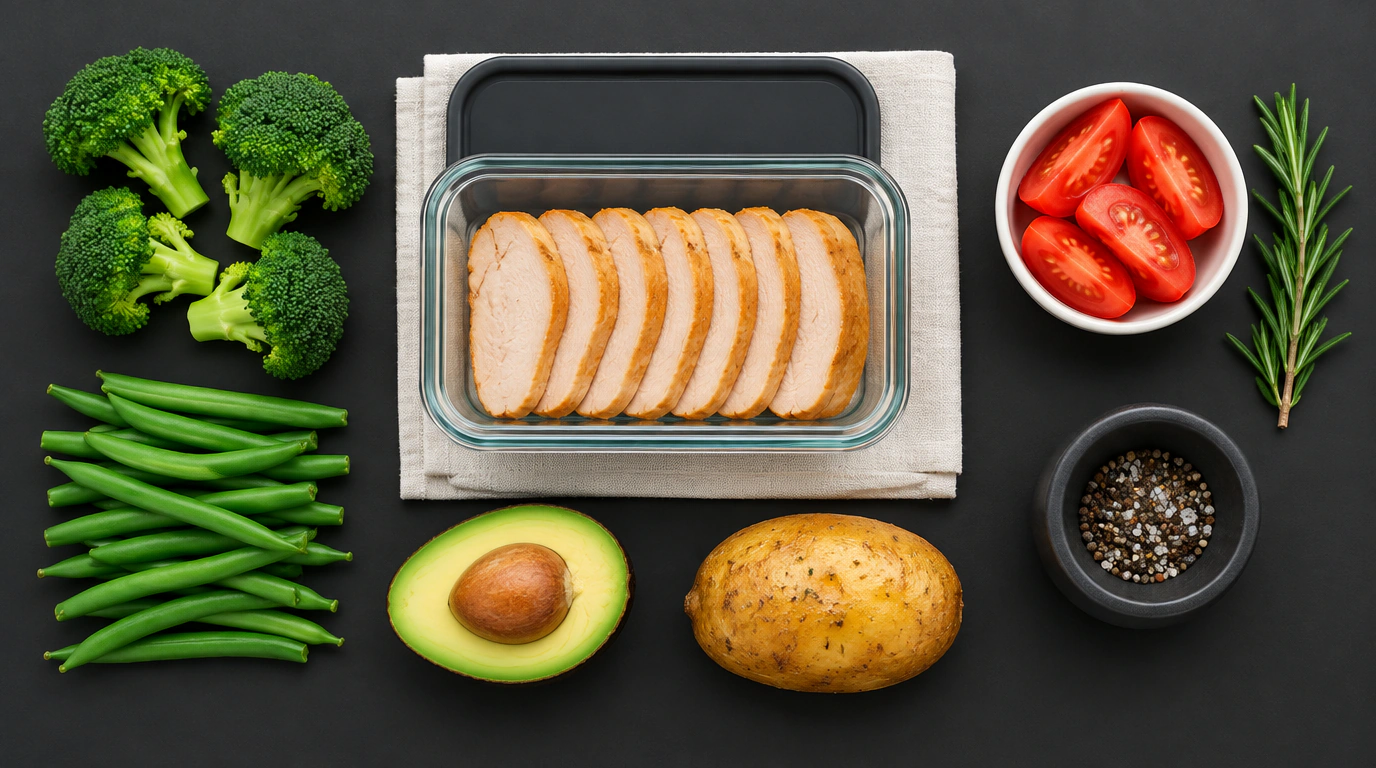
Studio still life of an athlete's meal prep: transparent container with sliced meat, sprigs of rosemary, and fresh vegetables.
Alexander Alekseevich shares a simple coaching protocol for prepping food 3–4 days ahead (meal prep) that saves time, money, and digestion:
- Buy a whole cut: Pick up 1.2–1.5 kg of lean beef (silverside, chuck), boneless turkey thigh, or lean pork loin. A whole cut is always cheaper than factory-processed cuts and contains no phosphates or preservatives.
- Cold marinade and spices: Make shallow slits across the meat, stud it with garlic cloves, and rub with salt, black pepper, rosemary, thyme, and smoked paprika. Spices aren't just for flavor: rosemary and garlic pack potent antioxidant polyphenols that further protect meat lipids from oxidizing during heating.
- Roast in its own juices: Place the cut in an oven roasting bag, tie the ends, and put it in the oven at 140–150 °C for 1.5–2 hours. The meat will braise slowly in its own broth. At this temperature, connective-tissue collagen slowly hydrolyzes into silky, water-soluble gelatin. The fibers turn melt-in-your-mouth tender, and the meat stays remarkably juicy without a single drop of added vegetable oil.
- Portioned storage: Let the meat cool completely right inside the bag so it reabsorbs the aromatic juices. Slice the chilled cut thinly against the grain and pack into airtight glass containers. Stored this way in the fridge, it keeps easily for 4 days.
In each container, place 130–160 g of roasted meat slices, a portion of complex carbs (baked jacket potatoes, buckwheat, or durum-wheat pasta), and fill the rest to the brim with broccoli, green beans, or sauerkraut. A balanced lunch is ready in two minutes in the microwave.
Strength training is a lifelong marathon, not a sprint to see if your gut survives. Drop the protein extremism, respect your body's physiological limits, cook gently—and your muscles will reward you with steady strength gains, clear skin, and rock-solid well-being.
