You've been sticking honestly to a calorie deficit for two months: weighing your food carefully, training hard, and the first 6–8 kilograms flew right off. Suddenly, the scale needle freezes. One week passes, then two, then three—the exact same number stares back at you.
In fitness forums, a hundred "experts" immediately rush in with a scary diagnosis: "You broke your metabolism! Your body entered starvation mode and is now storing fat out of thin air and a glass of water!"
The authors of the evidence-based blog «лёгкий зож» suggest calming down: the first law of thermodynamics works flawlessly inside your body, and humans haven't learned to store calories from air. What you've hit is metabolic adaptation, and its real mechanism looks very different from internet myths.
When a person loses weight, daily energy expenditure naturally drops for two reasons:
- Predicted reduction: if you weigh 10 kilograms less, your body now needs less energy to move itself through space. The mass of internal organs (liver, heart, GI tract) has shrunk slightly too. That natural drop is easy to calculate with the Mifflin-St Jeor equation.
- Adaptive thermogenesis: this is the body's genuine adaptation to an energy deficit beyond what equations predict. Yet how many calories does it actually "steal"? Studies in metabolic chambers show that at the level of resting basal metabolic rate (BMR), adaptation amounts to a modest 50–150 kcal per day. That's the price of a single apple! By itself, that number cannot erase a 500 kcal deficit.
So where does the deficit actually vanish?
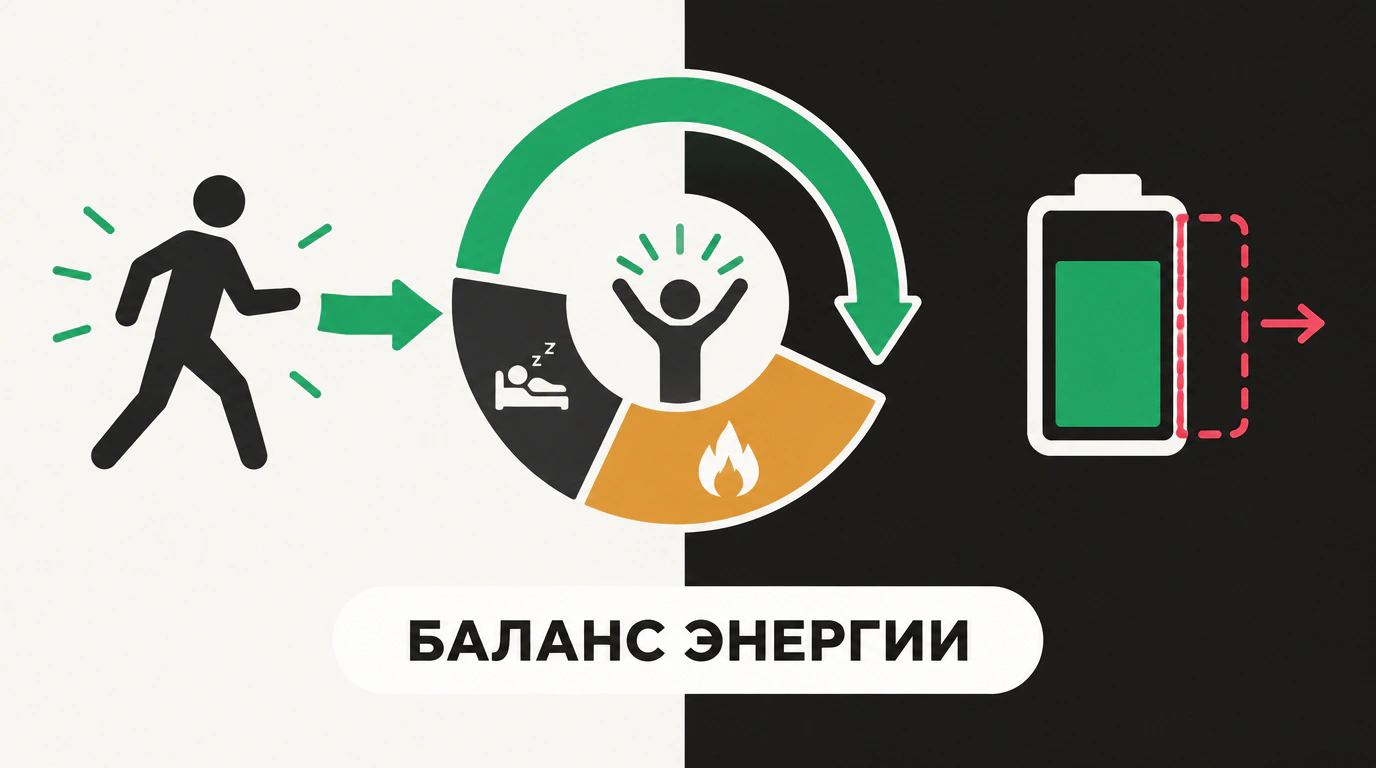
The main leak happens through NEAT (Non-Exercise Activity Thermogenesis)—non-exercise everyday movement. That covers all our spontaneous motion: walking pace, hand gestures, fidgeting in a chair, holding posture, tidying up the house.
Sensing an energy shortage, the hypothalamus quietly flips on energy-saving mode without your conscious awareness. You start walking slower, lean back into your chair more often, stop gesturing while talking, and take the elevator instead of the stairs. A drop in NEAT can shave 200 to 500 kcal off your daily burn!
Now add weighing errors: studies using the gold-standard doubly labeled water method proved that even disciplined dieters underestimate their true calorie intake by 20–30% (an uncounted drizzle of oil, a sauce, a bite on the run). The scissors snap shut: an unnoticed 250 kcal drop in NEAT plus an unnoticed 250 kcal food overshoot completely wipe out a planned 500 kcal deficit. Weight stalls.
How do you outsmart this mode and break the plateau?
- Diet breaks (the MATADOR study): In a study by Byrne et al. published in the International Journal of Obesity, an intermittent dieting protocol proved remarkably effective. Alternating 2 weeks of moderate deficit with 2 weeks of eating at maintenance blunts adaptive thermogenesis, lifts leptin levels, and produces greater total fat loss than continuous dieting.
- Track daily steps: Don't let your hypothalamus slash NEAT. Set a firm floor—for example, 8,000–10,000 steps every day. That locks your energy expenditure at a steady level.
- Protein and strength training: Keep protein at 1.6–2.0 g/kg and lift weights in the gym so the deficit draws from fat stores while preserving metabolically active muscle tissue.
If your weight has stalled for more than three weeks, don't slash calories even further! Take a diet break: bring calories back up to maintenance for 10–14 days using complex carbs, catch up on sleep, and keep your step count steady. Your hormonal system will rebound, and fat loss will resume.
Treat your body as a smart partner rather than an enemy, and break through plateaus using the laws of physiology.