"Want big arms? Do heavy barbell squats!" That advice has been passed down in gyms from veterans to beginners for decades as an unshakable truth.
The theory sounds biochemically tidy: legs are the body's largest muscle group. If you load your quads and glutes with near-maximal weight, the body goes through intense stress and dumps a surge of endogenous testosterone and growth hormone (somatotropin) into the bloodstream. Those hormones supposedly circulate through your vessels and "incidentally" help your biceps, triceps, and delts grow.
Coach Artyom proposes putting this myth to rest once and for all by turning to rigorous experimental physiology.
In 2009, the research group of legendary professor Stuart Phillips (Daniel W. D. West, Stuart M. Phillips et al.) published a brilliant experiment in the prestigious Journal of Physiology.
The scientists took trained young men and had them train their biceps under two fundamentally different protocols:
- Low-hormone protocol (LH): participants performed isolated curls with one arm only. Blood levels of testosterone, growth hormone, and IGF-1 stayed at resting baseline.
- High-hormone protocol (HH): participants trained the other arm, but immediately afterward performed an exhausting series of heavy leg presses and leg extensions. That triggered a massive spike of testosterone and growth hormone into systemic circulation.
What did muscle biopsies show? The rate of muscle protein synthesis (MPS) and phosphorylation of intracellular signaling molecules (p70S6K, mTORC1) in the biceps were completely identical in both protocols! The systemic hormone surge gave the arms zero milligrams of extra anabolism.
In a later 12-week study by Phillips involving 56 athletes, researchers found no link whatsoever between the size of a post-workout testosterone spike and actual muscle mass gains.
Why does this happen?
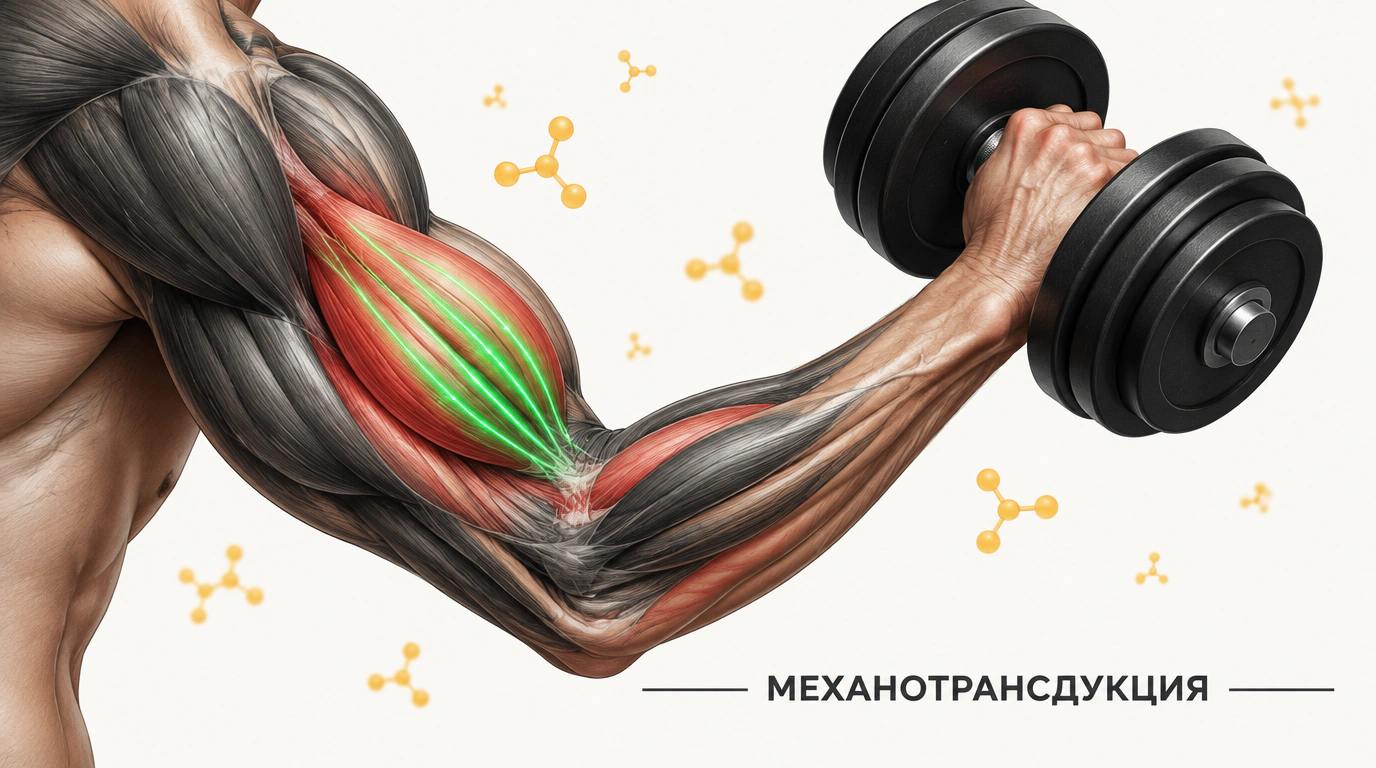
- Local mechanotransduction: muscle growth is triggered by deformation of mechanosensors (integrins and costameres) on the sarcolemma strictly inside the fiber that overcame the load. Mechanical tension itself turns on protein synthesis via mTORC1 on site.
- Receptor saturation: androgen receptors in cell nuclei are already saturated by baseline physiological levels of circulating testosterone. A brief 15–20 minute hormone blip after a set simply doesn't last long enough to trigger gene transcription.
Pharmacological bodybuilding plays by completely different rules: it uses supraphysiological doses of exogenous drugs (10–50 times above normal) that keep receptors continuously occupied 24 hours a day for months. Natural physiological fluctuations during a workout have nothing in common with that.
If you want bigger biceps—train your biceps. If you want a wide back—do pull-ups. Squats are fantastic for building leg muscles and strengthening your quads, but hoping they'll grow your shoulders or arms is a waste of time and energy.
Plan your training rationally, give target muscles a local stimulus, and stop believing old gym myths.