You've probably come across tempting ads online more than once: "Cleanse your blood vessels in two weeks," "IV drips for plaque," "Herbal blend dissolves cholesterol without chemicals." It sounds seductively simple. Our brains love clear, everyday analogies: if a kitchen drainpipe is clogged with rust and grease, we grab caustic powder or a long plumber's snake, clear the blockage—and the water happily rushes through with full pressure again.
In cardiology, this seductive image has played a cruel trick on millions of people. For decades, medicine was dominated by a grim conviction: once a plaque forms in an artery, it is there forever. A scar in the vessel wall was thought to be like a granite monolith that could only slowly grow year by year, while all available pills like statins could at best only slow that growth and delay a fatal myocardial infarction.
But in late October 2026, the prestigious journal JAMA Cardiology published the results of the Danish clinical trial FLOWPROMOTE (Martin Bødtker Mortensen's research group at Aarhus University Hospital). Cardiologists proved that atherosclerotic plaque can indeed be reversed and physically reduced in volume. Yet it doesn't happen the way supplement sellers promise. There is no "dissolving without a trace" in nature. What happens is a deep architectural remodeling, where an unstable powder keg is replaced by a dense scar. Let's break down this mechanism down to every nut and bolt so we understand where the line lies between modern science and dangerous illusions.
The "Vessel Plunger" Myth: Why Cleanses Don't Work
Let's take off the rose-colored glasses right away and look at why the concept of "vessel cleansing" is unscientific at its core. A plaque is not a lump of fat stuck to the inside of a vessel wall like a bit of margarine on the wall of a kitchen pipe. If cholesterol simply floated through the arterial lumen and settled on it like limescale in a kettle, you really could wash it away with some solvent.
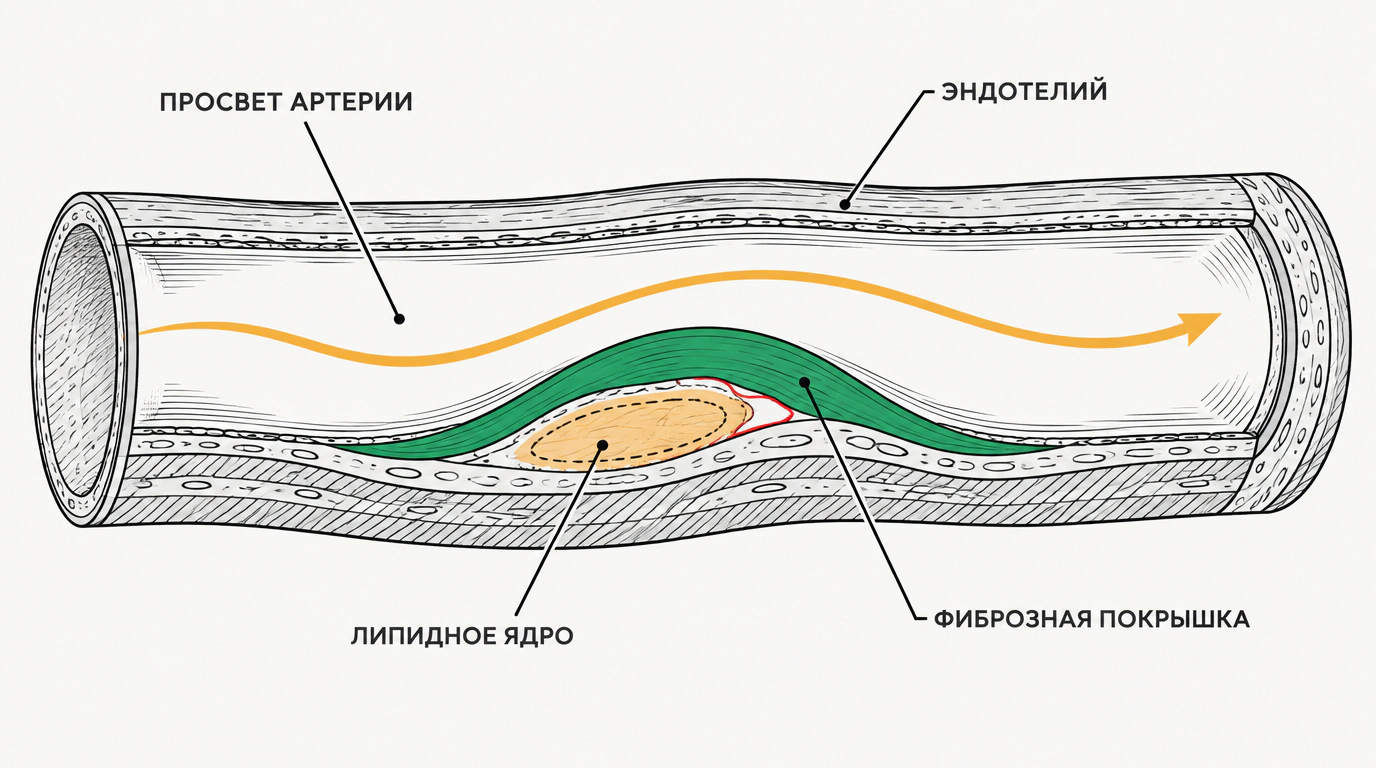
In reality, everything is far more complex and dramatic. An artery is a living, multi-layered organ. Its inner surface is lined by a razor-thin layer of cells—the endothelium. Beneath it lies the inner layer of the vessel wall, the intima; deeper still is the muscular framework (media) and the outer coat (adventitia). And an atherosclerotic plaque grows inside the wall itself, beneath the endothelium, deep within the intima.
Imagine a pimple or a deep splinter under your skin: no matter how much you wash your hands with soap, the splinter won't come out from under the skin until the damaged tissue heals. Trying to infuse a vein with a "cleansing IV" of saline, vitamins, or so-called chelators like EDTA has nothing to do with biology. The fluid simply rushes down the arterial channel past the plaque without entering the lesion sealed inside the tissue, while the excess IV volume only overloads the right side of the heart and the kidneys.
The only way to influence that sealed-off lesion is to change the physicochemical conditions in the blood so that the body itself begins pulling lipids back out of the inflamed wall. And the key player here is low-density lipoprotein cholesterol (LDL-C).
Anatomy of a Powder Keg: How an Unstable Plaque Is Built
To appreciate the breakthrough of the FLOWPROMOTE trial, we need to look inside the plaque itself. How does it form in the first place?
It all starts with microdamage to the endothelium. Smoking, spikes in blood pressure, chronic systemic inflammation, or high blood sugar damage the vessel's protective barrier. Through microcracks in the endothelium, atherogenic lipoprotein particles carrying apolipoprotein B (apoB) on their surface begin to slip into the intima. They get trapped in the meshwork of connective tissue like flies in a sticky web and become oxidized.
To the immune system, oxidized cholesterol is a foreign toxin. The body sounds the alarm: white blood cells—monocytes—rush to the site. Once inside the intima, they transform into macrophages, voracious scavengers. Macrophages start greedily swallowing the oxidized fat. But they cannot digest an endless stream of lipoproteins: the cells literally become stuffed with fat droplets and turn into so-called "foam cells."
When a foam cell dies, its contents spill into the extracellular space. A semi-liquid, mushy necrotic core forms—a lipid pool made of free cholesterol crystals, cellular debris, and inflammatory enzymes.
To wall off this toxic lesion from the arterial lumen, smooth muscle cells migrate into the intima and begin producing a tough protein—collagen. Thus, a fibrous cap grows over the lipid core. And here lies the central paradox of vascular surgery:
- A stable plaque has a thick, dense fibrous cap and a small lipid core. It may narrow 70–80% of the vessel lumen, causing shortness of breath and crushing chest pain during brisk walking (exertional angina), but it rarely leads to sudden death because its cap is strong.
- A vulnerable (unstable) plaque may narrow the lumen by only 30–40% and cause no symptoms at all. Yet it has a huge, inflamed lipid core and a critically thin cap—thinner than 65 micrometers. Inflammatory enzymes (metalloproteinases) thin this membrane even further.
During a moment of stress or a sharp spike in blood pressure, the thin cap tears. Blood comes into contact with the necrotic contents of the core, the clotting cascade triggers instantaneously, and within minutes a thrombus forms, completely blocking the coronary artery. This is how an acute myocardial infarction strikes out of "perfect health."
The Danish Cardiologists' Breakthrough: FLOWPROMOTE Design and Results
Until recently, it was believed that once a lipid core formed, it would remain in the artery forever. The FLOWPROMOTE trial set out to test what happens to plaque structure if you don't just lower cholesterol to average therapeutic targets, but drive it down to ultra-low levels.
The study enrolled 104 patients with stable coronary artery disease who had coronary stenoses greater than 50% on computed tomography angiography (CT angiography), confirmed by a functional fractional flow reserve test (FFR-CT <= 0.80). A critically important detail: none of these patients had ever taken statins before (they were statin-naive). This allowed the scientists to measure the pure biological effect of therapy without the picture being blurred by prior courses of medication.
Participants were divided into two observation groups for 18 months:
- Intensive monotherapy group: patients received high-dose atorvastatin 40 mg daily.
- Ultra-intensive combination therapy group: patients took rosuvastatin 40 mg plus ezetimibe 10 mg daily—a drug that blocks cholesterol absorption in the small intestine.
Progression was tracked using high-precision multislice CT angiography with volumetric quantitative analysis across all vascular beds: scientists measured total plaque volume (TPV), soft non-calcified plaque volume (NCPV), and dense calcium volume (CPV) at baseline, 9 months, and 18 months.
The results were stunning:
- In the atorvastatin group, "bad" LDL cholesterol dropped from 119.7 mg/dL (3.1 mmol/L) to 69.5 mg/dL (1.8 mmol/L)—a 38% reduction.
- In the rosuvastatin plus ezetimibe group, LDL dropped from 127.4 mg/dL (3.3 mmol/L) to 42.5 mg/dL (1.1 mmol/L)—a 65% reduction.
And what happened to the plaques themselves? The median reduction in total plaque volume was 13.6% on monotherapy and 21.1% on combination therapy. But the most sensational shift occurred in the non-calcified, soft lipid pool—that explosive filling. On atorvastatin monotherapy, non-calcified volume shrank by 20.0%, and on combination therapy by 28.2%—nearly a third!
Documented regression of the dangerous non-calcified pool was recorded in 77% of patients in the atorvastatin group and an incredible 98% of patients in the rosuvastatin-plus-ezetimibe group. In almost every participant who reached an LDL level around 1.1 mmol/L, the explosive core began to deflate.
The Biochemistry of Regression: What Leaves and What Stays Forever
What amazes me most in these numbers is the cellular logic: what actually causes the plaque to shrink?
Volumetric schematic 3D model of a foam cell transporting excess cholesterol to high-density particles.
When plasma LDL particle concentrations drop below 1.4–1.8 mmol/L, the diffusion gradient reverses. The influx of new lipids beneath the endothelium virtually stops. The liver factory no longer supplies excess cholesterol, and ezetimibe shuts the reabsorption valve in the gut.
Under conditions of lipid scarcity in the arterial intima, the reverse transport system wakes up:
- Special transporter proteins (ABCA1 and ABCG1) activate on foam cell membranes. They literally pump cholesterol crystals out of the cell and hand them off to high-density lipoprotein particles ("good" HDL cholesterol), which carry the fat to the liver for processing and excretion in bile.
- Foam cells unload their lipid cargo. Toxic tissue irritation subsides, and the intracellular NLRP3 inflammatory complex quiets down.
- Macrophages switch from an aggressive inflammatory state (M1) to a reparative mode (M2). They stop releasing enzymes that destroy collagen and begin stimulating healing.
But the most fascinating thing happened with calcium. In the FLOWPROMOTE trial, the volume of the calcified matrix in both groups not only did not shrink—it actually ticked up slightly. And this is not a failure; it is a magnificent protective response!
As the liquid cholesterol core deflates, the freed space is filled in by tough connective tissue—type I collagen. The plaque cap thickens, becomes saturated with calcium hydroxyapatite crystals, and turns into a hard, smooth, mineralized shell.
The plaque does not vanish from the arterial map. Yet from a smoldering powder keg with a short fuse, it transforms into a cold, cemented sarcophagus. The pulse wave of blood can no longer tear it open. The risk of sudden thrombosis and fatal heart attack plummets. We already covered the history of statin discovery, when scientists first realized that lipid control saves lives precisely by strengthening the vascular cap.
Limits of the Possible: When Pills Are Powerless Without a Scalpel
It would be a huge mistake to swing to the other extreme and assume that a handful of pills can now solve every vascular problem. Biological regression has strict physical limits that cannot be ignored.
First, a 20–30% plaque regression is a giant success for preventing rupture, yet a modest victory in terms of lumen geometry. If an artery was 90–95% blocked by an old, dense plaque, shrinking it by a quarter still leaves a 70–75% stenosis. The patient will still experience angina and breathlessness when trying to climb to the third floor.
In situations of critical narrowing that threaten myocardial necrosis here and now, no pills can replace emergency surgical intervention—percutaneous coronary intervention with stent placement or coronary artery bypass grafting. Medications build the long-term foundation, but during acute ischemia, it is the metal mesh of a stent that props the pipe open.
Second, regression takes time. In the FLOWPROMOTE trial, CT scanners detected the first clear shifts only after 9 months, and the full result took a year and a half of continuous therapy. As soon as a patient quits their pills ("because my labs are back to normal"), the liver returns to its previous rate of LDL synthesis, the protective cap begins to thin again, and the lipid core refills with fresh cholesterol within weeks.
A drop in blood cholesterol levels while taking medication is not a reason to stop the drug—it is proof that the prescribed dose is working. Stopping therapy returns vascular risks to baseline within just 10–14 days.
A Practical Roadmap: Target LDL Numbers and Overcoming Phobias
What are today's clinical benchmarks for someone who wants to protect their blood vessels based on evidence-based medicine?
The European Society of Cardiology (ESC) and the Russian Society of Cardiology rely on strict tiered risk criteria:
- Moderate risk (young people without diabetes, smoking, or hypertensive crises): target LDL below 2.6 mmol/L.
- High risk (long-standing hypertension, heavy smoking, moderate kidney impairment): target LDL below 1.8 mmol/L and at least a 50% reduction from baseline.
- Very high risk (documented plaques in carotid or coronary arteries, prior heart attack, diabetes with organ damage): target LDL strictly below 1.4 mmol/L (under 55 mg/dL).
- Extreme risk (recurrent vascular events within two years despite therapy): the bar drops below 1.0 mmol/L.
You are probably thinking right now: "Wait—cholesterol is needed for the brain and hormone production! Isn't it dangerous to push it down to such tiny numbers?"
That fear is understandable, but science gave an exhaustive answer long ago. In the massive FOURIER and ODYSSEY OUTCOMES trials using the latest PCSK9 inhibitors, LDL cholesterol in hundreds of patients was lowered below 0.8 and even 0.5 mmol/L. Researchers specifically tested cognitive function, memory, and testosterone and cortisol synthesis: no abnormalities were found. The reason is that brain cells and gonads know how to synthesize all the cholesterol they need locally; they do not depend on atherogenic particles circulating in the blood.
As for fears about "liver and muscle destruction," we covered myths about statins destroying muscles in detail: blinded placebo-controlled trials in 150,000 people showed that the difference in muscle aches between the real drug and a placebo pill is a negligible 0.5%.
Before starting lipid-lowering therapy, a baseline biochemistry panel is drawn: ALT, AST, creatinine, and the muscle-breakdown enzyme CK. A follow-up test is done at 8–12 weeks. If the numbers are normal, monitoring is only needed once a year.
Today's stepped approach to reaching target numbers looks like this:
- A potent modern statin at an adequate dose (atorvastatin 40–80 mg or rosuvastatin 20–40 mg).
- If the target level isn't reached after 6–8 weeks, ezetimibe 10 mg is added to the statin (as in the FLOWPROMOTE trial). This yields an extra 15–20% drop in LDL without burdening the liver.
- In severe cases, PCSK9 inhibitors (monoclonal antibody injections every two weeks) or an interfering-RNA drug—inclisiran (just two subcutaneous injections per year)—are added.
Lifestyle as a Load-Bearing Wall, Not a Replacement for Pharmacotherapy
Does all this mean you can forget about a healthy lifestyle, eat fast food, and rely on rescue pills? Not at all.
Lifestyle and drug therapy solve fundamentally different tasks:
- Pills lower the biochemical concentration of atherogenic apoB particles and halt the influx of lipids into the plaque core.
- Lifestyle protects the endothelium from new injury, preserving the integrity of the vessel wall.
A Mediterranean eating pattern (fatty sea fish twice a week, extra-virgin olive oil, plenty of soluble fiber from vegetables, legumes, and whole grains) supplies antioxidants and omega-3 polyunsaturated fatty acids that lower inflammatory status.
Meanwhile, regular rhythmic activity (at least 150–300 minutes of brisk walking, swimming, or light jogging per week) stimulates endothelial nitric oxide synthase (eNOS). Nitric oxide dilates blood vessels, prevents spasms, and makes the endothelium slippery and resistant to platelet sticking.
Quitting smoking removes the main toxic trigger of vasospasm and oxidative stress, while keeping blood pressure below 130/80 mmHg shields the plaque cap from the destructive hydrodynamic hammer of the pulse wave.
Reversing atherosclerosis is not a miracle shot or an herbal detox. It is rigorous, evidence-based biochemical work that demands patience, consistency, and a level-headed partnership with your cardiologist. And now we know for sure: turning the process around is possible. The main thing is not to waste time on illusions.