"Not just now—for decades. A baby is born with very low vitamin K reserves. It crosses the placenta poorly, there's very little of it in breast milk, and without it, blood doesn't clot properly." That was the direct response from physician and Borodaty ne proboval... channel author Dr. Burlakov to a viral video by blogger Berik Bagdatov. The video claimed hospitals had suddenly started injecting newborns with "suspicious Vikasol" and urged parents to add vitamin K to their vaccine refusal forms.
When you're preparing for a baby's arrival, every procedure in the first hours of life raises questions: why does a healthy full-term newborn get an intramuscular shot right in the delivery room, why do people confuse this vitamin with a vaccine, and what's actually at stake if a family signs a refusal? I checked Dr. Burlakov's breakdown against clinical neonatology guidelines and pediatric reviews—let's calmly walk through how a newborn's blood-clotting protection works in the first hours and weeks of life.
Why Newborns Have No Vitamin K Reserve: The Placental Barrier, Low-K Milk, and a Sterile Gut
It feels intuitive that a healthy mother's full-term baby—say, weighing 3,400 grams—is born with a full tank of every essential nutrient, and gets the rest from colostrum. That everyday assumption is exactly what "don't interfere with nature using extra shots" advice relies on.
In reality, newborn physiology works differently. During the first weeks of life, a breastfed infant faces a triple vitamin K deficit that a mother's diet simply cannot bridge:
- The placental barrier. Fat-soluble vitamin K crosses poorly from mother to fetus through the placenta. Even if a mother ate leafy greens and broccoli throughout pregnancy, cord-blood levels in the newborn remain below 0.05 ng/mL—barely a trace.
- A sterile gut. In adults, gut bacteria cover a noticeable share of vitamin K needs by synthesizing vitamin K2 (menaquinone). A baby, however, is born with a sterile digestive tract, and a stable microbiome doesn't settle in during the first days.
- Breast milk composition. While a newborn needs roughly 1 mcg of vitamin K per kilogram of body weight daily, human milk contains less than 5 mcg/L (typically 1–4 mcg/L), whereas infant formulas are fortified to 50–100 mcg/L.
That leads to an important takeaway: exclusively breastfed babies without that initial protection are the most vulnerable. We've previously covered which nutrients a newborn truly needs—and which online supplements can be dangerous—in our breakdown of essential supplements for newborns.
Vitamin K Deficiency Bleeding: What One Hospital Shot Actually Prevents
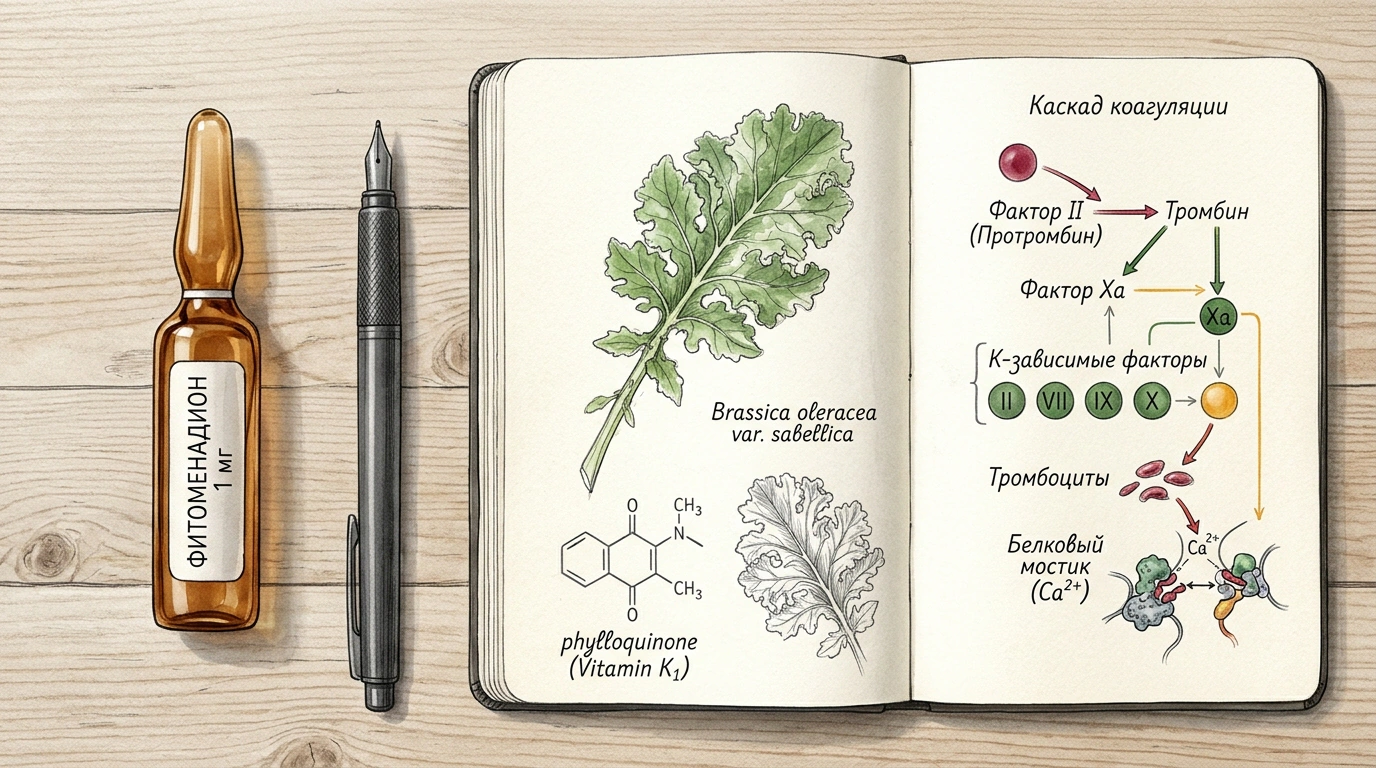
To see what the shot does, picture the blood-clotting (coagulation) system as an emergency crew rushing to seal a leak in a pipe. The main patching materials are plasma proteins built in the liver: prothrombin (factor II) along with factors VII, IX, and X (the prothrombin complex).
A newborn's liver assembles these protein blanks just fine, but without vitamin K they roll off the line incomplete. Vitamin K acts as a coenzyme in the liver—the final key that attaches specialized "latches" to those proteins. Without that finishing step, clotting factors float right past an injury, unable to bind calcium ions and lock platelets into a clot.
Right after birth, the activity of these factors in a newborn is only 30–50% of adult levels. If reserves aren't topped up, vitamin K deficiency bleeding (VKDB) can develop. Doctors distinguish three risk windows:
- Early form (first 24 hours). A rare presentation caused by medications the mother took during pregnancy that interfere with vitamin K metabolism (such as anticonvulsants or anticoagulants).
- Classic form (days 2 to 7). Without prophylaxis, it occurs in 0.25–1.7% of infants (1 in 200–400 newborns), showing up as bruising, oozing from the umbilical stump, and gastrointestinal bleeding.
- Late form (weeks 2 to 12–24, peaking at weeks 4–8). The biggest threat for breastfed babies who didn't get the shot at birth: in 50–65% of cases, it strikes suddenly with intracranial (brain) bleeding, carrying a 20–50% mortality rate and severe neurological consequences for survivors.
When our 3,400-gram newborn receives 1 mg (0.1 mL) of natural vitamin K1 (phytomenadione) into the thigh muscle within the first two hours of life, that risk is shut down. Within 24 hours, plasma vitamin K rises above the protective threshold of 100 ng/mL, the liver activates factors II, VII, IX, and X, and the muscle depot carries the baby through the early months until gut bacteria establish and solid foods begin.
The "Extra Vaccine" Myth and Clinical Guidelines: What Cochrane Reviews and Data Show
The push to lump vitamin K onto vaccine refusal forms grew out of simple confusion: because it's given by syringe in the maternity ward around the same time as BCG and the hepatitis B shot, people mistake it for a vaccine.
Yet a vitamin and a vaccine have nothing in common. A vaccine introduces a microbial antigen so the immune system learns to make antibodies. As Dr. Burlakov put it bluntly in the comments: "Vitamin K is not a vaccine." Phytomenadione contains no viruses or bacteria, does not stimulate the immune system, and does not cause post-vaccination reactions. And for why fears around real vaccine ingredients also clash with physiology, see our piece on the anatomy of anti-vaccine myths.
The American Academy of Pediatrics (AAP) has recommended this shot since 1961, and a Cochrane review of 13 clinical trials confirmed that a single 1 mg injection of phytomenadione normalizes clotting within 24 hours and prevents classic bleeding. Replacing the shot with oral drops is deemed unreliable in AAP guidance: drops require repeated doses (at birth, 1–2 weeks, and 4–6 weeks), absorb unevenly in an immature gut, can be lost with spit-up, and offer weaker protection against late brain bleeds.
A 2026 study in JAMA tracking 5.2 million U.S. newborns between 2017 and 2025—a period when refusal rates climbed from 3.1% to 6.8%—showed the real cost of skipping it. Among babies who didn't get the shot, intracranial bleeding before six months occurred in 33.0 per 10,000 infants versus 13.2 per 10,000 among those who received it: after adjusting for other factors, the risk of brain hemorrhage was 2.43 times higher, and overall bleeding was 47% more common (288.0 vs. 185.9 per 10,000).
In Russia, care follows the Ministry of Health's clinical guidelines on Hemorrhagic Disease of the Fetus and Newborn, authored by neonatologists. The first-line standard is intramuscular vitamin K1 (phytomenadione) within the first 2–4 hours of life: 1 mg for full-term babies and 0.5 mg for preterm infants under 1,500 grams. Domestic water-soluble Vikasol (a synthetic K3 analog) is kept only as a backup when K1 isn't available, because phytomenadione acts faster and is gentler on a newborn's red blood cells.
- Check which form is used. Ask whether the maternity ward uses standard phytomenadione (K1) or backup Vikasol.
- Review the discharge summary. Vitamin K administration is recorded in the baby's discharge summary separately from the immunization record.
- Mention maternal medications. If the mother took anticoagulants or anticonvulsants during pregnancy, let the care team know ahead of time.
Closing his video urging parents to sign a refusal, the blogger said: "Please don't rely on doctors, because they're inside the system too... All the responsibility, dear parents, is on you." On that question of responsibility, Dr. Burlakov lands the sharpest point, calling such videos outright harmful: a social media creator won't bear the consequences of another family's tragedy, whereas a calm parent saying yes to a decades-proven vitamin shot closes a dangerous gap in a newborn's protection in under a minute.