A strange split has formed around evening meals. On one side, old-school rules ban going near the stove after 6 p.m., warning that any late bite turns straight into body fat. On the other, people who skip dinner or choke down plain boiled egg whites at night keep gaining weight after midnight fridge raids—while folks who enjoy a solid late dinner lean out just fine.
Does an evening meal really shut down fat burning because of insulin? I checked fitness coach Artyom's arguments (Trener Artyom channel) against a systematic review and meta-analysis in the British Journal of Nutrition. Let's see why the kitchen clock isn't what controls your weight.
The "Two Egg Whites" Tale: Where Fear of Nighttime Carbs and Dinner Came From
Old-school fitness lore says: if your stomach growls at night, eat two chicken egg whites without the yolks and wash them down with water. Untangle cause and effect, though: if you swap your usual dinner for two egg whites totaling just 35 kcal, you've simply slashed your daily intake. When weekly energy intake drops below energy burned, weight comes off by the law of energy conservation—the egg whites aren't performing magic.
For a working person, that kind of starvation often backfires. Take a realistic schedule: you burn 2,200 kcal a day and get home at 9:00 p.m. with a real appetite. If you try to fool your stomach with two egg whites instead of dinner, your brain trips the hunger alarm by midnight. At 2:00 a.m., you wake up at the fridge and polish off 1,200 kcal of sandwiches and sweets—or make up for it with a double breakfast.
Insulin vs. Growth Hormone: Why Nighttime Hormone Waves Don't Override a Deficit
You're probably thinking: "Wait—after a hearty dinner with carbs, insulin spikes! Doesn't that block nighttime growth hormone from burning fat while I sleep?"
That argument confuses hourly hormone waves with your 24-hour energy balance. Growth hormone (somatotropin) peaks 60–90 minutes after you fall into deep sleep, yet in adults it drives tissue repair and muscle protection rather than burning fat independently of calories. Fat tissue works like a 24-hour bank account: insulin briefly pauses fat breakdown after a meal, and between meals your body draws on stored energy again. As long as you burn more calories than you eat across the week, evening insulin won't halt fat loss—we unpacked that in detail in our piece on myths about calories and overnight fat burning.
What the Research Review Found: Why Meal Timing Doesn't Block Weight Loss
Researchers led by Michelle Fong (Fong et al.) examined this in a meta-analysis of clinical trials in the British Journal of Nutrition (PMID: 28967343). They compared people dieting on equal daily calories who split their food differently: some ate big breakfasts and light evening snacks, while others shifted most of their calories to dinner.
There was no meaningful difference in weight loss—the average gap was just 0.89 kg, well within statistical noise. In several trials, a satisfying dinner actually made the diet easier to stick to by cutting daytime hunger. The everyday link between late eating and weight gain only shows up when chips and cookies are eaten on top of a full day's calories.
Evening Plate Strategy: Eating a Satisfying Dinner Without Midnight Raids
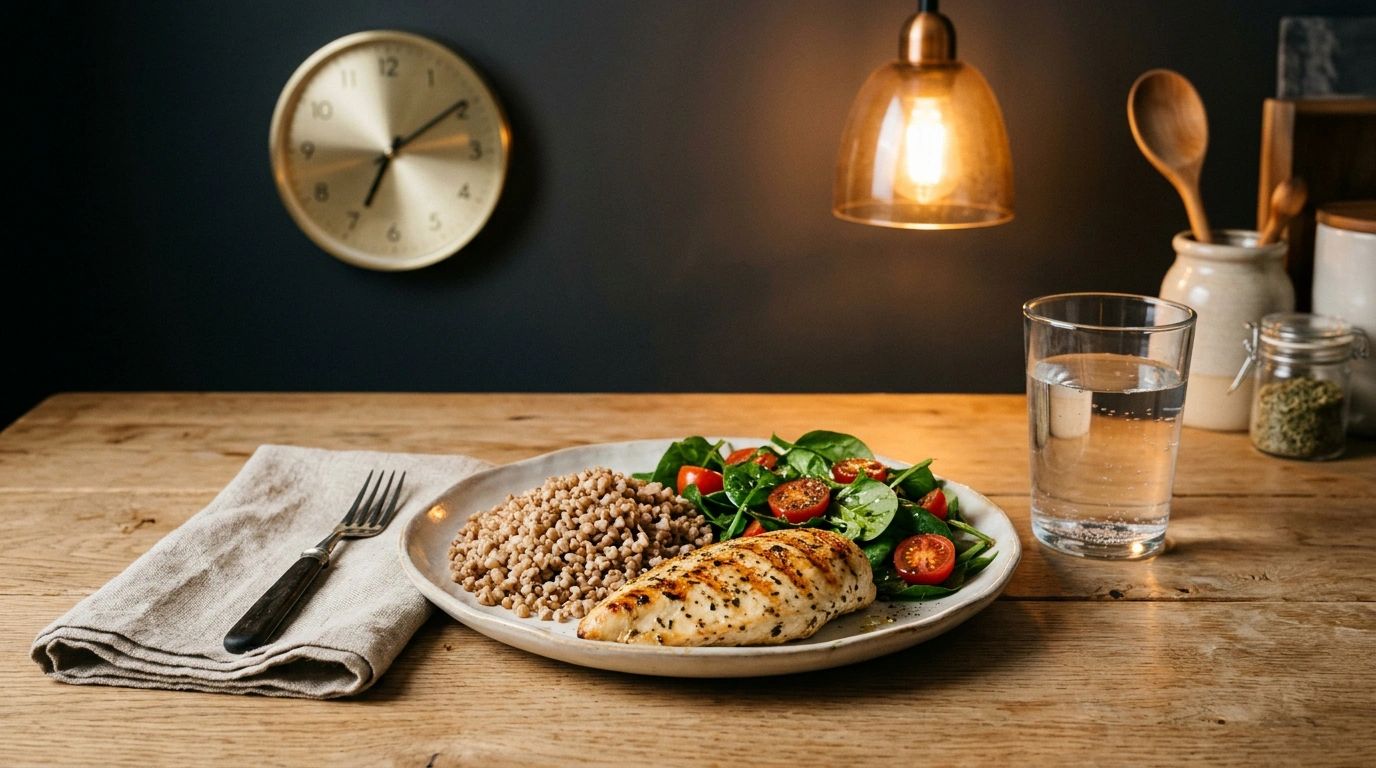
Back to our commuter getting home late from work. Instead of starving, he sticks to a 1,700 kcal daily target and sits down to a balanced 700 kcal dinner: chicken breast, buckwheat, and salad with olive oil. Protein, complex carbs, and fiber support solid sleep without cravings, while the 500 kcal daily gap adds up to a 3,500 kcal weekly deficit—shedding 400–500 g of fat a week. The one real rule is about digestion: finish a hearty dinner 2–3 hours before bed without heavy grease so lying flat doesn't trigger heartburn and reflux.
Don't beat yourself up if work leaves evening as your only time for a proper meal, and don't demand a textbook schedule overnight. Build your plate around your actual life: when dinner leaves you satisfied and fits your weekly calorie budget, your body lets go of extra weight without stress or guilt.