The moment high cholesterol shows up on a lab report, old habits kick in and the fridge gets purged: fried eggs, shrimp, and cheese are first on the chopping block. It sounds logical enough—if arterial plaque is made of cholesterol, eating less cholesterol should clear it out. Yet months of bland egg-white breakfasts often end in disappointing repeat labs. Why does boycotting egg yolks barely budge your bloodwork, and what actually coats your arteries in plaque?
I broke down endocrinologist Maxim Kuznetsov's overview and checked it against the European Society of Cardiology (ESC/EAS) guidelines. Once you peek inside lipid metabolism, it becomes clear that fighting eggs means fixing the wrong pipe.
The Liver Factory: Why Your Body Makes 80–90% of Its Own Cholesterol
Cholesterol is a basic building block for cell membranes, steroid hormones, and bile acids. Roughly 80–90% of all circulating cholesterol (800–1,000 mg a day) is manufactured from scratch by your liver and tissues, while only 10–20% (200–300 mg) comes from food.
Your liver runs like a plant with a built-in thermostat, with the enzyme HMG-CoA reductase running the main line. In most people, a feedback loop keeps things balanced: when you get a serving of cholesterol from a meal, the internal assembly line simply dials back production.
The Diet Trap: Why Skipping Eggs Doesn't Stop Arterial Plaque
Of the cholesterol sitting on your plate, your gut absorbs an average of just 40–50%. Take a classic scenario: someone with total cholesterol of 7.5 mmol/L cuts out eggs, butter, and cheese for three months, only to see their follow-up test drop by a mere 0.3–0.5 mmol/L (5–10%)—because the liver quietly made up the difference. Why 1–2 eggs a day are actually fine for most people is something we unpacked in our deep dive into egg and cholesterol myths. The real catch isn't dietary cholesterol itself, but the fats that block your liver from clearing excess cholesterol out of the bloodstream.
The Real Culprits Behind Plaque: Saturated Fats, Trans Fats, and Genetics
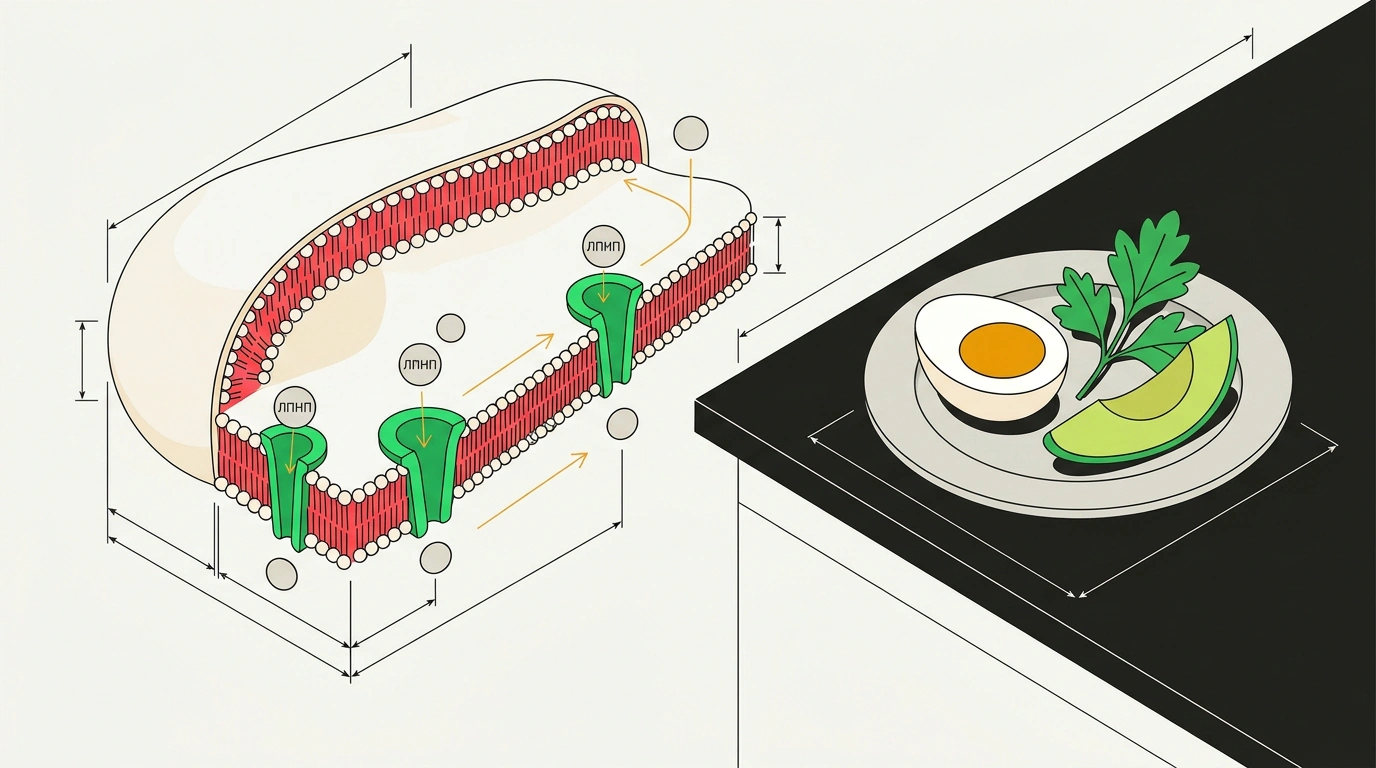
Cholesterol travels through your blood inside protein-wrapped capsules, and the main trouble for arteries comes from low-density lipoproteins (LDL)—so-called "bad" cholesterol. Liver cells are studded with receptor traps that grab LDL particles and pull them in for recycling.
What jams those receptors is an excess of animal saturated fats (fatty meat, lard, cured meats, sausages, mayonnaise, butter) and trans fats from fast food and commercial baked goods. They effectively shut down liver receptors, leaving LDL particles drifting in the bloodstream longer, where they oxidize and build plaque. Maxim Kuznetsov gives a classic skillet example: bacon frying in butter next to eggs, topped off with sausages and deli meat. Four fat sources in one sitting overwhelm the filter and feed carotid artery plaque. To protect your liver receptors, stick to three simple rules:
- keep no more than one fat source per meal;
- limit butter to about one finger-joint per day;
- build your daily base around lean poultry, fish, lean beef, and plant oils, saving pork for special occasions.
Under ESC/EAS guidelines, saturated fats should stay below 10% of daily calories (and below 7% if your cardiovascular risk is high). Every 1% of calories where animal fats are swapped for plant oils, nuts, and fish trims LDL by 0.02–0.04 mmol/L.
When Diet Isn't Enough: Lipid Panel Rules and Seeing a Doctor on Time
If a 20- or 30-year-old walks around with total cholesterol stuck at 7.5–9.0 mmol/L (say, 8.8 mmol/L with LDL at 6.2 mmol/L), the culprit is usually familial hypercholesterolemia—an inherited glitch in those liver receptors. Maxim Kuznetsov stresses that a cholesterol level of 9.0 mmol/L is a disaster for blood vessels and an absolute reason to treat.
If total cholesterol stays persistently above 7.5–8.0 mmol/L or LDL exceeds 4.9 mmol/L, see a doctor, get a carotid artery ultrasound, and start prescribed therapy (such as statins or ezetimibe). For how these medications help the liver clear blood without harming hormones, check our guide to cholesterol biochemistry and statins.
In ESC/EAS guidelines, target LDL depends on your personal cardiovascular risk: from <3.0 mmol/L at low risk and <2.6 mmol/L at moderate risk down to <1.8 and <1.4 mmol/L at high and very high risk. Modern prevention moves past chasing egg yolks toward a clear division of labor: in the kitchen, you protect liver receptors from fat overload; in the clinic, you catch genetic glitches early.